








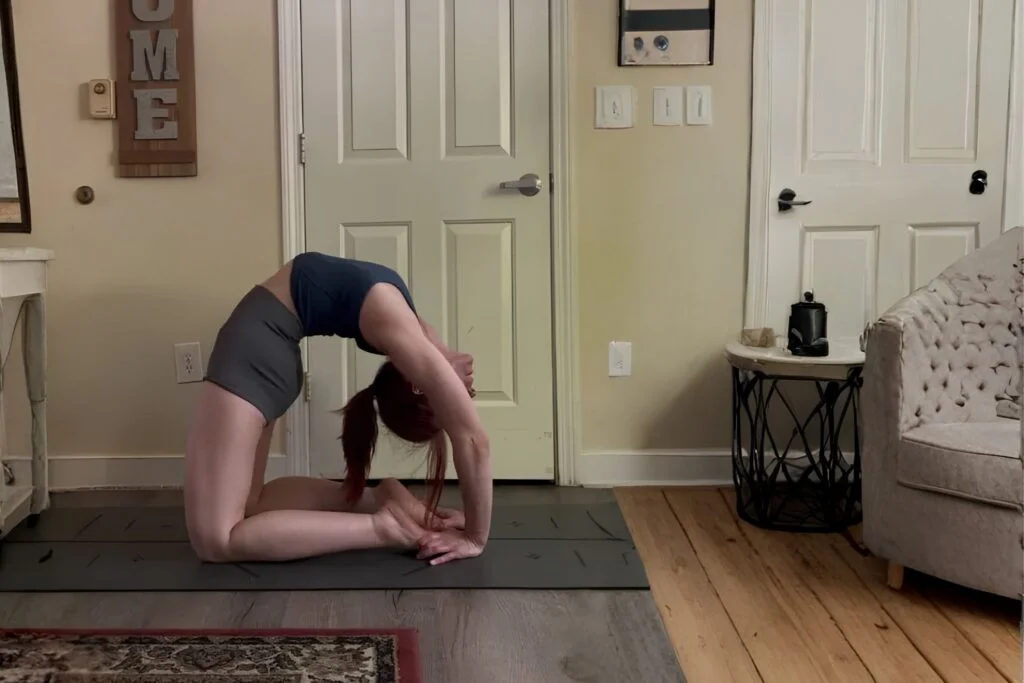
I have taught vinyasa and hatha for nine years. In that time, I have watched hundreds of students blame their bodies for problems their mat caused. Aching wrists in plank. A knee that stings during low lunge. Ankles that wobble in tree pose. Nine times out of ten, the mat was the wrong depth. In every session I conduct, the question of whether a yoga mat 5mm thick is truly worthwhile arises. Yes, for the majority of people. Here’s how to find out if you match the summary.
How Yoga Mat 5mm Thick Feels Under Your Knees and Hands
Yoga mats usually run from 1.5mm to 8mm. Five millimeters sits right in the middle, and that middle does a lot of quiet work.
You get real padding under your kneecaps. Additionally, you maintain your feet on the ground. Spread your toes in Warrior Two, and you still feel the ground pushing back. Drop into a lunge on hardwood and the mat takes the hit instead of your joint.
Beginners feel the difference fastest. New students kneel more, hold poses longer, and shift around while they learn. A small amount of padding helps them focus on the breath rather than the sting.
Yoga Mat 5mm Thick vs Every Other Option
| Thickness | How it feels | Best for | Trade-off |
| 1.5mm to 3mm | Firm, close to the floor | Travel, ashtanga, fast vinyasa | Rough on knees and wrists |
| 4mm | The everyday standard | Studio classes, general flow | Thin during long kneeling work |
| 5mm | Cushioned but grounded | Hatha, beginners, hardwood floors, tender joints | A bit heavier to carry |
| 6mm to 8mm | Plush and soft | Yin, restorative, meditation, prenatal | Wobbly in balance poses |
Notice the pattern. Speed wants thin. Stillness wants thick. Most of us practice in the middle.
Density Beats Thickness Every Time
Here is the part most buying guides skip.
Two mats can both measure 5mm and feel nothing alike. Cheap foam is packed with air pockets. It collapses the moment you kneel, and your knee meets the floor anyway. Yogis call this bottoming out.
Test any mat yourself before you buy:
- Press your thumb hard into the surface for three seconds. Slow recovery means low density.
- Kneel on it over a hard floor, never carpet. You should feel support, not the subfloor.
- Fold one corner. Good rubber creases and bounces back. Foam keeps the dent.
- Push down and drag sideways. The surface should grip, not slide under pressure.
A dense 5mm natural rubber mat protects your joints better than a spongy 8mm one. Density is the number nobody prints on the box.
Material Decides How Long Your Mat Lasts
Thickness handles comfort. Everything else is taken care of by the material, including grip, odor, longevity, and what happens when you eventually retire it.
PVC mats cost little and turn slick when wet. They are also dumped in landfills for centuries. Instead of building up, an eco friendly yoga mat composed of organic cotton or natural tree rubber decomposes.
An excellent illustration of a well-made eco friendly yoga mat is Gayo’s Eco Balance Pro 5mm. It has alignment lines to help with posture, an EcoLock surface that maintains grip during sweaty sessions, and a blend of natural tree rubber and high-performance Eco-PU. At 72 × 26 inches, it is also wider than a standard mat, giving taller practitioners or those who need extra space during poses like half-moon more room to move comfortably.
Some of my students like to cover a rubber mat with an organic cotton woven mat for slower sessions. It is 74 inches long, moisture-wicking, hand-washable, and suitable for outdoor practice on grass, yin yoga, and meditation.
Make Your Mat Last Five Years, Not One
Rubber rewards small habits:
- After sweaty lessons, wipe it down with warm water, a moist cloth, and mild soap.
- Air dry it flat before rolling. Trapped moisture breeds odor.
- Store it away from direct sun. UV hardens rubber and cracks the surface.
- Roll it with the top face outward so the edges lie flat.
- Keep cats off it. Claws scar a smooth surface permanently.
Now do the math. An $80 mat that survives five years costs $16 a year. A $25 foam mat you replace every ten months costs more and performs worse.
Quick Answers
Is a 5mm thick yoga mat too soft for balance poses?
Not if it is dense. Soft foam wobbles. Firm rubber stays put.
Does 5mm work for hot yoga?
Yes, provided the top layer grips when wet. Look for polyurethane or textured rubber.
Will it help my knee pain?
Usually, for arthritis or ongoing pain, fold a blanket under the knee rather than buying an even thicker mat.
Why does my new rubber mat smell?
That is natural latex doing its thing. Unroll it in a well-ventilated room for two or three days, and the smell will fade.
How heavy is a 5mm mat?
Roughly eight pounds. Easy to carry across town, less ideal for a carry-on.
The Bottom Line
Choose your mat for your practice, not for the number on the label.
Flow fast, sweat hard, and crave floor feedback? Stay at 3mm or 4mm. Spend long minutes kneeling or seated? Go thicker. And if you do a bit of everything, which describes almost everyone I teach, a yoga mat 5mm thick quietly solves problems you did not know you had. Your knees will notice by week two.
Disclaimer
This disclaimer applies to the discussion of 5 mm yoga mats. This article is for general information only. Product specifications, prices, availability, and warranties may change. Comfort, durability, performance, and other benefits depend on the model, use, care, and individual needs. Verify details with the manufacturer or seller, follow product instructions, and review return terms before purchasing.