


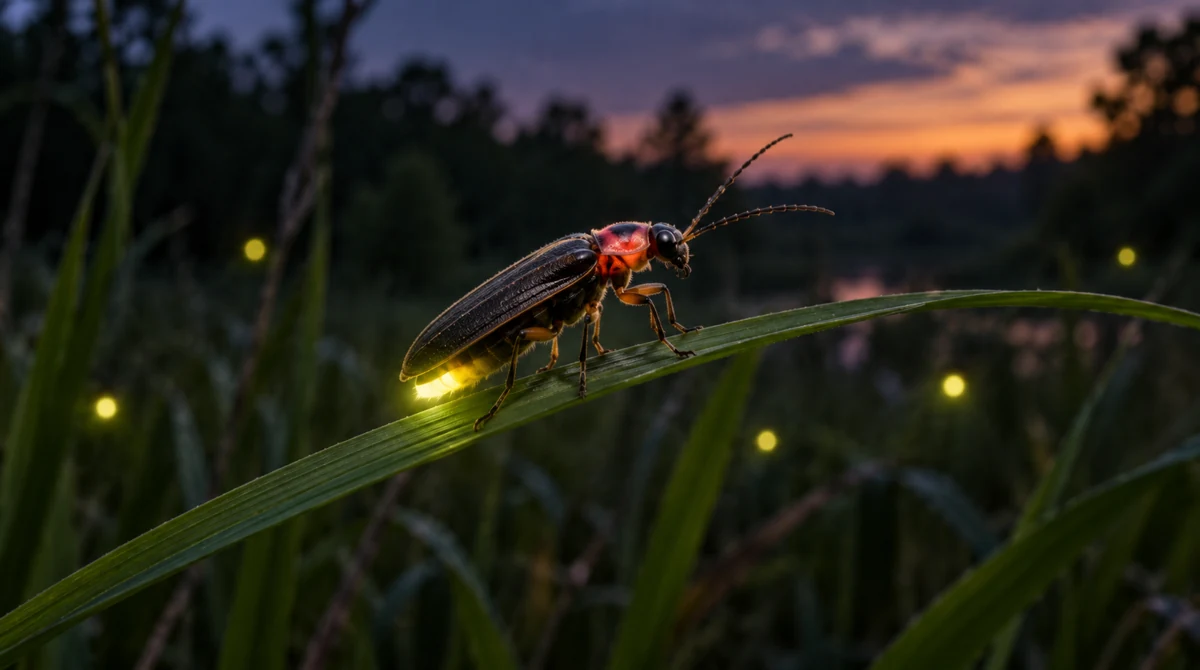
A small light flashes above the grass, disappears, then flashes again a few steps away. Out in the ocean, another animal carries a glowing lure in front of its mouth. Far below the surface, a squid uses light to confuse an approaching predator.
These animals are doing something remarkable: using living light to survive.
Animals that glow in the dark include fireflies, New Zealand glow-worms, certain anglerfish, lanternfish, flashlight fish, bobtail squid, vampire squid, crystal jellyfish and some comb jellies. Their light comes from chemical reactions, either within the animal or in bacteria living inside special organs.
But not every bright animal makes its own light. A scorpion under an ultraviolet lamp and a firefly flashing in a dark garden glow for different reasons. Understanding that difference makes these animals even more interesting.
How Can Animals Make Their Own Light?
The production of light by a living organism is called bioluminescence.
It happens when a chemical reaction releases energy as light. Different organisms use different chemical systems, so there is no single recipe shared by every glowing species.
Some animals produce light within their own tissues. Others provide a home for light-producing bacteria. In that partnership, the bacteria receive a suitable place to live, while the host animal benefits from their glow.
The result can be a brief flash, a steady light or a cloud of glowing material released into the water.
The Natural History Museum’s explanation of bioluminescence describes how animals use these reactions for communication, hunting and protection.
Bioluminescence vs Fluorescence: What Is the Difference?
The easiest way to separate the two is to ask where the energy comes from.
| Light effect | What happens | Does it need incoming light? | Example |
|---|---|---|---|
| Bioluminescence | A chemical reaction produces light | No external illumination is needed for the light-producing reaction | A flashing firefly |
| Fluorescence | A material absorbs light and quickly emits light at another wavelength | Yes | A scorpion under suitable UV light |
| Iridescence or diffraction | A structure changes how incoming light is scattered | Yes | Rainbow colours along a comb jelly’s moving comb rows |
A fluorescent animal does not become a self-powered lamp simply because it looks bright in a photograph.
The same caution applies to aquarium displays. Coloured lighting can make an animal look luminous even when it is not producing the light you see.
Fireflies: Flashing Signals Above the Grass
Fireflies are among the most familiar bioluminescent animals. Despite their name, they are beetles rather than flies.
In many species, adults use flashes during courtship. Those signals help potential mates locate and recognise one another. The timing of a flash can matter as much as its brightness.
Their light comes from organs in the abdomen. It is not sunlight stored during the day, and it does not require a UV lamp to become visible.
A firefly display becomes more interesting when you watch the pattern rather than chasing individual insects. Look for repeated pauses, short bursts or replies from nearby vegetation.
Glowing and being active at night are separate traits. Many animals move around after dark without producing light, as our guide to nocturnal animals and their nighttime habits explains.
New Zealand Glow-Worms: A Light That Attracts Prey
The glow-worms associated with New Zealand caves are not worms. They are the larval stage of fungus gnats.
A larva produces light and suspends sticky threads below its resting place. Small flying insects attracted towards the glow can become caught in those threads.
The light comes from the animal. The hanging threads are the trap, not tiny electric cables.
A group of larvae on a dark ceiling can resemble a sky filled with stars. Behind that beautiful appearance is a practical hunting method: attract prey close enough to capture it.
The name “glow-worm” can cause confusion because it is also used for certain beetles elsewhere in the world. The location and species matter when describing how a glow-worm lives.
Deep-Sea Anglerfish: A Glowing Lure Near the Mouth
Certain deep-sea anglerfish have a lure positioned in front of the head. In some species, bacteria inside that structure produce its light.
The lure can attract another animal towards the anglerfish’s mouth. In a dark environment, even a small light can become a strong point of interest.
This is one reason the familiar anglerfish image is so striking: the attractive light and the waiting mouth are close together.
However, “anglerfish” describes a broad group. Not every species has the same appearance, habitat or light-producing arrangement.
A careful description therefore refers to certain deep-sea anglerfish rather than claiming that every anglerfish carries the same glowing lure.
Lanternfish: Light That Helps Them Hide
Lanternfish have light-producing organs called photophores. Their placement creates patterns across the body.
One use of these lights is camouflage. From below, a fish can appear as a dark shape against the faint light coming down through the water. Light produced on its underside can reduce that contrast.
This strategy is called counterillumination.
It may seem strange that shining helps an animal hide. The important point is that predators are looking for a difference between the animal and its background. Carefully matched light can make the outline less obvious.
The lanternfish is a useful reminder that bioluminescence is not always about attracting attention.
Flashlight Fish: Bacteria Beneath the Eyes
Flashlight fish have light organs beneath their eyes that contain glowing bacteria.
Depending on the species, they can conceal or reveal those organs. This creates the impression of lights being switched on and off.
The bacteria produce the light, while the fish controls when it is visible.
Some flashlight fish use a “blink and run” escape tactic. They move with the lights visible, hide the glow, then change direction. A predator following the bright points may lose track of them.
This partnership shows why bacterial light still belongs in a discussion of bioluminescent animals. The host may not perform the light-producing reaction itself, but it carries and uses a living source of light.
Bobtail Squid: A Living Camouflage System
Certain bobtail squid house bioluminescent bacteria in a specialised organ beneath the body.
The arrangement benefits both partners. The squid supports the bacteria, and their light helps it blend into the background when viewed from below.
Like lanternfish, the squid can use light to reduce its silhouette.
This example also explains why “glowing sea creatures” are not limited to animals of the deepest ocean. Bioluminescence has uses wherever light conditions make it helpful, including shallower marine environments.
The interesting question is not simply whether an animal shines. It is how that light changes what another animal can see.
Vampire Squid: Glowing Defences in Deep Water
The vampire squid has light-producing structures, including organs near the ends of its arms.
When threatened, it can use glowing displays as a distraction. It can also release luminous material into the surrounding water, creating another obstacle for a predator trying to follow it.
A sudden display in deep darkness may confuse an attacker long enough for the animal to escape.
The vampire squid is particularly memorable because of its dark body and webbed arms. Its light is part of a defence system rather than a permanent decorative glow.
It also illustrates why a still photograph tells only part of the story. The timing and movement of the display are important.
Crystal Jellyfish: Light Around a Transparent Bell
The crystal jelly, Aequorea victoria, is a transparent jellyfish capable of producing a green-blue glow.
Light-producing structures are arranged around the edge of its bell. The delicate appearance can make the animal seem almost invisible until it lights up.
Not all jellyfish produce light, and the colours seen in an exhibit may come partly or entirely from aquarium lighting.
When looking at a glowing jellyfish photograph, check the species and the description. A bright blue tank does not prove that the jellyfish itself emits blue light.
Crystal jellies provide a real example of bioluminescence, but they should not be used to make a claim about every jellyfish.
Some Comb Jellies: Two Different Light Effects
Comb jellies create one of the most confusing displays in the ocean.
Their moving rows of tiny structures can scatter incoming light into rainbow colours. Those travelling bands of colour are not, by themselves, bioluminescence.
Some comb jelly species can also produce their own light. The Arctic comb jelly is one example with bioluminescence.
That means an animal can be capable of producing light while a particular colourful photograph shows a different effect.
Other comb jellies do not share that ability. The bloody-belly comb jelly, for example, can appear brilliant under exhibit lights without being bioluminescent.
The useful distinction is between what the animal can do and what is creating the colour in the image.
Why Do Animals Glow?
Light can solve several different problems. Its purpose depends on the species, the setting and the animal receiving the signal.
Finding a Mate
A flash can help an animal locate a potential partner in darkness. For many fireflies, the pattern carries information rather than acting as a random sparkle.
Attracting Prey
An anglerfish lure or glow-worm display can draw another animal closer. Here, light becomes part of a trap.
Escaping a Predator
A sudden flash, a change in visible light or released glowing material can interrupt a predator’s pursuit.
Hiding Against the Background
Counterillumination helps reduce a dark outline against brighter water above. Producing light can therefore make an animal less noticeable.
These uses explain why glowing animals do not all behave like permanently switched-on lamps. A signal is often most useful at a particular moment.
Do Scorpions Glow in the Dark?
Scorpions can appear blue-green under suitable ultraviolet light. This is fluorescence, not the same process that produces a firefly’s flash.
Materials in the outer body absorb the incoming light and emit visible light. Remove the UV illumination, and the familiar fluorescent display is no longer visible.
The biological purpose of scorpion fluorescence is still being investigated. It should not be presented as a fully solved mystery.
A photograph of a glowing scorpion should therefore mention the lighting conditions. Otherwise, readers may reasonably think the animal shines that way in complete darkness.
Do not handle a scorpion or disturb it to create a photograph.
Why Does the Sea Sometimes Glow Blue?
Sparkling waves are often caused by bioluminescent dinoflagellates—tiny, single-celled organisms.
Movement in the water can trigger flashes from certain species, making a breaking wave or a boat’s wake appear luminous.
These organisms should not simply be counted as another animal on an animal list. “Plankton” describes organisms that drift with currents; it is not the name of one animal group.
A glowing shoreline also does not mean every creature in the water is producing light. The visible display may come from a dense gathering of microscopic organisms.
How to Watch Glowing Wildlife Responsibly
Start with a place where the species is known to occur and follow local viewing guidance. Seasonal conditions, weather and natural activity can affect what you see.
During a visit:
- Keep unnecessary lights off.
- Follow restrictions on flash photography.
- Stay on marked paths.
- Avoid touching animals or their surroundings.
- Do not shake, catch or disturb wildlife to trigger a display.
Our guide to the best places to see wildlife provides broader ideas for planning wildlife-focused trips.
Allow time to observe. A natural display may be brief or much subtler than a photograph suggests. Cameras and editing can make colours appear brighter than they look to the human eye.
Frequently Asked Questions
What Is the Name for Animals That Produce Light?
They are described as bioluminescent animals. The term refers to light produced through a biological chemical reaction, including light supplied by bacteria living in an animal’s light organs.
Do All Animals That Glow Need UV Light?
No. Bioluminescent animals can produce light without external illumination. Fluorescent animals need suitable incoming light for their visible fluorescent effect.
Why Do Fireflies Glow?
In many species, adults use light signals to find and communicate with potential mates. The flashes are biologically produced, not reflected torchlight.
Do All Jellyfish Glow in the Dark?
No. Some species are bioluminescent, while others are not. Aquarium lighting can also make jellyfish appear to glow.
Are Glow-Worms Really Worms?
No. The name refers to different insects. New Zealand glow-worms are fungus gnat larvae, while the name is used for certain beetles in other regions.
Is a Comb Jelly’s Rainbow Bioluminescence?
The rainbow effect along its comb rows comes from incoming light interacting with those structures. Some species also produce bioluminescence, but these are separate effects.
Are Glowing Animals Always Dangerous?
No. Glowing does not tell you whether an animal is safe to touch. Its light may serve communication, camouflage, hunting or defence. Observe unfamiliar wildlife without handling it.
A Flash Can Tell a Bigger Story
A firefly’s signal, an anglerfish’s lure and a squid’s glowing defence may look equally mysterious at first. Each becomes more remarkable when you understand what the light helps the animal do.
The next time you see an animal described as “glowing,” ask two questions: Where does the light come from, and what is it used for? Those answers reveal far more than the colour alone.