






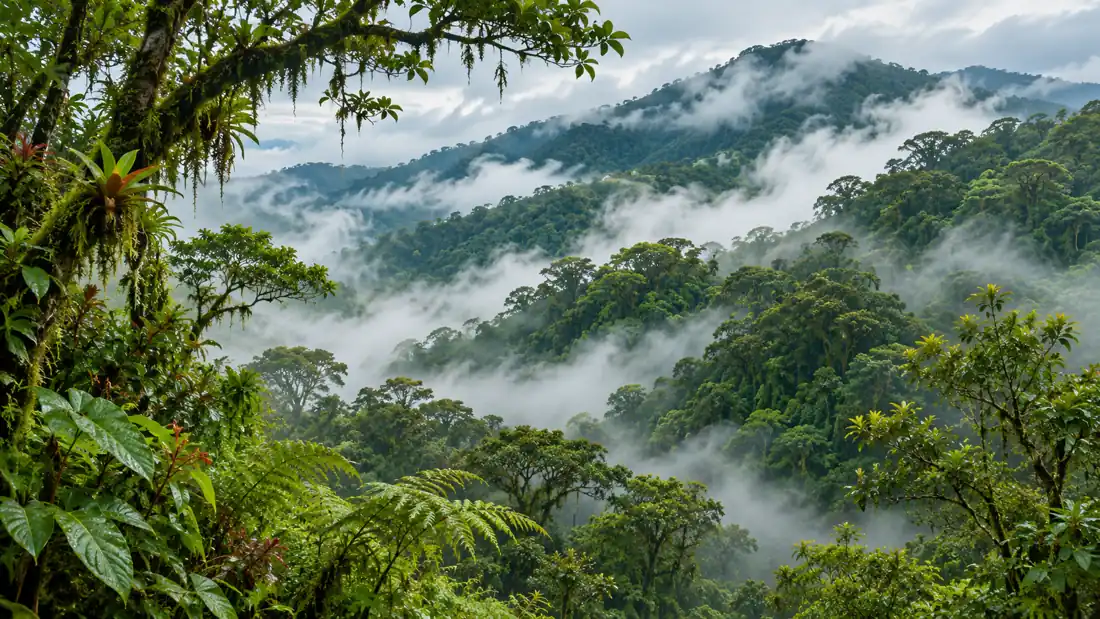
A cloud forest is a forest that regularly sits within low cloud or fog, often on tropical mountain slopes. Moist air moves through the trees, leaving droplets on leaves, branches and moss. This frequent contact with cloud helps shape the forest’s plants, wildlife and water supply.
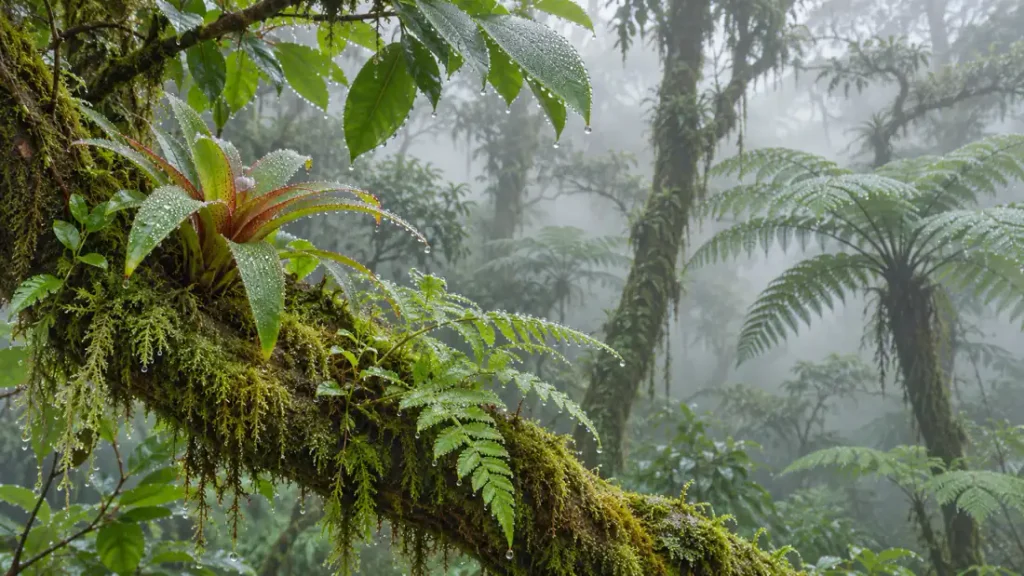
From a distance, the forest may look like green hills wrapped in mist. Inside, the details tell a richer story. Ferns grow along trunks, small plants cling to branches, and water can drip from the canopy even when rain is not falling.
Yet a cloud forest is more than a forest with a foggy view. Its living community depends on conditions that return often enough to influence growth and survival.
This guide explains how that environment forms, what lives there and why it matters.
What Makes a Forest a Cloud Forest?
The main feature is frequent cloud cover at the level of the vegetation.
Clouds do not simply pass high above the trees. Instead, moisture-filled air reaches into the canopy and sometimes surrounds the whole forest.
You may also see the term tropical montane cloud forest. “Montane” means related to mountains.
However, definitions vary between researchers and regions. There is no single worldwide altitude, temperature or rainfall total that identifies every cloud forest.
Cloud forests reveal how closely plants, animals, and water depend on one another. At Viltnemnda, we explore wildlife and natural habitats to help readers understand these connections. A cloud forest is a good place to see them in action.
An ordinary woodland can experience morning fog without becoming a cloud forest. The important difference is the recurring influence of cloud on its environment.
How Do Cloud Forests Form?
Mountains often provide the conditions that bring moist air and forest together.
Moist Air Moves Uphill
Wind carries moist air toward a slope. As the land rises, the air may rise with it.
Higher up, lower air pressure allows that rising air to expand and cool. If it cools enough, some water vapor condenses into tiny liquid droplets.
Those droplets form cloud.
When the cloud meets the mountainside, trees grow within it rather than beneath it.
Local Conditions Shape the Cloud Belt
The height of the cloud layer depends on several factors. These include air temperature, moisture, wind and the surrounding landscape.
For example, a slope facing moist winds may receive different conditions from a sheltered slope nearby.
The cloud belt can also move during the day or between seasons. Therefore, one mountainside may contain several forest types at different heights.
A cloud forest develops where these patterns repeatedly create suitable conditions.
Fog Becomes Part of the Habitat
Once cloud enters the forest, tiny droplets strike leaves, twigs and other surfaces.
Some droplets join together and fall to the ground. Others wet the plants growing on trunks and branches.
This process adds moisture without requiring a conventional rain shower. It also explains why a walk beneath the trees can feel wetter than an open area nearby.
What Is the Climate Like?
Cloud forests are often cool and humid compared with nearby tropical lowlands. However, they do not all share one climate.
Elevation, latitude, season and exposure to wind affect local conditions.
Temperature
Mountain temperatures generally fall with increasing elevation. As a result, tropical cloud forests can feel surprisingly cool.
However, “cool” does not mean that every site experiences freezing weather. A lower-elevation forest near a warm coast may differ greatly from a high mountain forest.
Use local climate information when describing a specific reserve rather than applying one temperature range worldwide.
Humidity and Light
Frequent cloud contact keeps many surfaces damp. Meanwhile, cloud cover reduces direct sunlight.
Plants still receive light, but the amount and pattern differ from those in an open, sunny habitat.
Even within the same forest, conditions vary. An exposed branch receives more wind and light than a sheltered hollow beneath the canopy.
Rainfall and Seasons
Cloud forests receive rain as well as moisture from fog. However, the contribution from each source changes between locations.
Some forests experience clear wet and dry seasons. Others remain damp through much of the year.
A dry season does not necessarily mean that the trees lose all contact with cloud. Equally, a cloud forest can experience sunny hours and periods without fog.
Where Are Cloud Forests Found?
Cloud forests occur in suitable mountain and island environments across several parts of the world.
Examples include parts of Central America, the tropical Andes, the Caribbean, Africa and Southeast Asia.
They do not form on every tropical mountain. The slope also needs the right pattern of moisture, temperature and cloud contact.
How High Are Cloud Forests?
The New York Botanical Garden describes cloud forests across a broad elevation range, with many occurring around 1,000–2,000 metres above sea level.
However, local conditions can support them at lower or higher elevations.
Altitude alone is therefore a poor identification test. A forest at 1,500 metres is not automatically a cloud forest, while a lower forest may receive frequent cloud contact.
Look at the climate and vegetation together.
Cloud Forest vs Rainforest
A cloud forest is often a type of moist mountain forest within the broader rainforest family.
Therefore, the most useful comparison is cloud forest versus lowland tropical rainforest, rather than treating all rainforests as one separate category.
| Feature | Cloud forest | Lowland tropical rainforest |
|---|---|---|
| Typical setting | Mountain slopes and ridges | Lower-elevation tropical landscapes |
| Cloud contact | Frequent contact with vegetation | Not its defining feature |
| Temperature | Often cooler than nearby lowlands | Usually warmer |
| Moisture | Rain plus varying amounts of fog water | Rain is a major moisture source |
| Tree form | Often shorter on exposed sites | Frequently tall, with layered canopies |
| Branch surfaces | Often rich in mosses and other plants | Also support epiphytes, with local variation |
These are general patterns, not rules for every location.
For instance, sheltered cloud forest can contain tall trees. Exposed ridges may support much shorter vegetation shaped by wind and other growing conditions.
What Plants Grow in Cloud Forests?
Cloud forest plants use space from the soil to the upper branches.
Their arrangement creates many small habitats within the larger forest.
Trees and Shrubs
Trees form the structure that supports much of the community. Their trunks provide growing surfaces, while branches create shade and shelter.
Tree shape varies across the landscape. Some exposed forests contain short, twisted trees. More sheltered areas can support taller growth.
Shrubs and young trees fill gaps beneath the canopy. Where a tree falls, extra light can change which plants grow successfully.
Mosses and Liverworts
Mosses and liverworts often cover bark, rocks and other damp surfaces.
Although small, these plants help create the forest’s distinctive appearance. Their mats can retain moisture and provide tiny spaces for other organisms.
However, moss alone does not prove that a forest is a cloud forest. Moss also grows in many other wet or shaded environments.
Orchids, Ferns and Other Epiphytes
An epiphyte is a plant that grows on another plant for support without feeding directly from its living tissues.
Many orchids and ferns grow this way. In some regions, bromeliads also occupy branches and trunks.
They obtain resources from their surroundings, including water and material that gathers around their roots.
This makes a tree more than a single organism in the scene. Its branches can support a small community of plants above the ground.
However, not every orchid or fern is an epiphyte. Some grow in soil or on rocks.
Tree Ferns
Tree ferns can form a noticeable layer beneath the canopy. Their large fronds add shade and help create the forest’s dense appearance.
Despite their tree-like shape, they are ferns rather than flowering trees.
The mix of tree ferns, mosses and branch-growing plants varies by region. A cloud forest in Central America does not contain the same plant community as one in Southeast Asia.
What Animals Live in Cloud Forests?
Cloud forests support birds, mammals, amphibians, insects and many less visible organisms.
However, there is no universal cloud forest animal list. Species depend on the continent, elevation and surrounding habitats.
Birds
Monteverde in Costa Rica is well known for birds such as the resplendent quetzal.
Other cloud forests support different bird communities. Some birds feed on fruit, while others take nectar or hunt insects.
These feeding habits connect birds with the wider ecosystem. Fruit-eating birds, for example, can move seeds away from the parent plant.
Still, a bird associated with cloud forest may also use nearby habitats. Its movements can change with food supply and season.
Mammals
Andean bears use cloud forests and other habitats in South America. They may also move through grassland between forest areas.
This makes the connections between habitats important. Protecting one patch may not preserve all the space an animal uses.
Other mammals vary by region, and many are difficult to see. A forest walk can pass through occupied habitat without producing a single large-animal sighting.
Amphibians and Invertebrates
Frogs and other moisture-dependent animals can find suitable conditions in wet forest habitats.
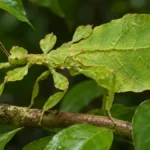
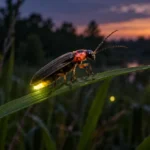
Meanwhile, insects and other invertebrates occupy leaves, bark, soil and decaying wood.
Some feed on plants, others hunt, and many help break down organic material. Together, they support food webs that visitors may barely notice.
Our Wildlife guides explore more of these connections between animals and their surroundings.
How Do Cloud Forests Collect Water?
Leaves, mosses and branches intercept droplets carried by moving fog. Water then gathers on those surfaces and may drip downward.
Scientists often describe this as cloud-water interception or fog interception.
Its contribution varies greatly between sites. Wind, vegetation and the frequency of cloud contact all affect how much water a forest collects.
The water can contribute to soil moisture and local water systems. In addition, shade and humid conditions influence how quickly surfaces dry.
However, this does not mean every cloud forest produces the same amount of water. Nor does it mean stream water is safe to drink without suitable treatment.
The practical lesson is simpler: removing forest can change more than the view. It can also change how the landscape receives and handles moisture.
Why Are Cloud Forests Important?
Cloud forests matter because their value extends beyond the trees.
They Support Distinctive Species
Some species occur only in a small region. Scientists call these species endemic.
When a species occupies a narrow range, damage to that area can affect a large share of its population.
Therefore, even a relatively small forest can have major conservation value. Area alone does not show how much unique life it supports.
They Contribute to Water Systems
Cloud contact, vegetation and soil influence how water moves through a mountain landscape.
Communities downstream may depend on water from forested catchments. Protecting those catchments therefore connects habitat care with human needs.
However, the exact benefit depends on local conditions. A responsible explanation should avoid assigning one global water percentage to all cloud forests.
They Support Research and Learning
Cloud forests offer opportunities to study plant relationships, water movement and responses to environmental change.
They also help people understand that a habitat depends on conditions, not just a list of species.
At Viltnemnda, that connection between wildlife and habitat provides a useful starting point for exploring unfamiliar ecosystems.
What Threatens Cloud Forests?
Several pressures can affect the same forest at once.
Clearing and Fragmentation
Agriculture, roads and other land uses can remove forest or divide it into smaller patches.
New edges expose parts of the remaining habitat to different light, wind and drying conditions.
Small patches can also become harder for some animals to move between. Therefore, protecting connections may matter alongside protecting individual reserves.
Changes in Cloud Conditions
Climate and land-use changes can alter temperature, moisture and cloud patterns.
If cloud contact becomes less frequent, plants adapted to damp conditions may face greater water stress.
Researchers also study the risk of cloud bases rising above some existing forests. However, the response varies between regions.
It would be inaccurate to claim that every cloud forest is losing fog at the same rate.
Limited Space Upslope
A species may find suitable conditions higher on a mountain as temperatures change. Yet moving upslope is not always possible.
Roads or cleared land may block movement. The right soil or vegetation may be absent. Near a summit, there may simply be little land left.
This is one reason connected habitats across different elevations can matter.
Damage to Small Habitat Features
Removing plants, trampling vegetation and widening trails can damage parts of the habitat.
A moss-covered branch may look like a minor detail, but it supports living organisms and takes time to develop.
Responsible visits should leave those features in place.
How Can People Protect Cloud Forests?
Protection requires more than planting a few trees.
Keeping existing forest intact is important. So is working with the people who live near it and depend on the surrounding land.
Restoration should use suitable native species and consider local growing conditions. A plantation of unrelated trees does not recreate the original ecosystem.
Kew’s work on protecting cloud forests provides one practical example. It includes training local rangers in native seed collection and conservation to support restoration in the Dominican Republic.
Long-term care also needs monitoring. Planting is a starting point; young trees still need conditions that allow them to survive.
Is Singapore’s Cloud Forest a Natural Forest?
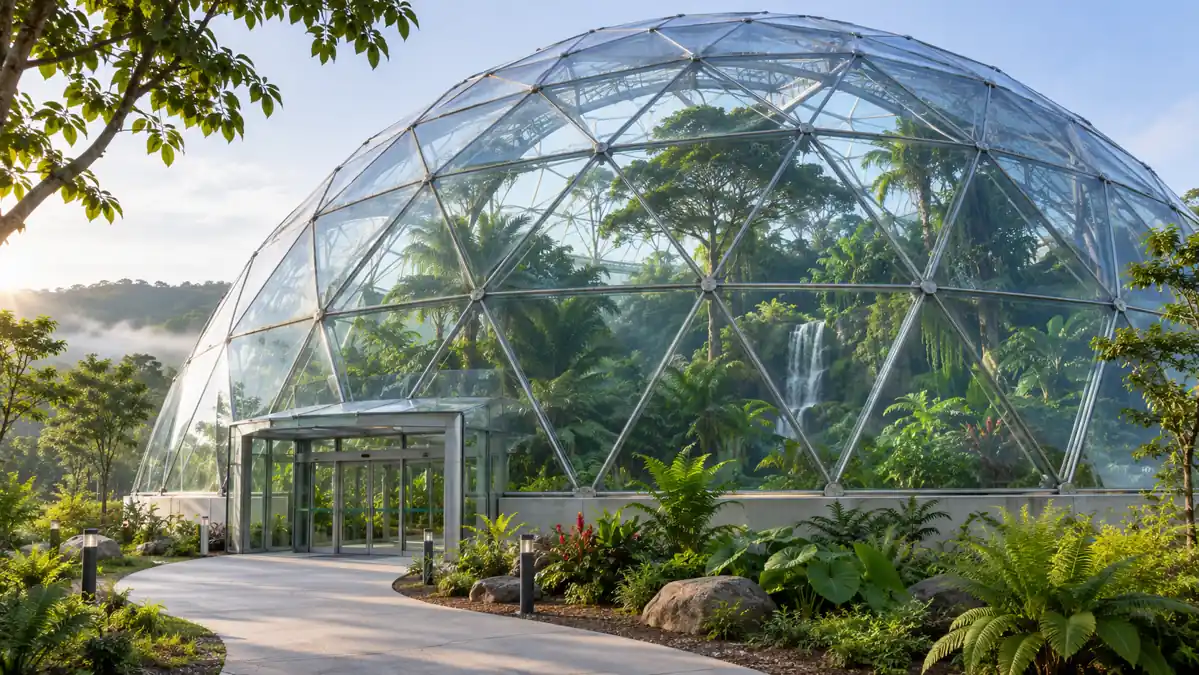
No. Cloud Forest at Gardens by the Bay is a cooled conservatory, rather than a naturally occurring mountain forest.
It presents plants and conditions associated with cool, moist highland environments inside a managed building.
That makes it useful for education, but it differs from an outdoor ecosystem shaped by natural weather and landscape.
If you have read our guide to what a biodome is, the distinction will be familiar: a recreated habitat can demonstrate natural processes without being the same as the original environment.
This also explains why search results for “cloud forest” sometimes show tickets and indoor waterfalls rather than mountain ecology.
What Should You Look for on a Visit?
Start with the habitat rather than a checklist of famous animals.
Notice whether cloud reaches the canopy. Look for water gathering on leaves and small plants growing along branches.
Then compare exposed and sheltered areas. Changes in wind and light may help explain differences in tree height or plant cover.
For a responsible visit:
- Stay on marked paths.
- Leave moss, orchids and other plants in place.
- Keep a respectful distance from wildlife.
- Avoid feeding or calling animals closer.
- Follow the reserve’s local rules and current access advice.
A local guide can help explain details that are easy to overlook. However, neither a guide nor a reserve can guarantee fog or a particular animal sighting.
Frequently Asked Questions
Why is it called a cloud forest?
Because low cloud frequently reaches the forest itself. Moist air moves through the vegetation rather than remaining only above it.
Is a cloud forest a rainforest?
Often, yes. Many cloud forests are moist mountain forests within the wider rainforest category. The clearer comparison is with lowland tropical rainforest.
Are cloud forests always foggy?
No. Cloud cover can change during the day and between seasons. Frequent cloud influence matters more than constant fog.
Are cloud forests cold?
They are often cooler than nearby tropical lowlands. However, their temperatures vary with location, elevation and season.
Do cloud forests only exist in Costa Rica?
No. Costa Rica has well-known examples, but cloud forests also occur in other suitable regions around the world.
What is the difference between fog and cloud?
Both contain tiny water droplets suspended in air. When cloud reaches the ground or surrounding terrain, we commonly describe it as fog.
Can cloud forests contain tall trees?
Yes. Some sheltered areas support tall trees. Shorter, wind-shaped growth is common on certain exposed sites, but it does not describe every cloud forest.
Is a cloud forest the same as a biodome?
No. A natural cloud forest develops outdoors through climate, landscape and living processes. A biodome is a human-made enclosure that supports or recreates an environment.
A Forest Shaped by Cloud
A cloud forest depends on a recurring meeting between moist air and vegetation.
That contact helps shape where plants grow, how water moves and which animals find suitable habitat. Yet the details differ from mountain to mountain.
Understanding those differences makes the forest more interesting—and explains why protecting trees alone is not enough. The surrounding landscape, local climate and connections between habitats matter too.