






Introduction
Caterpillar identification has seen a massive surge in popularity among backyard naturalists, gardeners, and wildlife enthusiasts alike. These fascinating creatures are no longer viewed simply as garden pests; instead, they are recognized as vital components of our ecosystems and spectacular examples of evolutionary design.
Observing caterpillars opens up a window into the complex dynamics of local food webs. By learning to identify them, you unlock a deeper understanding of the plants in your backyard, the changing seasons, and the delicate balance of local biodiversity.
One of the most common questions beginners ask is: Why do some caterpillars become butterflies while others become moths? The answer lies in their genetic programming, but their larval physical traits often hint at their ultimate transformation. This comprehensive guide will walk you through everything you need to know to accurately identify these creatures, understand their habits, and contribute to wildlife conservation.
What Is a Caterpillar?
A caterpillar is the larval stage of an insect belonging to the order Lepidoptera, which encompasses all butterflies and moths. While they may look like worms, they are structurally distinct insects designed primarily for one purpose: consumption. A caterpillar’s main job is to eat and store enough energy to fuel its transformation into an adult flying insect.
The Caterpillar Life Cycle
The life of a caterpillar begins as a microscopic egg laid carefully by an adult female on a specific host plant. Upon hatching, the caterpillar enters a cycle of intense feeding. Because its exoskeleton does not stretch, it must periodically shed its skin in a process called molting. The developmental stages between these molts are known as instars. Most species go through 5 to 6 instars before they are fully grown.
How Caterpillars Become Butterflies and Moths
The underlying biological mechanism that dictates whether a caterpillar turns into a butterfly or a moth is rooted in their lineage.
- Butterflies generally form a exposed, hardened pupa called a chrysalis, which often hangs from twigs or leaves.
- Moths typically spin a silk cocoon around themselves or burrow directly into the soil to pupate.
The Different Stages of Metamorphosis
This transformation is known as complete metamorphosis (holometabolous development), a four-stage process:
- Egg: Laid securely on a reliable food source.
- Larva (Caterpillar): The primary growth and feeding stage.
- Pupa (Chrysalis or Cocoon): The radical restructuring stage where larval tissues dissolve and rebuild into wings, antennae, and complex eyes.
- Adult (Imago): The reproductive stage, focused on mating and dispersing eggs.
How to Identify Caterpillars in 5 Easy Steps
Identifying a caterpillar doesn’t require a degree in entomology. By focusing systematically on five core visual and environmental clues, you can narrow down the identity of almost any specimen.
1. Look at the Caterpillar’s Color
Color is your first line of identification. Is it a brilliant, warning-sign green, or a dull, camouflaged brown? Note whether the color is uniform or split into distinct zones along its segments.
2. Check for Hairs, Spines, or Horns
Examine the texture of the body. Smooth-skinned caterpillars often rely on blending in, whereas those covered in stiff bristles (setae), fleshy spines, or sporting a prominent “tail horn” at the rear are using physical deterrents against predators.
3. Examine Body Patterns and Markings
Look closely for specific geometry:
- Stripes: Running lengthwise down the body or wrapping around horizontally like bands.
- Spots: Often arranged in rows or mimicking large, predatory “eyespots” to scare off birds.
- Saddles: Distinctly colored patches across the middle segments.
4. Identify the Plant It Is Eating
This is often the most revealing clue. Most Lepidoptera larvae are highly host-specific; they cannot survive on just any foliage. If you can confidently identify the tree, weed, or vegetable the caterpillar is actively eating, you have narrowed your search field by roughly 80%.
5. Observe Its Size and Behavior
Note its approximate length in millimeters or inches. Watch how it moves. Does it crawl flat against the leaf, or does it loop its body high into the air like an inchworm? Does it roll up into a tight ball when disturbed, or whip its head aggressively from side to side?
Identifying Caterpillars by Color
Coloration serves as either a stealth mechanism to hide from predators or an advertisement of toxicity. Here is how common species break down by color:
Green Caterpillars
Green is the most common color profile, offering perfect camouflage against leaves. The Cabbage White caterpillar is a classic example—velvety green and completely matte, making it nearly invisible against broccoli or cabbage leaves. The massive Luna Moth larva is also lime-green but features subtle yellow lines and small pink dots.
Black Caterpillars
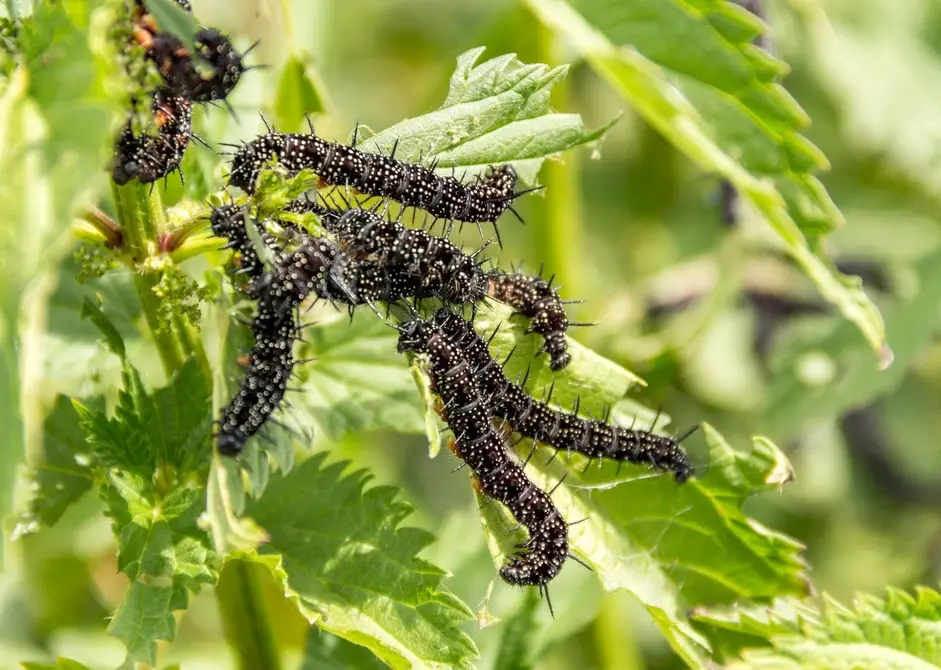
Black coloration absorbs heat efficiently and often signals a well-defended larva. The Peacock Butterfly caterpillar is a striking jet-black color covered in intricate white speckles and long, branching black spines.
Yellow Caterpillars
Bright yellow is frequently an warning indicator. The American Dagger Moth caterpillar is covered in dense, long yellow-to-white hairs with distinctive lone black spikes sticking out near its head and rear.
Orange Caterpillars
Orange is often paired with black to scream “unpalatable” to foraging birds. The Gulf Fritillary features a bright, glossy orange body covered completely in rows of soft black spines.
Brown Caterpillars
Brown variations are masters of mimicking twigs, bark, or leaf litter. Many Hawk-Moth and Geometer Moth (inchworm) larvae are shades of mottled brown, complete with bumps that resemble tree knots.
White Caterpillars
True white caterpillars are relatively rare and usually covered in long hairs. The Hickory Tussock Moth caterpillar has a fluffy white coat accented by a black chain-link pattern down its spine.
Red and Spotted Caterpillars
Spotted configurations break up the physical outline of the insect. The Monarch Butterfly caterpillar uses a bold, repeating pattern of yellow, white, and black vertical bands to warn predators of its toxic milkweed diet.
Hairy and Fuzzy Caterpillars Explained
The presence of hair completely alters a caterpillar’s defense strategy and demands caution from human observers.
Why Some Caterpillars Have Hair
The fine hairs covering these caterpillars are called setae. In some species, these are merely defensive barriers that make the insect unappealing or difficult for birds to swallow. In other species, the hairs are urticating—meaning they are hollow, brittle needles connected to venom sacs that break off in the skin, causing severe irritation.
Woolly Bear Caterpillars
Perhaps the most famous fuzzy caterpillar is the Isabella Tiger Moth larva, universally known as the “Woolly Bear.” It features dense, stiff hairs arranged in thick bands of black at both ends and a warm rusty-red or brown band in the middle. Folklore suggests the width of the brown band predicts the severity of the coming winter, though scientifically it simply reflects the caterpillar’s age and moisture exposure during growth.
Black Hairy Caterpillars
The Garden Tiger Moth caterpillar is the ultimate “woolly bear” of Europe. It is densely coated in long, dark charcoal-and-black hairs tipped with white, giving it a frosted appearance, with a base layer of bright orange-red hair near its feet.
Are Hairy Caterpillars Dangerous?
Safety Warning: As a general rule of thumb for wildlife tracking: If a caterpillar is exceptionally hairy or fuzzy, do not touch it with bare hands.
While the Woolly Bear is harmless, species like the Oak Processionary Moth or the Brown-Tail Moth carry highly dangerous urticating hairs that cause painful rashes, respiratory issues, and severe allergic reactions in humans and domestic pets.
Common Butterfly Caterpillars in the UK
The United Kingdom boasts some of the most recognizable and intensely studied butterfly larvae in the world.
Peacock Butterfly Caterpillar
- Scientific Name: Aglais io
- Appearance: Deep velvety black peppered with dozens of tiny white pinhead dots; heavily guarded by long, branched black spines.
- Primary Food: Exclusively Stinging Nettles (Urtica dioica).
Red Admiral Caterpillar
- Scientific Name: Vanessa atalanta
- Appearance: Variable coloration ranging from pale green-gray to deep blackish-brown. They feature a pale, creamy-yellow wavy line along their sides and are covered in spiky spines.
- Behavior: They are solitary architects, rolling up a single nettle leaf around themselves secured with silk to create a private feeding tent.
Painted Lady Caterpillar
- Scientific Name: Vanessa cardui
- Appearance: Dark gray-to-black body with a distinctive, broken yellow line running down the back and pale yellow branched spines.
- Primary Food: Thistles, mallow, and nettles.
Small Tortoiseshell Caterpillar
- Scientific Name: Aglais urticae
- Appearance: Blackish body heavily striped with two bright, parallel yellow lines running along the upper back.
- Behavior: They live and feed collectively inside large, conspicuous silk webs spun across the tops of nettle patches before dispersing as they mature.
Swallowtail Caterpillar
- Scientific Name: Papilio machaon
- Appearance: A stunning, exotic-looking larva. It features a bright chartreuse green body ringed with bold black velvet bands that contain rows of orange-red dots.
- Primary Food: Milk-parsley, fennel, and wild carrot.
Cabbage White Caterpillar
- Scientific Name: Pieris brassicae (Large White) & Pieris rapae (Small White)
- Appearance: The Small White is a uniform, matte leaf-green with a faint yellow spinal line. The Large White is a more conspicuous mottled yellow-green peppered heavily with black spots.
- Primary Food: Brassicas (Cabbages, kale, broccoli, nasturtiums).
Common Moth Caterpillars in the UK
Moth larvae in the UK display an astonishing range of structural adaptations, often eclipsing butterflies in sheer size and visual drama.
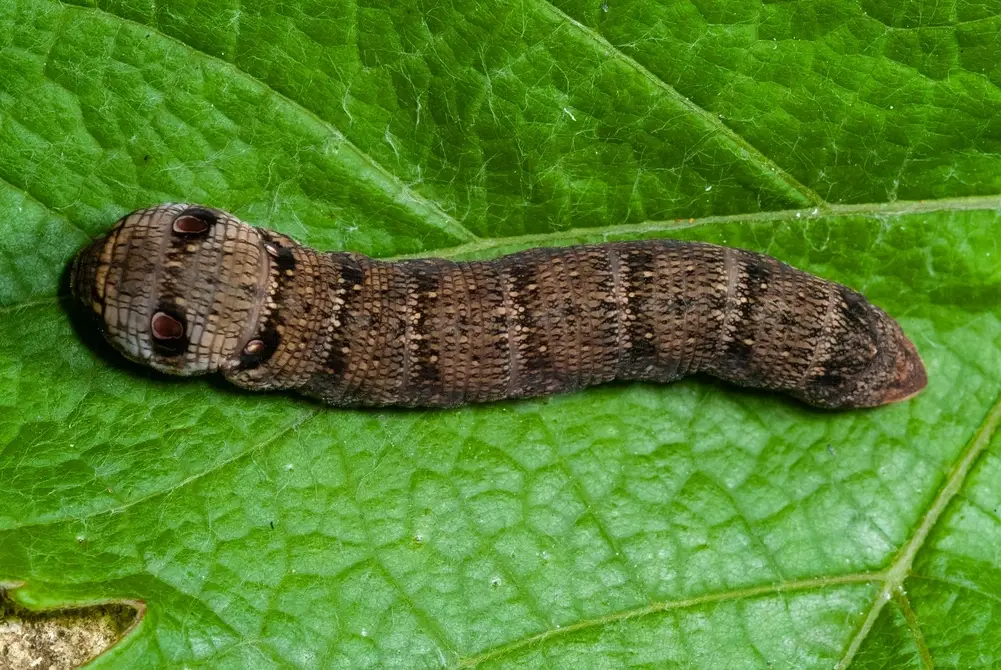
Elephant Hawk-Moth Caterpillar
- Scientific Name: Deilephila elpenor
- Appearance: A massive, hairless caterpillar that is usually deep grayish-brown (occasionally bright green). It features a distinctively tapered front end resembling an elephant’s trunk and carries four large, incredibly lifelike black-and-pink “eyespots” on its forward segments.
Garden Tiger Caterpillar
- Scientific Name: Arctia caja
- Appearance: Extremely hairy and long. Coated in a dense thicket of black and auburn hairs tipped with white.
- Primary Food: Broadleaved weeds, docks, dandelions, and nettles.
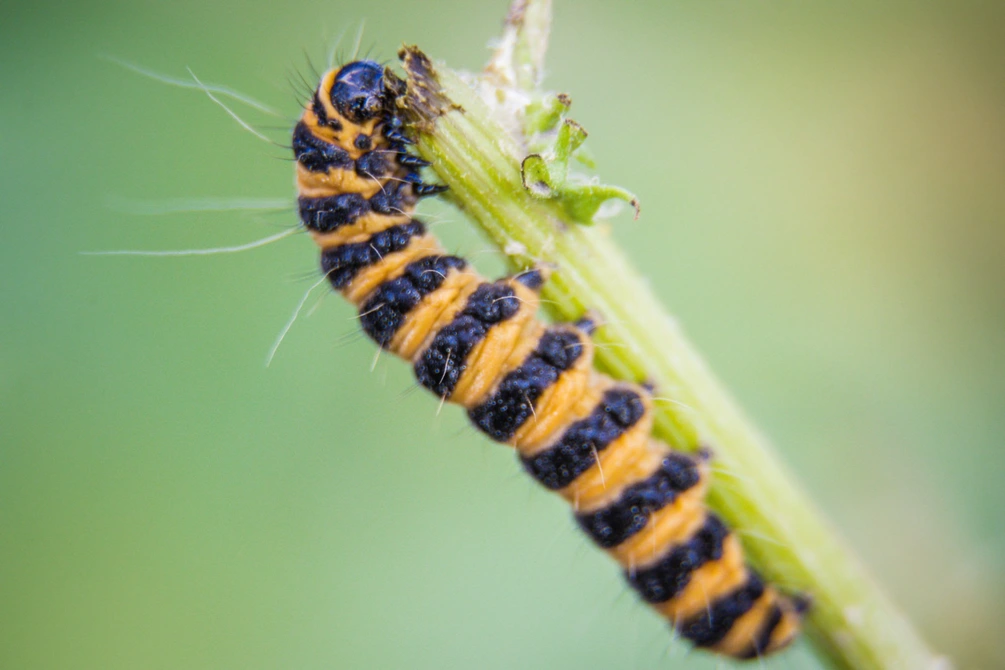
Cinnabar Caterpillar
- Scientific Name: Tyria jacobaeae
- Appearance: Impossible to mistake. It features alternating, razor-sharp horizontal bands of jet black and bright golden-yellow.
Buff-Tip Caterpillar
- Scientific Name: Phalera bucephala
- Appearance: A dark yellow-and-black checkered body covered in fine, short white hairs.
- Behavior: Highly gregarious; they feed packed tightly together on tree branches, stripping foliage completely before moving on.
Fox Moth Caterpillar
- Scientific Name: Macrothylacia rubi
- Appearance: Young larvae are dark blackish-brown with neat orange rings. Fully grown instars transform into massive, intensely fuzzy creatures covered in long, dark gray-brown hairs along the back and bright orange-red fur along the lower sides.
Emperor Moth Caterpillar
- Scientific Name: Saturnia pavonia
- Appearance: Starts black but matures into a spectacular bright green body divided by black bands that hold a ring of vibrant pink, orange, or yellow fleshy warts (tubercles) from which short black bristles emerge.
The Most Common Garden Caterpillars
Depending on where you are looking in your garden, you are likely to encounter completely different species adapted to those micro-habitats.
Caterpillars Found on Flowers
Flowers attract species that feed directly on buds and seed pods. The Pug Moth larvae are small, masterfully camouflaged caterpillars that often change color to match the exact petals of the flowers they are eating.
Caterpillars Found on Trees
Trees support our largest larvae. Look along the branches of Oak, Willow, and Birch trees for massive Lime Hawk-Moth larvae or the perfectly stick-mimicking Peppered Moth caterpillars hanging rigidly at an angle from twigs.
Caterpillars Found on Vegetables
Vegetable plots are primary targets for the Cabbage White family (looping on greens) and the Tomato Hornworm (in warmer climates or greenhouses), which is a massive green caterpillar with diagonal white stripes and a sharp blue-black horn on its tail segment.
Caterpillars Found in Backyards
In low-lying weeds, lawn edges, and leaf litter, you will routinely turn up heavy-set, dull-colored larvae known as Cutworms (the larvae of various Turnip and Noctuid moths). These roll into a tight, defensive ‘C’ shape the moment they are uncovered.
Caterpillar Identification Chart
Use this quick reference table to sort your findings by visual traits, food sources, and classification.
| Common Name | Main Color | Body Texture | Class | Primary Host Plant | Typical Habitat |
| Peacock Butterfly | Jet Black | Spiky / Spines | Butterfly | Stinging Nettle | Meadows, gardens, waste ground |
| Cabbage White | Matte Green | Smooth / Velvety | Butterfly | Cabbage, Kale, Nasturtium | Allotments, vegetable gardens |
| Elephant Hawk-Moth | Gray-Brown | Smooth with Eyespots | Moth | Willowherb, Fuchsia | Open woodlands, urban gardens |
| Cinnabar Moth | Yellow & Black | Smooth | Moth | Common Ragwort | Sand dunes, roadsides, pastures |
| Garden Tiger | Black & Orange | Deeply Hairy | Moth | Dandelion, Dock, Nettle | Overgrown gardens, hedgerows |
| Swallowtail | Green & Black | Smooth | Butterfly | Milk-parsley, Fennel | Fens, marshes, wetlands |
| Buff-Tip | Yellow & Black | Finely Hairy | Moth | Oak, Birch, Sallow | Woodlands, parks, large gardens |
What Do Caterpillars Eat?
Caterpillars are essentially highly specialized digestive systems on legs. Their lives revolve entirely around their host plants.
Favorite Plants of Caterpillars
Certain plants act as absolute magnets for egg-laying adult butterflies and moths. If you plant these species, caterpillars will inevitably follow.
- Caterpillars on Nettles: Stinging nettles are arguably the single most important wildlife plant for UK butterflies. They host the Peacock, Red Admiral, Small Tortoiseshell, and Comma butterflies.
- Caterpillars on Oak Trees: A single mature oak tree can support over 200 species of moth larvae, including the Buff-Tip, Merveille du Jour, and various prominent moths.
- Caterpillars on Garden Plants: Cultivated flowers like Nasturtiums draw in Cabbage Whites, while Fuchsias are the prime food source for elegant Elephant Hawk-Moth larvae.
Where Do Caterpillars Live?
Understanding the preferred ecosystems of these insects makes finding them significantly easier.
Gardens
Suburban gardens with a mix of cultivated flowers, vegetable beds, and unmanaged patches of weeds offer a rich mosaic of host plants.
Woodlands
The deep canopy and rich understory of broadleaf woodlands provide immense food volumes for tree-feeding species. Look closely at the undersides of leaves on low-hanging branches.
Meadows
Sunny, undisturbed grasslands filled with wildflowers, clovers, and thistles host an array of day-flying moth and butterfly larvae.
Wetlands
Fens, reedbeds, and marshy riverbanks are highly specialized ecosystems. They are the exclusive home to rare species like the Swallowtail caterpillar, which depends entirely on wetland plants like Milk-parsley.
Are Caterpillars Poisonous?
The short answer is: Some are, but only if eaten or touched improperly. Caterpillars do not have fangs or stingers like wasps, but they possess highly effective passive defense mechanisms.
Do Caterpillars Bite?
While caterpillars have powerful, chewing mouthparts (mandibles) designed to shred tough leaves, their muscles are not built to pierce human skin. If a large hornworm pinches you, it might feel like a tiny nip, but it is completely harmless and contains no venom.
Can Caterpillars Sting?
Caterpillars do not sting in the way bees do. However, species with urticating hairs or venomous spines can inflict what feels exactly like a chemical sting. When touched, these brittle hairs puncture the skin and release localized toxins.
Which Caterpillars Should You Avoid Touching?
- The Oak Processionary Moth (OPM): Found increasingly in southern England; their microscopic hairs cause severe skin rashes and eye irritation.
- The Brown-Tail Moth: Common along coastal areas; their hairs break off easily in the wind and can trigger asthma attacks.
- Any bright, excessively hairy caterpillar that you cannot confidently identify as a safe species (like the harmless Woolly Bear).
Rare and Unusual Caterpillars in Britain
Beyond our common garden residents lies a world of strange, threatened, and visually spectacular larvae.
Colorful Caterpillars
The larva of the Mullein Moth looks like an absolute piece of modern art. It is stark white with a striking grid of bright yellow blocks and neat black domino dots, feeding openly on garden verbascum plants without fear because its colors signal extreme bitterness to birds.
Giant Caterpillars
The Privet Hawk-Moth caterpillar holds the title of one of the largest larvae in the UK, reaching up to 9 centimeters (3.5 inches) in length. It is a brilliant, heavy-bodied neon green with bold lilac and white diagonal stripes running along its flanks, topped off with a curved black horn on its tail.
Endangered Caterpillar Species
Due to habitat fragmentation and modern industrial farming, several species are facing critical declines. The Marsh Fritillary caterpillar, which relies on devil’s-bit scabious in damp grasslands, is under strict legal protection across the UK to prevent its total loss.
How to Photograph and Observe Caterpillars Safely
Field tracking caterpillars is incredibly rewarding, provided it is conducted with respect for the animal and its habitat.
Best Time to Find Caterpillars
The prime searching season runs from late spring through early autumn (May to September). Warm, humid, overcast mornings are ideal. Caterpillars often move to the upper surfaces of leaves to feed when the sun isn’t drying them out completely.
Photography Tips
- Use Macro Mode: Switch your phone or camera to its macro setting to capture the fine details of hairs, claspers, and spiracles (breathing holes).
- Focus on the Head and Eyespots: If the caterpillar has structural features like eyespots or a horn, ensure those elements are sharply in focus.
- Avoid Harsh Flash: Direct flash can wash out subtle greens and browns, making later identification harder. Use natural, diffused light whenever possible.
Ethical Wildlife Observation
- Never pull a caterpillar forcefully off a leaf. Their tiny hooked feet (crochets) grip surfaces tightly. Pulling them can easily tear their delicate prolegs. Instead, snip the entire twig or leaf they are resting on.
- Leave them where you found them. Moving a caterpillar to a different plant usually spells disaster, as they cannot digest foliage outside their specific host range.
Frequently Asked Questions
What Kind of Caterpillar Is This?
To solve this puzzle, run through your 5-step checklist: Note its color, check for hairs or spines, locate the exact plant it was sitting on, look for defining stripes or spots, and measure its general size.
What Butterfly Will This Caterpillar Become?
You can generally tell by looking at the pupation structure or its physical smoothness. Most smooth, brightly banded caterpillars (like the Monarch or Swallowtail) become butterflies. Most incredibly hairy, subterranean, or plain brown, heavy-bodied larvae develop into moths.
How Long Do Caterpillars Live?
The larval stage typically lasts between 2 to 6 weeks during summer. However, some species that hatch late in the year overwrite this rule by overwintering as caterpillars, remaining in a suspended state of development (diapause) for up to 9 months before pupating in spring.
Why Are Some Caterpillars Hairy?
Hair acts as a vital protective shield. It deters predators from swallowing them, insulates their bodies against cold morning air, and—in the case of toxic species—delivers defensive chemical irritants to anything that tries to handle them.
How Can I Identify a Caterpillar From a Picture?
Focus on getting a clear, top-down shot of the back patterns and a crisp side profile shot showing the legs and hair distribution. Combine these images with the name of the plant you found it on when submitting to wildlife tracking apps or lookup guides.
Final Thoughts
The simplest way to master caterpillar identification is to shift your focus from the insect to the environment around it. Once you learn to recognize common host plants like stinging nettles, dock leaves, ragwort, and oak branches, the identities of the larvae feeding upon them will naturally click into place.
These creatures are far more than transient garden residents; they are fundamental to our wider ecosystems. Caterpillars act as an essential food source for nesting birds, while their adult forms serve as vital pollinators. By taking the time to record your sightings on local wildlife databases and preserving wild patches of native plants in your garden, you play a direct role in protecting this irreplaceable web of biodiversity.
Disclaimer
This disclaimer applies to the discussion of caterpillar identification. This article is for general educational purposes. Species identification, distribution, behaviour, and population information can vary by location and change as research develops. It is not a substitute for professional wildlife, veterinary, or field-safety advice. Verify current guidance with relevant conservation authorities and observe wildlife without disturbing or handling it.