








When you imagine the most massive creatures to ever grace our planet, your mind might jump to prehistoric dinosaurs. However, the true titan of our world is still swimming in our oceans today. If you are looking for incredible blue whale facts, you are in the right place.
What is a blue whale, exactly? It is a marine mammal of staggering proportions, officially holding the title of the largest animal on earth. This comprehensive guide will walk you through everything from blue whale size and anatomy to their specialized diet and the urgent conservation efforts needed to protect the endangered blue whale.
What Is a Blue Whale?
The blue whale is a gentle giant of the deep, a baleen whale belonging to the rorqual family. Despite their massive size, these marine mammals are incredibly elusive, spending much of their lives traversing the open ocean hidden beneath the waves.
Scientific Classification
Understanding the blue whale begins with its scientific lineage.
- Kingdom: Animalia
- Phylum: Chordata
- Class: Mammalia (Marine mammals)
- Order: Artiodactyla (Cetacea)
- Family: Balaenopteridae
- Genus: Balaenoptera
- Species: Balaenoptera musculus
Blue Whale Species Overview
There are currently a few recognized subspecies of the blue whale, categorized mostly by their geographic location and slight variations in physical traits. These include the Northern blue whale (B. m. musculus), the Antarctic blue whale (B. m. intermedia), the North Indian Ocean blue whale (B. m. indica), and the Pygmy blue whale (B. m. brevicauda). Don’t let the name “pygmy” fool you—even these are massive!
Why Blue Whales Are Unique
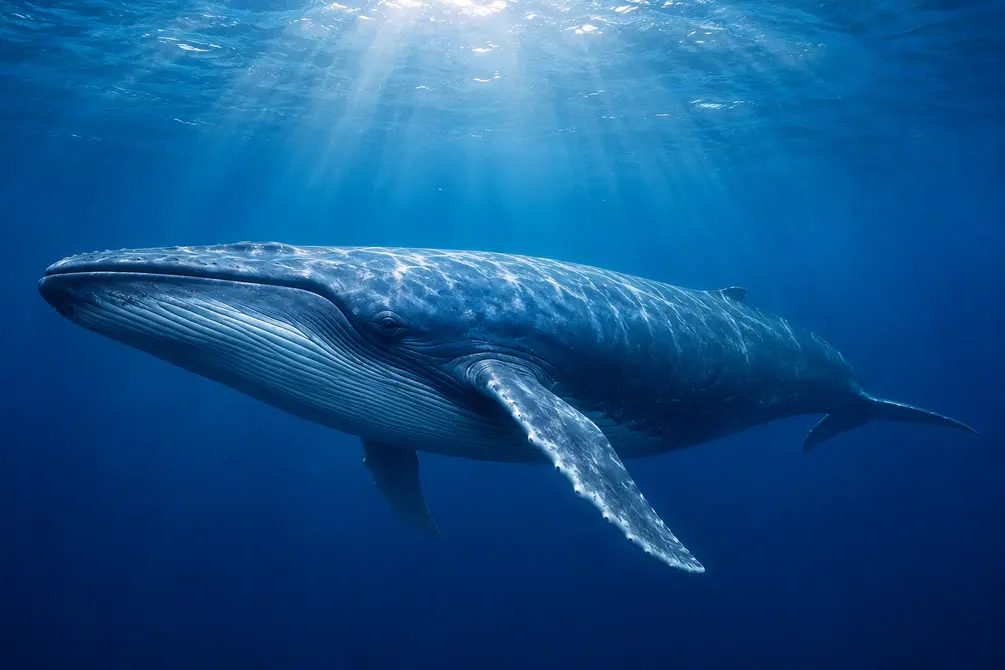
What sets the blue whale apart from other marine mammals isn’t just its record-breaking bulk. Their uniquely mottled, blue-gray skin appears a stunning, luminous aqua-blue underwater. Furthermore, they are baleen whales, meaning they lack teeth entirely, relying on fringed plates of baleen to filter food from the water.
Blue Whale Size and Weight
When discussing blue whale facts, their physical dimensions are usually the first thing people want to know. The blue whale size is almost difficult to comprehend without visual comparisons.
How Big Is a Blue Whale?
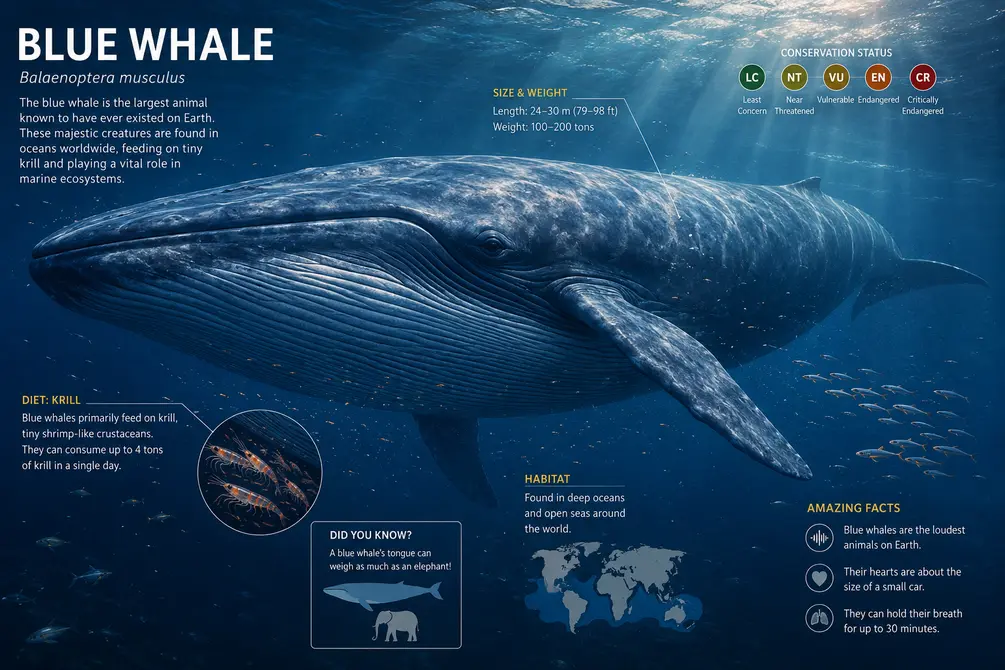
A mature adult can reach lengths ranging from 80 to 100 feet (24 to 30 meters). To put that in perspective, that is the length of about three standard school buses lined up bumper-to-bumper.
How Much Does a Blue Whale Weigh?
The sheer mass of this creature is astounding. A healthy adult weighs anywhere from 100 to 150 tons, with some extreme cases reaching up to 200 tons.
Blue Whale Size Compared to Humans and Elephants
| Subject | Average Length | Average Weight |
| Human | 5.5 – 6 feet | 150 – 200 lbs |
| African Elephant | 18 – 24 feet | 4 – 7 Tons |
| Blue Whale | 80 – 100 feet | 100 – 150 Tons |
It would take roughly 30 to 40 fully grown African elephants to equal the weight of a single adult blue whale!
Why Is the Blue Whale the Largest Animal on Earth?
Evolution pushed the blue whale to become the largest animal on earth due to the physics of the ocean environment. Water provides buoyancy, supporting their massive weight in a way that gravity on land would never allow. Furthermore, their immense size helps them store vast amounts of energy to survive long migrations.
Record-Breaking Measurements
Everything about this marine mammal breaks records. Even as babies, they are giants. A newborn calf is about 23 feet long and weighs around 3 tons—already larger than most adult terrestrial animals.
Biggest Blue Whale Ever Recorded
The longest accurately measured blue whale was a female caught by whalers in the Antarctic in 1909, measuring a staggering 110 feet (33.5 meters). The heaviest on record weighed an estimated 190 metric tons (418,000 pounds).
Blue Whale vs Other Giant Animals
Even the mightiest dinosaurs fall short. The famous Megalodon shark, though fierce, only reached about 50-60 feet and 50 tons. The largest known dinosaur, the Argentinosaurus, weighed an estimated 70-100 tons—still a fraction of a healthy Antarctic blue whale’s bulk.
Also Read This Article: Most Dangerous Animal in the World.
Where Do Blue Whales Live?
The blue whale habitat is as vast as the animal itself. These nomadic marine mammals are truly global citizens, found in all major oceans of the world, except for the ice-choked regions of the high Arctic.
Blue Whales in the Pacific Ocean
In the eastern North Pacific, a well-studied population spends summers feeding off the coast of California before migrating down to the warm waters of Mexico and Costa Rica to breed in the winter.
Blue Whales in the Atlantic Ocean
The Atlantic populations are smaller but can be spotted from the Gulf of St. Lawrence in Canada all the way over to the coasts of Iceland and the Azores.
Blue Whales in the Indian Ocean
Pygmy blue whales and North Indian Ocean blue whales inhabit these waters. They are often detected by underwater acoustic monitoring, singing their low-frequency songs off the coasts of Sri Lanka and Australia.
Antarctic Blue Whale Habitat
The Antarctic blue whale subspecies is the largest of them all. They spend their summers gorging in the nutrient-rich, freezing waters of the Southern Ocean surrounding Antarctica, before migrating closer to the equator to calve.
Blue Whale Migration Patterns
To understand the blue whale habitat, you have to understand their incredible mobility. They do not stay in one place year-round.
Why Blue Whales Migrate
Their lives are governed by a strict seasonal cycle. They migrate to balance two distinct biological needs: finding enough food to sustain their massive bodies, and finding safe, warm waters for their vulnerable calves.
Feeding Grounds
During the summer months, blue whales travel to polar or sub-polar waters. Here, ocean upwelling creates massive blooms of phytoplankton, which in turn support astronomical numbers of krill.
Breeding Areas
When winter approaches and the polar ice freezes over, they migrate thousands of miles to warmer, tropical or subtropical waters. These areas have much less food, meaning the adults often fast for months, surviving entirely on their thick layers of blubber while mating and giving birth.
What Do Blue Whales Eat?
One of the most fascinating blue whale facts is the contrast between the size of the predator and the size of its prey.
Blue Whale Diet Explained
The blue whale diet is incredibly specialized. They are carnivores, but they do not hunt large fish, seals, or sharks. Instead, they feed almost exclusively on tiny, shrimp-like crustaceans called krill.
The Importance of Krill
Krill are only about 1 to 2 inches long, but they form massive, dense swarms in cold waters. Because a blue whale’s throat is surprisingly narrow (only about the diameter of a beach ball), they cannot swallow large prey even if they wanted to. Krill are the perfect, nutrient-dense fuel.
How Much Food Does a Blue Whale Eat Daily?
To maintain their incredible mass, an adult needs a lot of calories. During the peak summer feeding season, a single adult can consume up to 4 tons (8,000 pounds) of krill in a single day. That translates to roughly 40 million individual krill daily!
How Do Blue Whales Feed?
Their feeding mechanism is a marvel of evolutionary engineering.
Filter Feeding Process
Blue whales use a technique called “lunge feeding.” The whale accelerates toward a massive swarm of krill, opening its jaws nearly 90 degrees. It takes in a colossal volume of water and krill—sometimes an amount of water equal to its own body weight!
Baleen Plates Explained
Once its mouth is full, the whale shuts its jaws and uses its massive tongue to push the water back out. Hanging from the roof of their upper jaw are hundreds of overlapping plates made of keratin (the same material as human fingernails) called baleen. The water filters out through the stiff bristles of the baleen, leaving the trapped krill behind to be swallowed.
Hunting and Feeding Adaptations
To accommodate the massive influx of water during a lunge, blue whales have ventral pleats—deep grooves running from their chin down to their navel. These pleats expand like an accordion, allowing the throat pouch to balloon outward.
Blue Whale Anatomy
If you are looking for amazing blue whale facts, you need to look under the hood. Their internal anatomy is mind-boggling.
Blue Whale Heart
The heart of a blue whale is the largest of any animal. It weighs about 400 pounds (180 kg)—roughly the size and weight of a golf cart or a small bumper car. It beats incredibly slowly, dropping to just 2 to 10 beats per minute when the whale goes on a deep dive, to conserve oxygen.
Blue Whale Tongue
Their tongue is so massive that it can weigh up to 3 tons, which is as much as an adult forest elephant. It is entirely flexible and vital for their filter-feeding process.
Blue Whale Blowhole
Unlike fish, marine mammals must surface to breathe. The blue whale has twin blowholes on the top of its head, guarded by powerful muscular splash guards. When they exhale, they shoot a spectacular column of vaporized water and air up to 30 feet (9 meters) into the sky.
Blue Whale Tail and Flippers
Despite their length, their pectoral flippers are relatively short (about 1 foot for every 10 feet of body length). Their power comes from their massive tail flukes, which can be 25 feet wide from tip to tip.
Blue Whale Skeleton
The skeleton of the largest animal on earth is heavily adapted for oceanic life. Because water supports them, their bones are highly porous and filled with oil, which helps with buoyancy.
Blue Whale Behavior and Communication
They are usually solitary wanderers, but they are deeply connected through the ocean’s acoustic landscape.
Social Behavior
Blue whales are not known to form tight-knit pods like orcas or dolphins. They are usually seen alone or in pairs (typically a mother and her calf). Occasionally, they will gather in loose aggregations if there is a particularly rich swarm of krill.
Blue Whale Songs
They are among the loudest animals on the planet. They produce a series of low-frequency pulses, groans, and moans. These sounds are often below the threshold of human hearing but are incredibly powerful, registering at up to 188 decibels (louder than a jet engine).
Communication Underwater
Because low-frequency sound travels incredibly well through water, researchers believe these marine mammals can hear each other across vast oceanic basins, communicating across hundreds, or even thousands, of miles.
How Fast Can a Blue Whale Swim?
Despite their enormous bulk, they are graceful and shockingly fast when they need to be.
Swimming Speed
While cruising and migrating, they typically travel at a leisurely 5 mph (8 km/h). However, if they are alarmed or interacting socially, they can reach sprint speeds of over 20 mph (32 km/h) for short bursts.
Diving Abilities
While they can dive to depths of 1,600 feet (500 meters), they typically feed at depths of around 300 feet (100 meters). A typical feeding dive lasts around 10 to 20 minutes, though they can hold their breath for up to 30 minutes if necessary.
Daily Travel Distance
During migration, these endurance athletes can travel anywhere from 70 to 100 miles a day, driven by the change of seasons and the search for food.
Blue Whale Reproduction and Life Cycle
Ensuring the survival of the endangered blue whale relies heavily on successful reproduction, which is a slow and energy-intensive process.
Mating Season
Mating occurs during the late autumn and winter when the whales are in warmer waters. The exact rituals of blue whale courtship remain largely a mystery to scientists, as they are rarely observed.
Pregnancy and Birth
A female’s gestation period is roughly 10 to 12 months. She generally gives birth to a single calf once every two to three years.
Blue Whale Calves
A newborn calf is a giant baby. From the moment it is born, it must swim to the surface to take its first breath. Because they are born in warm waters lacking food, the mother must nourish her calf entirely with her milk.
Growth and Development
Blue whale milk is incredibly rich, consisting of roughly 40% to 50% fat. A calf drinks up to 50 gallons of milk a day and gains an astonishing 200 pounds every 24 hours during its first few months of life.
How Long Do Blue Whales Live?
Given their size, the blue whale lifespan is understandably lengthy. Larger mammals typically enjoy longer lives.
Average Lifespan
While exact ages are difficult to track in the wild, scientists estimate that the average blue whale lifespan ranges from 80 to 90 years, making them one of the longest-living creatures on Earth.
Growth Stages
They are weaned at around 6 to 8 months of age, just in time for their first migration back to the polar feeding grounds. They reach sexual maturity between 5 and 10 years of age.
Aging Process
Scientists estimate the age of deceased whales by examining ear wax! Whales accumulate layers of wax in their ear canals over time, creating bands that can be counted much like the rings of a tree.
Are Blue Whales Endangered?
Yes. Learning about the plight of the endangered blue whale is vital to ensuring they remain in our oceans for generations to come.
Current Population Estimates
Before human interference, the global blue whale population was estimated to be over 250,000. Today, the blue whale population is estimated to sit between 10,000 and 25,000 individuals worldwide.
History of Commercial Whaling
The primary reason for their decline was the brutal commercial whaling industry of the 20th century. With the invention of exploding harpoons and factory ships, human hunters decimated the population. Between 1900 and the mid-1960s, nearly 360,000 blue whales were slaughtered, pushing them to the very brink of extinction.
Conservation Status
Today, they are listed as “Endangered” under the IUCN Red List. While commercial whaling has ended, their numbers are recovering at a painfully slow rate.
Threats Facing Blue Whales
While hunters no longer pose a threat, modern industrial society has introduced new dangers to the blue whale habitat.
Climate Change
This is perhaps the most significant long-term threat. Warming ocean temperatures and melting sea ice directly impact the life cycle of krill. A reduction in the blue whale diet could be catastrophic for their recovery.
Ship Strikes
Because they feed in waters near major global shipping lanes (like off the coast of California or Sri Lanka), ship strikes are a leading cause of unnatural death. A collision with a massive cargo ship is often fatal.
Plastic Pollution
Microplastics are a growing concern. As filter feeders, whales inadvertently ingest massive amounts of microplastics present in the water alongside their krill.
Ocean Noise
Commercial shipping, military sonar, and seismic exploration create intense underwater noise pollution. This disrupts their ability to communicate, navigate, and find mates across long distances.
Fishing Gear Entanglement
Though they are not targeted, they can become entangled in heavy commercial fishing gear, which can lead to injury, exhaustion, or drowning.
Blue Whale Conservation Efforts
Blue whale conservation is an active, ongoing, global mission.
International Protection Laws
The most crucial step was the global moratorium on commercial whaling enacted by the International Whaling Commission in 1986. They are also protected in the US under the Endangered Species Act and the Marine Mammal Protection Act.
Marine Protected Areas
Governments are working to establish Marine Protected Areas (MPAs) in critical feeding and breeding grounds, restricting shipping traffic and industrial activity in these sensitive zones.
Scientific Research and Tracking
Marine biologists use satellite tags to track migration routes. This data is vital—if we know exactly where the whales travel, we can ask shipping companies to adjust their routes or lower their speeds to prevent ship strikes.
How You Can Help Save Blue Whales
You don’t have to be a marine biologist to help. Supporting organizations dedicated to ocean conservation, reducing your reliance on single-use plastics to clean up their habitat, and advocating for climate change initiatives all indirectly protect these magnificent marine mammals.
Amazing Blue Whale Facts
To summarize the wonder of this animal, here are some rapid-fire amazing blue whale facts:
- Blue whales are the largest animals ever known to exist.
- Their hearts can weigh as much as a small car.
- They can consume millions of krill in one day.
- Their calls can travel hundreds of miles underwater.
- A newborn calf gains weight extremely quickly, roughly 8 pounds every hour!
- Blue whales can live for many decades, often reaching 80 to 90 years.
- They migrate thousands of miles each year between feeding and breeding zones.
- Their tongues can weigh as much as an elephant.
- They are found in every major ocean except the Arctic.
- Despite their size, they feed on tiny crustaceans.
Blue Whale Facts for Kids
If you are putting together a school project, here are the easiest blue whale facts for kids to remember!
- Size and weight: They are 100 feet long (like 3 school buses) and weigh up to 150 tons!
- What they eat: They eat tiny shrimp-like bugs called krill.
- Where they live: They live in every big ocean in the world.
- Why they are endangered: People used to hunt them a long time ago. Now they are safe from hunting, but we have to keep the oceans clean for them.
- Fun facts for school projects: When they breathe out of their blowhole, the water spouts up 30 feet high!
Read More Blogs About Wildlife
Frequently Asked Questions
How big is a blue whale?
Adults typically range from 80 to 100 feet in length and weigh between 100 and 150 tons, though some have been recorded as being even larger.
What do blue whales eat?
They eat almost exclusively krill, which are tiny, shrimp-like crustaceans. An adult can eat up to 4 tons of krill per day.
Where do blue whales live?
They are found in all major global oceans, migrating between cold polar waters in the summer to feed, and warmer tropical waters in the winter to breed.
How many blue whales are left?
Current scientific estimates suggest there are roughly 10,000 to 25,000 individuals remaining in the wild today.
Can a blue whale swallow a human?
No. Despite having a mouth large enough to hold a school bus worth of water, their throats are incredibly narrow—only about the size of a beach ball.
Why are blue whales endangered?
They were aggressively hunted during the 20th century by commercial whalers, which nearly drove them to extinction. Today, they face threats from climate change, ship strikes, and ocean pollution.
How fast can a blue whale swim?
They usually cruise at about 5 mph but can reach burst speeds of up to 20 mph when necessary.
What is the lifespan of a blue whale?
Scientists estimate that they live between 80 and 90 years on average in the wild.
What is the scientific name of a blue whale?
The scientific name is Balaenoptera musculus.
What is the biggest blue whale ever recorded?
The longest on record was a female measuring 110 feet (33.5 meters), caught in the early 1900s.
Disclaimer
This disclaimer applies to the discussion of blue whale facts. This article is for general educational purposes. Species identification, distribution, behaviour, and population information can vary by location and change as research develops. It is not a substitute for professional wildlife, veterinary, or field-safety advice. Verify current guidance with relevant conservation authorities and observe wildlife without disturbing or handling it.