






Spiders are among the most evolutionarily successful and visually fascinating creatures on our planet. While many people think of them as tiny corner-dwellers spinning delicate webs, a select few species have evolved into true giants. These absolute monsters of the arachnid world hold a unique place in human culture—sparking equal parts intense terror and deep scientific curiosity.
But what exactly makes a spider “large”? Depending on how you look at it, size can mean two entirely different things: total weight or sheer leg span.
If you are looking for a quick answer: The biggest spider in the world is the Goliath Birdeater (Theraphosa blondi) by mass and weight, while the Giant Huntsman Spider (Heteropoda maxima) claims the crown for the longest leg span.
What Is the Biggest Spider in the World?
The undisputed heavyweight champion of the arachnid world is the Goliath Birdeater (Theraphosa blondi). This colossal tarantula belongs to the family Theraphosidae and is native to the upland rainforest regions of northern South America, including Suriname, Guyana, French Guiana, northern Brazil, and southern Venezuela.
When it comes to pure physical presence, no other spider matches its mass:
- Weight: Up to 175 grams (6.2 ounces)—roughly the weight of a young puppy or a large apple.
- Body Length: Up to 13 centimeters (5.1 inches).
- Leg Span: Up to 30 centimeters (12 inches), which is large enough to comfortably cover a dinner plate.
Despite its dramatic common name, it rarely actually eats birds. Instead, it is a formidable ground-dwelling hunter that relies on sheer size, strength, and powerful fangs to overpower its prey.
How Scientists Determine the Largest Spider
To accurately rank the world’s largest arachnids, arachnologists (scientists who study spiders) evaluate specimens across several distinct physical and behavioral dimensions.
Leg Span
Leg span is measured from the tip of the front leg to the tip of the rear leg on the opposite side when the spider is naturally extended. This metric favors lighter, long-limbed species like huntsman spiders.
Body Weight
Mass is the ultimate arbiter of size in the animal kingdom. Heavy-bodied tarantulas carry significantly more tissue, muscle, and exoskeleton than long-legged web-weavers, making weight the standard metric for the absolute “biggest” title.
Body Length
This measures the distance from the chelicerae (the jaws/fang bases) at the front of the cephalothorax to the very back of the abdomen. Large tarantulas can have bodies longer than the entire leg span of many common household spiders.
Hunting Ability
While not a strictly physical measurement, a spider’s predatory capability often reflects its functional size. Larger spiders possess thicker cuticles, stronger musculature, and longer fangs, allowing them to hunt vertebrate prey rather than relying strictly on small insects.
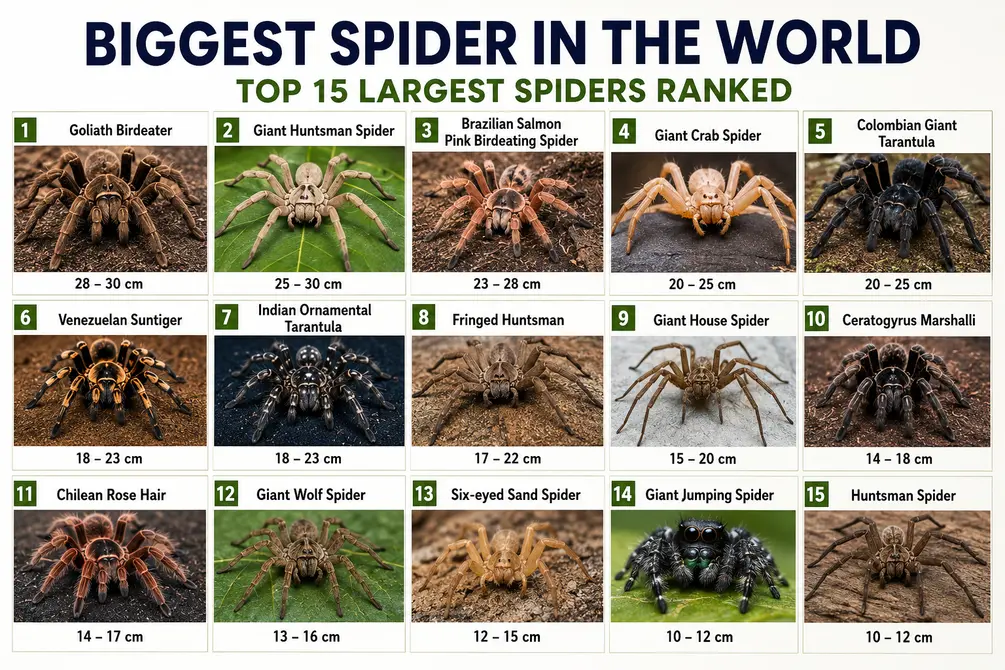
Top 15 Biggest Spiders in the World
Here is the definitive, data-backed ranking of the top 15 largest spider species globally, ordered by a combination of maximum recorded leg span and overall body mass.
1. Goliath Birdeater (Theraphosa blondi)
As detailed above, this South American giant rules supreme as the largest tarantula in the world by mass. It lives in deep silk-lined burrows in the rainforest floor and defends itself by rubbing its hind legs together to release urticating (barbed, irritating) hairs that cause severe itching and blindness in predators.
2. Giant Huntsman Spider (Heteropoda maxima)
Discovered in a cave system in Laos in 2001, the Giant Huntsman holds the world record for the biggest spider by leg span, reaching an astonishing 30 centimeters (12 inches). Unlike the heavy Goliath Birdeater, the Giant Huntsman has a flattened, relatively lightweight body structure adapted for scurrying across cave walls and tracking down prey with blinding speed.
3. Brazilian Salmon Pink Birdeater (Lasiodora parahybana)
Native to northeastern Brazil, this incredibly popular species in the exotic pet trade is one of the world’s biggest tarantulas. It boasts a leg span of up to 28 centimeters (11 inches). It grows rapidly and gets its name from the beautiful salmon-colored hairs interspaced across its dark gray body.
4. Hercules Baboon Spider (Hysterocrates hercules)
This is an elusive, potentially mythical giant of Africa. The only known official specimen was collected over a century ago and is preserved in the Natural History Museum in London. It reportedly possessed a leg span approaching 20 centimeters (8 inches) and a remarkably thick, heavy-set body designed for deep burrowing.
5. King Baboon Spider (Pelinobius muticus)
An absolute titan of East Africa (Kenya and Tanzania), the King Baboon Spider features a leg span of up to 20 centimeters (8 inches). It is famous for its massive, thick back legs which it uses to excavate deep burrows in hard clay soil. It is highly defensive and will fiercely hiss when threatened.
6. Colombian Giant Tarantula (Megaphobema robustum)
Found deep within the tropical rainforests of Colombia, this striking arachnid reaches a leg span of roughly 15 to 20 centimeters (6 to 8 inches). It is visually distinct due to its bright orange-red legs and dark black carapace, and it uses a fascinating defensive mechanism: it spins in circles to confuse and ward off attackers.
7. Giant Crab Spider (Family Sparassidae)
A broad category of giant spiders found globally in warmer climates (including parts of Australia and the US). These large spiders can easily achieve a leg span of 15 centimeters (6 inches). Their legs twist outwards in a crab-like orientation, allowing them to slide sideways into narrow tree bark crevices.
8. Camel Spider (Order Solifugae)
Note: While historically grouped with giant spiders by the public, Solifugids are technically unique arachnids, distinct from true spiders.
They can grow up to 15 centimeters (6 inches) in length including their long pedipalps. Found in arid deserts worldwide, they are famous for tall tales of chasing humans (they are actually just running toward your shadow to escape the blistering sun).
9. Brazilian Giant Tawny Red Tarantula (Grammostola anthracina)
Living in the temperate grasslands of Brazil, Uruguay, and Argentina, this heavy-bodied species has an impressive leg span of up to 17 centimeters (6.7 inches). It is exceptionally long-lived, with females frequently passing the 20-year milestone in captivity.
10. Chaco Golden Knee Tarantula (Grammostola pulchripes)
An incredibly beautiful and docile giant native to Argentina and Paraguay. It reaches a leg span of up to 17.8 centimeters (7 inches). Its name comes from the striking, bright yellow accents on its leg joints, which contrast sharply against its dark, furry body.
11. Giant House Spider (Eratigena duellica)
A common sight across Europe and parts of North America. While its body length is modest, males can develop a leg span approaching 10 to 12 centimeters (4.7 inches). They are harmless to humans and hold records for being among the fastest-running true spiders on flat ground.
12. Poecilotheria Rajaei (Poecilotheria rajaei)
Discovered in Sri Lanka in 2009, this massive arboreal (tree-living) tarantula features a leg span of up to 20 centimeters (8 inches). It belongs to the famous “Tiger Spider” genus, known for geometric, neon-yellow leg markings and incredibly potent, medically significant venom.
13. Mexican Red-Knee Tarantula (Brachypelma hamorii)
The quintessential poster child of world’s biggest spiders. Native to the Pacific coast of Mexico, it grows to a respectable 16-centimeter (6.3-inch) leg span. They are highly celebrated for their bright orange knee bands and exceptionally calm demeanor.
14. Cerbalus Aravaensis (Cerbalus aravaensis)
A massive huntsman spider native to the shifting sand dunes of the Arava Valley in Israel and Jordan. With a leg span of up to 14 centimeters (5.5 inches), it creates unique, hinged trapdoors out of sand and silk to ambush insects passing by at night.
15. Sydney Funnel-Web Spider (Atrax robustus)
While it maxes out at a leg span of about 10 centimeters (4 inches), its heavy build, massive fangs, and notorious status as one of the most toxic, dangerous spiders in the world earn it a vital spot on any list detailing giant arachnids.
Biggest Spider in the World vs. Giant Huntsman Spider
The battle between these two iconic giants comes down to a classic biological trade-off: Mass vs. Length.
| Feature | Goliath Birdeater (T. blondi) | Giant Huntsman (H. maxima) |
| Primary Record | Heaviest / Largest by Mass | Longest Leg Span |
| Max Leg Span | ~30 cm (11.8 inches) | ~30 cm (12.0 inches) |
| Max Weight | ~175 grams | ~30-40 grams |
| Body Shape | Stout, thick, heavily muscular | Flat, thin, elongated |
| Hunting Style | Ground ambush / Burrowing | High-speed pursuit / Cave-dwelling |
While the Giant Huntsman can technically edge out the Goliath Birdeater by a fraction of an inch in leg reach, it is incredibly light and spindly. The Goliath Birdeater is overwhelmingly larger when measuring absolute biovolume.
Where Do Giant Spiders Live?
Giant spider species have successfully adapted to a wide array of ecosystems across the globe, though they overwhelmingly thrive in warm, tropical zones.
- South America: The epicenter of heavy tarantula diversity. The Amazon basin provides the perfect high-humidity climate for heavy-bodied species like the Goliath Birdeater and Salmon Pink Birdeater.
- Asia: Home to fast-moving arboreal tarantulas and the long-legged Giant Huntsman found in deep Southeast Asian cave systems.
- Africa: Host to highly aggressive, deep-burrowing “Baboon Spiders” that thrive in both tropical forests and arid scrublands.
- Australia: Renowned for massive huntsman variants and highly venomous funnel-web spiders that inhabit coastal forests and urban gardens.
What Do Giant Spiders Eat?
As apex predators of the invertebrate world, large tarantulas and huntsman species expand their diets far beyond simple flies and beetles.
[Giant Spider Prey Spectrum]
  ├── Insects (Crickets, Cockroaches, Beetles)
  ├── Amphibians (Tree Frogs, Toads)
  ├── Small Reptiles (Geckos, Anoles, Small Snakes)
  ├── Small Mammals (Mice, Shrews)
  └── Avian Prey (Rarely: Nestlings, Small Birds)
Because spiders cannot consume solid food, they use their fangs to inject digestive enzymes directly into their prey. These enzymes liquefy the inner tissues, allowing the spider to drink the resulting nutrient-rich fluid.
Are Giant Spiders Dangerous to Humans?
The short answer is no. While their immense size makes them terrifying to look at, the reality of giant spiders is far tamer than Hollywood horror films suggest.
- The Venom Myth: Almost all giant tarantulas possess mild venom. A bite from a Goliath Birdeater is often compared to a wasp sting—painful due to the mechanical puncture of large fangs, but not deadly to an adult human.
- Urticating Hairs: For New World tarantulas (from the Americas), the real danger isn’t the bite; it’s the irritating hairs on their abdomen. They kick these hairs into the air when threatened, which can cause severe respiratory distress and painful rashes if inhaled or embedded in human eyes.
- Shy Demeanor: Spiders are acutely aware of size differences. To a giant spider, a human is a mountain-sized predator. Given the choice, they will almost always run away or hide inside their burrows rather than attack.
Why Do Some Spiders Grow So Big?
The extreme size of these giant spiders is a result of island gigantism, evolutionary niches, and abundant food supplies in tropical ecosystems. In dense rainforest floors, small vertebrates like frogs, lizards, and rodents are incredibly common. Spiders that evolved larger bodies were able to tap into this abundant food source, outcompeting smaller arachnids. Furthermore, the warm, stable temperatures of the tropics optimize the metabolic rates required to maintain such large exoskeletons.
Conservation of Giant Spider Species
Many of the world’s largest spider species are facing steep population declines. Habitat destruction through deforestation in the Amazon and Southeast Asia continues to erase critical hunting grounds. Additionally, the illegal pet trade targets wild caught rare specimens (such as Poecilotheria species), disrupting local ecosystems. Organizations worldwide are working to establish sustainable captive-breeding programs to protect wild populations from over-collection.
Frequently Asked Questions
What is the biggest spider in the world?
The Goliath Birdeater (Theraphosa blondi) is the biggest by weight and body mass, while the Giant Huntsman (Heteropoda maxima) is the largest by leg span.
Can giant spiders eat birds?
Yes, but it is rare. They primarily consume insects, frogs, and small rodents, only eating small birds if they happen to stumble across a low-nesting chick.
Are giant spiders poisonous?
Spiders are venomous (they inject toxins via fangs), not poisonous (which implies harm via ingestion). The venom of most giant spiders is not medically significant to humans.
What is the largest tarantula in the world?
The Goliath Birdeater holds the definitive record as the largest tarantula species.
Can a giant spider kill a human?
No recorded human deaths have been attributed to a Goliath Birdeater or Giant Huntsman spider bite.
Conclusion
The world’s biggest spiders are extraordinary examples of natural adaptation. From the heavy-set, subterranean Goliath Birdeater of South America to the lightning-fast, cavern-dwelling Giant Huntsman of Laos, these ancient creatures play a vital ecological role in controlling insect and small-vertebrate populations. Rather than fearing their impressive size, we should appreciate them as magnificent, sensitive wonders of the natural world.
Disclaimer
This disclaimer applies to the discussion of large spider species. This article is for general educational purposes. Species identification, distribution, behaviour, and population information can vary by location and change as research develops. It is not a substitute for professional wildlife, veterinary, or field-safety advice. Verify current guidance with relevant conservation authorities and observe wildlife without disturbing or handling it.