







Introduction
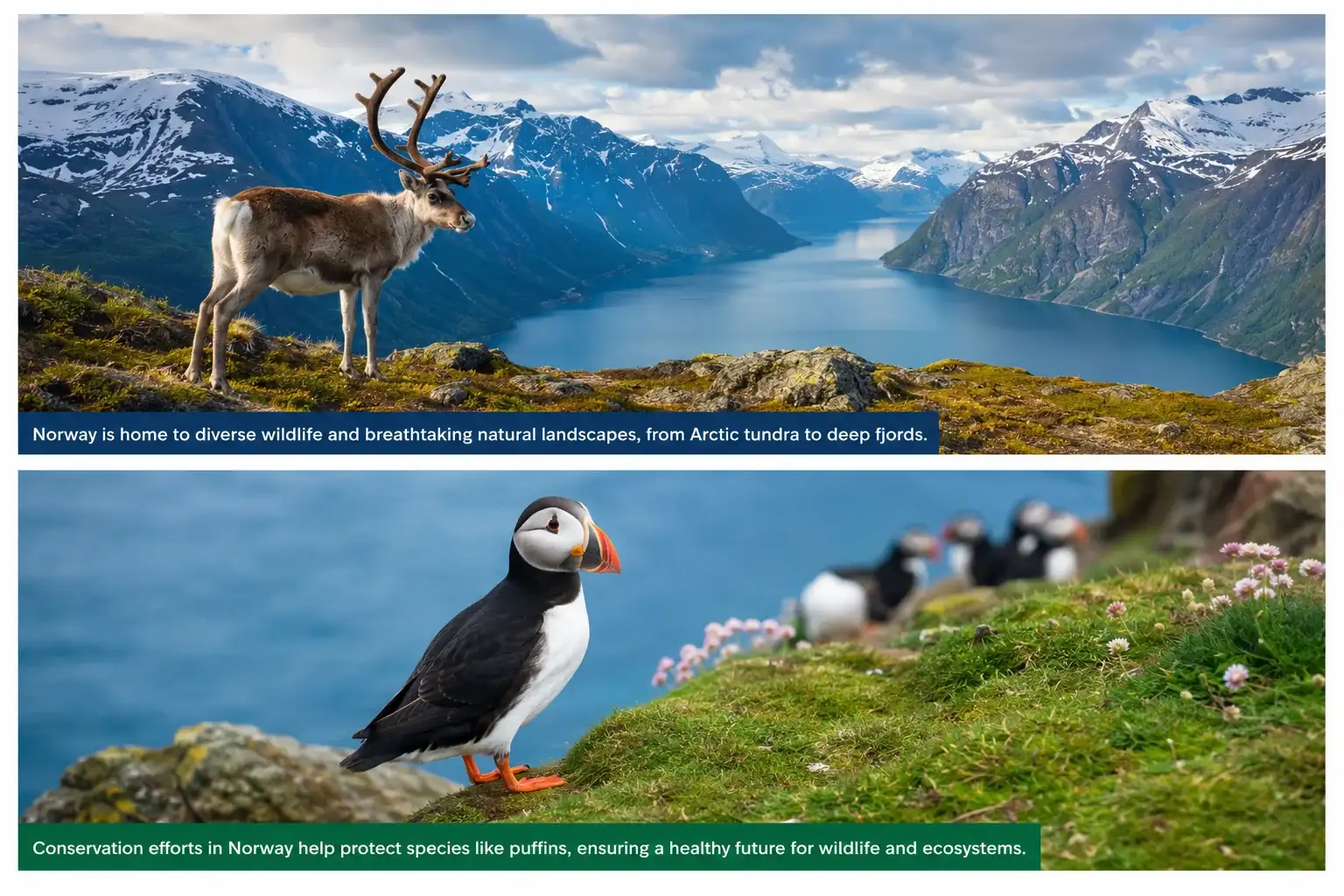
Norway is home to some of Europe’s most important Arctic ecosystems, including polar bears, wolves, lynx, and reindeer. These iconic animals rely on fragile, interconnected habitats that span from deep boreal forests to high mountain tundras and isolated polar islands.
Active wildlife conservation is critical because these unique species face escalating modern pressures. Climate change, severe habitat loss, and expanding human footprint threaten to irreversibly alter Norway’s fragile environmental balance.
In this comprehensive guide, you will learn exactly how Norway structures its environmental protection framework. We will explore the country’s major wildlife species, evaluate the primary modern threats to their survival, highlight significant conservation successes, and explain the intersection of traditional hunting with sustainable scientific management.
Quick Answer: What is Wildlife Conservation in Norway?
Wildlife conservation Norway refers to the protection and sustainable management of wild animals, habitats, and ecosystems through national laws, scientific research, and conservation programs.
Key Takeaways:
- Norway protects its diverse wildlife through strict, modern environmental legislation.
- A vast network of national parks shields massive expanses of natural habitats.
- Critically threatened and endangered species receive targeted national protection plans.
- Rapid climate change presents the single greatest long-term threat to Norway’s ecosystems.
- Regulated monitoring, DNA tracking, and sustainable hunting maintain healthy population balances.
- Dedicated government bodies cooperate closely with scientific groups and NGOs.
What Is Wildlife Conservation in Norway?
Definition and Main Goals
At its core, wildlife conservation in Norway is a legally mandated, scientifically driven effort to preserve natural biodiversity. Rather than simply separating animals from human society, Norway’s approach balances strict protection with active environmental management.
The strategy relies on four primary structural goals:
- Biodiversity protection: Safeguarding the complete variety of native plant and animal life across all regions.
- Ecosystem preservation: Maintaining intact natural habitats so physical biological systems can function without collapse.
- Species recovery: Reversing population declines in vulnerable, threatened, or critically endangered fauna.
- Sustainable resource management: Balancing traditional human interactions, resource extraction, and hunting with wildlife welfare.
Why Norway’s Wildlife Is Globally Important
Norway holds a vital position in international conservation because it serves as one of the last major sanctuaries for specialized cold-climate species. The country’s geography features distinct, highly sensitive ecological zones:
These wild spaces act as critical strongholds for species that have been entirely wiped out or severely fragmented throughout the rest of continental Europe. The sub-Arctic and High Arctic zones provide essential breeding grounds, winter migration paths, and unique maritime conditions that sustain rich food webs.
Major Wildlife Species Found in Norway
The vast Norwegian wilderness contains a remarkable collection of specialized large carnivores, migratory herbivores, and marine life.
- Polar Bears (Ursus maritimus): Located primarily within the Svalbard archipelago. The Barents Sea subpopulation contains roughly 2,650 bears, with around 250 remaining strictly resident along Svalbard’s coastal fringes. Status: Vulnerable.
- Arctic Foxes (Vulpes lagopus): Specially adapted to high alpine and tundra landscapes. Mainland populations became critically endangered due to overhunting and red fox expansion. Status: Critically Endangered (Mainland); Least Concern (Svalbard).
- Eurasian Lynx (Lynx lynx): The only large wild cat native to Norway. They inhabit dense boreal forests, preying primarily on roe deer. Status: Endangered (National).
- Grey Wolves (Canis lupus): Confined to a strictly managed “wolf zone” along the southeastern border with Sweden. The population is heavily managed and remains exceptionally small. Status: Critically Endangered (National).
- Wolverines (Gulo gulo): Solitary, powerful carnivores found primarily in alpine tundra and remote northern forests. Status: Endangered (National).
- Moose (Alces alces): Known locally as the “King of the Forest.” They are abundant throughout mainland wood systems, with populations numbering in the tens of thousands. Status: Least Concern.
- Wild Reindeer (Rangifer tarandus): Norway hosts Europe’s last remaining wild tundra reindeer populations, centered in the rugged southern high plates. Status: Near Threatened (National).
- Atlantic Puffins (Fratercula arctica): Pelagic seabirds that nest in dense, rocky coastal colonies during spring and summer. Status: Endangered (National).
How Does Norway Protect Wildlife?
Wildlife Protection Laws in Norway
Norway’s regulatory framework is deeply entrenched in national legislation. The foundational pillar is the Nature Diversity Act (Naturmangfoldloven), which dictates that all wild management must be based on verifiable scientific knowledge and precautionary environmental principles. Additionally, specific wildlife regulations under the Viltloven dictate how human interactions and populations are handled.
On the global stage, Norway coordinates its policies via strict adherence to international agreements, including the Bern Convention on the Conservation of European Wildlife and Natural Habitats, the Convention on Biological Diversity (CBD), and the CITES agreement regulating international wildlife trade.
Government Agencies Responsible for Conservation
Two main state organizations execute and support Norway’s conservation mandates:
- The Norwegian Environment Agency (Miljødirektoratet): This primary agency enforces environmental policy, manages protected regions, oversees hunting quotas, and directs targeted species action programs.
- The Norwegian Biodiversity Information Centre (Artsdatabanken): A specialized data entity that maps national ecosystems, tracks wild species health, and regularly publishes the authoritative Norwegian Red List for Species.
Protected Areas and National Parks
Norway uses a robust spatial defense system to shield vulnerable species from industrial footprint and urban sprawl. Across the mainland and Svalbard, Norway manages 48 national parks (41 on mainland territories and 7 within Svalbard) alongside thousands of specialized nature reserves.
- Hardangervidda National Park: Europe’s largest mountain plateau, safeguarding vital migratory pathways for the world’s largest wild reindeer herds.
- Jotunheimen National Park: A high alpine terrain characterized by towering peaks and glaciers, offering sanctuary to cold-adapted birds and mammals.
- Dovrefjell-Sunndalsfjella National Park: A rugged alpine environment famous for hosting a unique, reintroduced population of prehistoric muskoxen.
- Svalbard Nature Reserves: Enormous, strictly isolated arctic reserves established to safeguard polar bear denning zones, walrus haul-outs, and massive seabird colonies.
What Are the Biggest Threats to Wildlife in Norway?
Climate Change
Climate change is shifting ecosystems faster in the high north than almost anywhere else on Earth. The Barents Sea region is warming multiple times faster than the global average, triggering immediate, visible disruptions to cold-adapted species.
Case Study: Polar Bears in Svalbard
Polar bears depend directly on seasonal sea ice to hunt ringed seals. Due to rapid regional warming, landfast ice around Svalbard has dropped by roughly 50 percent compared to late-20th-century baselines, shortening the effective ice hunting season by over two months.
As a consequence, coastal bears are increasingly forced to remain isolated on land. This habitat shift has forced them to forage for bird eggs and actively hunt land mammals like Svalbard reindeer, leading to lower genetic exchange between historically connected sub-populations.
Habitat Loss and Fragmentation
The physical division of wilderness areas by human infrastructure poses a major hurdle for large roaming animals. Linear developments like industrial transit corridors, expanding cabins, and mountain roads slice up contiguous home ranges. Furthermore, while green energy initiatives like mountain wind farms and hydropower projects lower carbon reliance, their physical construction and footprint disrupt localized avian pathways and ungulate grazing territories.
Human-Wildlife Conflict
The coexistence of large apex predators and rural farming creates recurring social and political friction. Large carnivores like grey wolves and wolverines occasionally target free-ranging domestic sheep grazing in unprotected forests and mountain pastures. This economic threat drives intense public debate over seasonal predator management, resulting in strict statutory limits on carnivore territories and legally mandated culling operations.
Pollution and Marine Plastic Waste
Ocean currents drag global industrial waste directly into northern waters. High levels of persistent organic pollutants (POPs) accumulate upwards through the food chain, settling in high concentrations inside apex predators like polar bears and killer whales.
Simultaneously, microplastics and discarded commercial fishing gear pollute critical nesting shorelines, directly impacting oceanic health and causing high mortality in coastal bird species like Atlantic puffins.
Wildlife Conservation Success Stories in Norway
Recovery of the Arctic Fox Population
At the turn of the 21st century, mainland Scandinavia’s Arctic fox population had cratered to an estimated 40 to 60 remaining adults due to historical overharvesting and intense competition from expanding red foxes. To save the species, Norway established a specialized captive breeding facility at Sæterfjellet.
Pups raised in this predator-proof facility are systematically reintroduced into high alpine areas. Supported by networks of remote winter feeding stations and localized red fox management, the mainland population has successfully rebounded to several hundred breeding adults, sparking natural den recolonizations across the tundra.
Wild Reindeer Conservation Programs
Norway holds a unique global responsibility for protecting European wild reindeer. Through the implementation of a dedicated national management mechanism, key alpine ranges have been strictly protected from commercial developers.
When major infrastructure cuts through ancestral migration paths, scientists utilize underground wildlife tunnels, traffic restrictions, or land-restoration techniques to reconnect fragmented sub-populations.
Sea Eagle Population Recovery
Once driven close to localized extinction by bounty hunting and chemical pesticides like DDT, the white-tailed sea eagle (Haliaeetus albicilla) has staged a spectacular comeback. Following total legal protection in 1968 and strict bans on toxic agri-chemicals, Norway’s population recovered so vigorously that the country now hosts the largest sea eagle population in Europe, allowing birds to be translocated to aid restoration efforts in Scotland and Ireland.
Sustainable Moose Management
During the early 20th century, moose populations across Norway were notably low. By implementing a highly structured “selective harvesting” system—which meticulously calculates winter carrying capacities and assigns highly specific hunting licenses based on age and sex ratios—Norway successfully transformed its moose population into one of the healthiest, most stable large-mammal cohorts in the world.
How Scientists Monitor Wildlife in Norway
To ensure conservation policies remain rooted in hard evidence rather than guesswork, Norwegian researchers employ a suite of non-invasive tracking and imaging technologies:
- GPS Collar Tracking: Researchers fit large mammals, such as wolves and polar bears, with specialized satellite tracking collars. This reveals precise migration corridors, territory sizes, and seasonal habitat preferences.
- Camera Traps: Automated, motion-activated trail cameras hidden along wildlife pathways monitor elusive forest carnivores like the Eurasian lynx, yielding vital data on reproduction rates and population density.
- DNA Monitoring: Field rangers collect non-invasive biological samples, such as hair snags and scat, from remote mountain paths. Advanced genetic profiling tracks individual animals, maps pack sizes, and monitors overall genetic diversity without necessitating physical capture.
- Satellite Technology: High-resolution orbital tracking maps sea ice retreat in real time and charts structural changes to vegetation across alpine plateaus.
Sustainable Hunting and Wildlife Management in Norway
Hunting in Norway is completely integrated into the nation’s environmental protection architecture rather than operating separate from it. Population control is viewed as a necessary tool to maintain stable ecological dynamics, protect agricultural assets, and mitigate human-wildlife encounters.
State biologists calculate precise annual population targets. If a species exceeds its regional carrying capacity or threatens agricultural livelihoods, the government issues strict, non-transferable harvest quotas to highly trained, licensed hunters.
Balanced Analysis: Regulated Hunting in Conservation
| System Benefits | Long-Term Challenges |
| Prevents Overgrazing: Regulated hunting of abundant moose and deer prevents severe forest degradation. | Predator Controversy: Large carnivore culling quotas trigger intense ethical debates between rural farmers and conservationists. |
| Funds Active Conservation: License sales directly fund public habitat restoration and wildlife research. | Genetic Isolation: Low statutory population ceilings can result in high inbreeding risks among small carnivore packs. |
| Mitigates Disease Spread: Managing population densities reduces the transmission of wasting diseases. | Climate Instability: Historic harvest models face unpredictable variances due to sudden, climate-driven food shortages. |
How Individuals Can Support Wildlife Conservation in Norway
Supporting Norway’s delicate ecosystems requires conscious effort from both local residents and international visitors.
1. Practice Responsible Tourism
When exploring Norway’s national parks, always adhere to the principles of Friluftsliv (open-air life) and “Leave No Trace.” Stay strictly on marked trails to prevent soil erosion and avoid disturbing sensitive ground-nesting birds. If you encounter wild animals, such as reindeer or alpine muskoxen, maintain a minimum safe distance of 200 meters.
2. Support Conservation Organizations
Consider volunteering time or donating financial resources to reputable non-profit organizations actively managing field projects in the region. Organizations like WWF Norway (Verdens Naturfond) and the Norwegian Trekking Association (DNT) lead critical public education initiatives and hands-on habitat restoration programs.
3. Report Wildlife Observations
You can contribute directly to citizen science by reporting animal sightings, tracks, or signs of wildlife disease through the public digital portal Artsobservasjoner (managed by the Norwegian Biodiversity Information Centre). This real-time crowd-sourced data helps state biologists keep track of species distribution shifts.
4. Reduce Your Carbon Footprint
Because climate change represents the ultimate existential threat to Arctic species like the polar bear and Arctic fox, personal climate action is a form of indirect conservation. Minimize vehicle emissions by utilizing Norway’s comprehensive public transit systems, choose eco-certified travel operators, and support localized sustainability initiatives.
Common Myths About Wildlife Conservation Norway
Myth 1: Norway’s wildlife is fully protected everywhere.
Reality: While massive areas are set aside as national parks, wildlife management is zoned. Large carnivores are strictly managed outside designated preservation zones, and regulated hunting of abundant species occurs annually across extensive portions of the country.
Myth 2: Predators are increasing uncontrollably.
Reality: Large carnivore populations, particularly grey wolves, are restricted to tight, government-mandated zones. Their populations are kept at low, stable target levels via closely regulated, annual conservation culling allocations.
Myth 3: Climate change affects only Arctic species.
Reality: Rising temperatures affect ecosystems across all elevations. Warmer winters cause alpine snow to melt prematurely, shifting plant growth windows and allowing lower-elevation species like the red fox to expand upward, outcompeting native mountain wildlife.
Myth 4: Conservation and hunting cannot coexist.
Reality: Norway’s entire management strategy relies on hunting as a primary mechanism of ecological population balance. Regulated harvesting prevents overpopulation, reduces human conflict, and generates funding used to protect endangered species.
Wildlife Conservation: Norway vs. Other Nordic Countries
Norway coordinates its environmental strategies with its neighboring Nordic nations, yet distinct regional differences exist due to unique topographies and political landscapes.
| Factor | Norway | Sweden | Finland |
| Protected Areas | Focuses heavily on steep mountainous topography, fjords, and high Arctic island territories. | Dominating focus on massive, contiguous old-growth boreal forest systems. | Characterized by massive networks of inland peatlands and connected lake districts. |
| Predator Policy | Employs highly restrictive carnivore zones with low population thresholds. | Permits larger wolf and lynx territories across expansive, contiguous woodlands. | Balances EU regulations with managed exceptions for traditional reindeer herding zones. |
| Hunting System | Intensely regulated via strict state quotas based on annual scientific counts. | Historically rooted system with substantial local management authority. | Highly managed structure focused closely on balancing large moose populations. |
| Arctic Conservation | Direct, extensive management of high Arctic environments via the Svalbard archipelago. | Focused on alpine tundra conservation along the northern mountain chain. | Geared primarily toward sub-Arctic wetland restoration and tundra management. |
Frequently Asked Questions
Is wildlife protected in Norway?
Yes, wild fauna is protected under the Nature Diversity Act. This law establishes that all wild species are inherently protected unless specific hunting seasons or management culling operations are explicitly authorized by the state based on scientific data.
What animals are endangered in Norway?
Several high-profile species are listed on the national Red List, including the critically endangered mainland Arctic fox and grey wolf. The white-tailed sea eagle and moose are secure, but species like the wolverine, Eurasian lynx, and Atlantic puffin face ongoing environmental pressures.
Who manages wildlife conservation in Norway?
The Norwegian Environment Agency handles overall administration and policy enforcement. They collaborate with the Norwegian Biodiversity Information Centre, which monitors populations, and local governor offices who supervise municipal environmental issues.
How many national parks does Norway have?
Norway manages a total of 48 national parks. Of these protected territories, 41 are situated across the mountainous mainland, while 7 large arctic parks are located within the remote Svalbard archipelago.
Is hunting legal in Norway?
Yes, hunting is fully legal and integrated into the state’s wildlife management framework. Game species like moose, red deer, and wild grouse are harvested during strictly regulated seasons to maintain ecological balance and manage human-wildlife conflicts.
What is Norway doing about climate change and wildlife?
Norway invests heavily in ecological research, tracks ice-dependent species using satellite telemetry, and establishes immense nature reserves in Svalbard to safeguard vanishing habitats. The state also focuses on reducing localized landscape stressors to build ecosystem resilience.
Why is Arctic conservation important?
The Arctic contains specialized, highly sensitive ecosystems that react rapidly to temperature increases. Protecting these northern regions ensures the survival of specialized species that cannot survive in warmer climates, preserving global genetic diversity.
Conclusion
Norway operates one of the world’s most scientifically structured and rigorous wildlife conservation systems. By combining firm statutory laws like the Nature Diversity Act with a sprawling network of 48 national parks, the country successfully balances the needs of complex ecosystems with human society.
However, accelerating climate change remains an existential threat that borders and regional policies alone cannot solve. Protecting unique species like the polar bear and Arctic fox demands persistent public participation, strict defense of remaining wild habitats, and continuous international cooperation.
Whether you are a researcher, traveler, or nature enthusiast, understanding wildlife conservation Norway helps support the protection of Arctic biodiversity for future generations.
Disclaimer
This disclaimer applies to the discussion of Norwegian wildlife conservation. This article provides general information about wildlife conservation and management, not legal advice or an official decision. Laws, responsibilities, access rules, and conservation conditions may change and differ by location. Check current legislation and guidance from the responsible municipality or public authority before acting.