






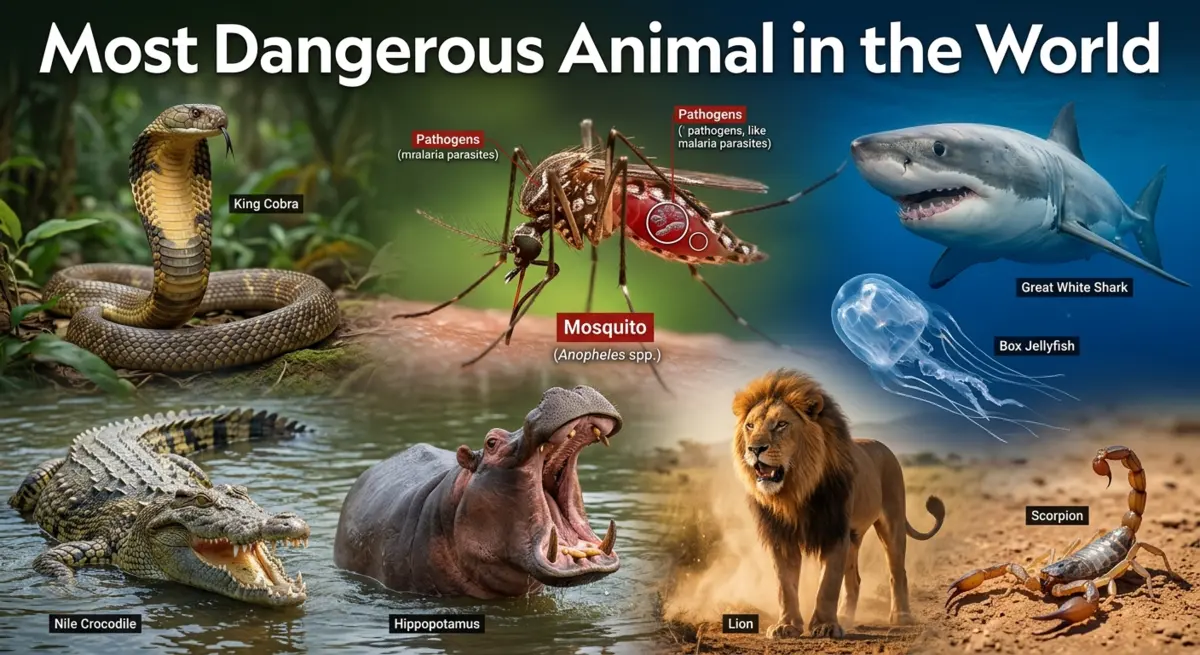
When you think of the most dangerous animals on Earth, what comes to mind? A massive great white shark with razor-sharp teeth? A roaring lion pacing through the tall grass? Or a huge crocodile waiting beneath the water?
While these large predators are certainly scary, the real truth about the world’s deadliest animals might surprise you. Some of the most dangerous creatures on Earth are so small you can barely see them, while others are animals we keep in our own homes.
In this ultimate guide, we will look at the top dangerous animals on Earth. We will learn why they are dangerous, how many people they affect, and how you can stay safe.
What Is the Most Dangerous Animal in the World?
If we judge danger by how many human lives are taken every single year, the title of the most dangerous animal in the world does not belong to a shark, a tiger, or a bear.
It belongs to the tiny, buzzing mosquito.
🏆 WORLD’S DEADLIEST CREATURE 🏆 Animal: Mosquito Size: Less than 0.5 inches Weapon: Disease Transmission (Malaria, Dengue, etc.) Annual Human Deaths: 700,000+
How Scientists Define Dangerous Animals
When scientists and wildlife experts make a list of dangerous animals, they look at data. They do not just ask, “Which animal looks the scariest?” Instead, they ask:
- How many humans does this animal kill or injure each year?
- How toxic is its venom?
- How easily does it spread deadly diseases?
Animal Death Statistics Explained
There is a big difference between an animal being aggressive and an animal being deadly.
For example, a grizzly bear is highly aggressive and very strong. However, because bears live far away from most people, they cause fewer than a dozen deaths a year. On the other hand, animals that live very close to humans—like stray dogs or insects—cause much higher animal attack statistics because we cross paths with them every day.
Why Mosquitoes Rank Number One
Mosquitoes are the deadliest animals because they act like flying needles. When a mosquito bites an infected person or animal, it sucks up blood containing viruses or parasites. When it flies to the next person, it injects those dangerous germs right into their bloodstream. They don’t kill with sharp teeth; they kill with microscopic diseases.
How We Ranked the World’s Deadliest Animals
To create this list of the deadliest creatures on earth, we analyzed several important factors:
- Annual human deaths: The average number of people who lose their lives to this animal each year.
- Venom and toxins: How powerful the animal’s chemical weapons are.
- Disease transmission: Whether the animal carries dangerous bacteria, viruses, or parasites.
- Aggressive behavior: How likely the animal is to attack if a human gets too close.
- Frequency of attacks: How often humans and these animals come into contact.
Top 25 Most Dangerous Animals in the World
Here is the complete breakdown of the 25 animals that kill humans the most, starting from the absolute deadliest down to highly dangerous localized threats.
1. Mosquito (The Deadliest Animal to Humans)
- Scientific Name: Culicidae
- Habitat: Found worldwide, especially in warm, wet, tropical regions.
- Estimated Deaths Per Year: 700,000 to 1,000,000+
- Why It Is Dangerous: Mosquitoes carry devastating diseases like Malaria, Dengue Fever, Yellow Fever, and the Zika Virus.
- Interesting Fact: Only female mosquitoes bite humans! They need the protein in our blood to develop their eggs.
- Safety Tip: Use bug spray, sleep under mosquito nets, and empty out standing water around your home where they like to lay eggs.
2. Snake
- Scientific Name: Serpentes
- Habitat: Every continent except Antarctica.
- Estimated Deaths Per Year: 100,000 to 138,000
- Why It Is Dangerous: Venomous snakes like the Black Mamba, King Cobra, and Saw-Scaled Viper possess highly toxic venom that can stop a human heart or paralyze muscles within hours.
- Interesting Fact: Snakes do not want to eat humans. They usually only bite when they are stepped on or startled.
- Safety Tip: Wear thick boots when walking in tall grass, watch where you step, and never try to pick up a wild snake.
3. Dog
- Scientific Name: Canis lupus familiaris
- Habitat: Worldwide, living alongside humans.
- Estimated Deaths Per Year: 59,000
- Why It Is Dangerous: While dogs are man’s best friend, infected dogs can spread a deadly virus called rabies through bites and scratches.
- Interesting Fact: Over 99% of all human rabies cases worldwide are caused by dog bites.
- Safety Tip: Ensure your pets are vaccinated against rabies, and keep your pets away from stray or unfamiliar dogs that act strangely.
4. Freshwater Snail
- Scientific Name: Gastropoda (various species)
- Habitat: Freshwater rivers, lakes, and ponds in Africa, Asia, and South America.
- Estimated Deaths Per Year: 20,000
- Why It Is Dangerous: These snails release tiny parasitic worms into the water. If you swim or wash your clothes in contaminated water, worms can burrow into your skin and cause a painful, chronic disease called Schistosomiasis.
- Interesting Fact: This makes them one of the deadliest sea animals (technically freshwater) despite moving incredibly slowly!
- Safety Tip: Avoid swimming in slow-moving freshwater lakes and rivers in tropical countries where the parasite is common.
5. Assassin Bug
- Scientific Name: Reduviidae
- Habitat: North America, South America, and Central America.
- Estimated Deaths Per Year: 10,000
- Why It Is Dangerous: Also known as the “kissing bug” because it bites people around their lips and eyes while they sleep. It leaves behind a parasite that causes Chagas disease, which can lead to severe heart failure years later.
- Interesting Fact: The bug doesn’t infect you through its bite, but rather through its waste material left near the bite wound.
- Safety Tip: Keep your home sealed tight to prevent bugs from entering, and avoid sleeping in mud or adobe houses in rural areas.
6. Tsetse Fly
- Scientific Name: Glossina
- Habitat: Rural areas of sub-Saharan Africa.
- Estimated Deaths Per Year: 10,000
- Why It Is Dangerous: This large fly sucks blood and transmits a parasite that causes African Trypanosomiasis, also known as “Sleeping Sickness.” It attacks the human brain and makes people sleep constantly until they fall into a coma.
- Interesting Fact: Tsetse flies are attracted to bright, dark colors, especially blue and black!
- Safety Tip: Wear neutral-colored clothing, such as khaki or olive drab, when going on an African safari.
7. Crocodile
- Scientific Name: Crocodylidae
- Habitat: Tropical regions of Africa, Asia, Australia, and the Americas.
- Estimated Deaths Per Year: 1,000 to 5,000
- Why It Is Dangerous: Crocodiles are ancient ambush predators. They hide just beneath the water’s surface, wait for an animal or human to approach, and snap their jaws shut with incredible force.
- Interesting Fact: The Nile Crocodile and the Saltwater Crocodile have the strongest bite forces ever measured in the animal kingdom.
- Safety Tip: Obey all warning signs near waterways, and never stand close to the edge of water where crocodiles live.
8. Hippopotamus
- Scientific Name: Hippopotamus amphibius
- Habitat: Rivers and lakes in Sub-Saharan Africa.
- Estimated Deaths Per Year: 500
- Why It Is Dangerous: Don’t let their round, cute appearance fool you. Hippos are highly aggressive, dangerous mammals. They have giant teeth that grow up to 20 inches long and can easily crush a small boat.
- Interesting Fact: Despite weighing up to 4,000 pounds, a hippo can run faster than a human on land!
- Safety Tip: Never get between a hippo and the safety of the water, and never approach them in a kayak or canoe.
9. Elephant
- Scientific Name: Elephantidae
- Habitat: Forests and grasslands of Africa and Asia.
- Estimated Deaths Per Year: 500
- Why It Is Dangerous: Elephants are usually peaceful, but if they feel crowded, threatened, or are protective of their babies, they can crush vehicles and trample humans.
- Interesting Fact: Male elephants experience a period called “musth” where their testosterone levels skyrocket, making them incredibly hostile to anything in their path.
- Safety Tip: Always give wild elephants plenty of space and never crowd them for a photo.
10. Shark
- Scientific Name: Selachimorpha
- Habitat: Oceans worldwide.
- Estimated Deaths Per Year: 5 to 10
- Why It Is Dangerous: Great White Sharks, Tiger Sharks, and Bull Sharks possess powerful jaws filled with rows of sharp teeth. However, most attacks are cases of “mistaken identity,” where the shark thinks a human is a seal.
- Interesting Fact: You are actually more likely to be struck by lightning than to be attacked by a shark!
- Safety Tip: Avoid swimming at dawn or dusk, when sharks feed, and do not swim near people who are fishing or schools of baitfish.
==================================== THE DANGER ZONE: EXTENDED LIST ====================================
11. Box Jellyfish
- Scientific Name: Chironex fleckeri
- Habitat: Coastal waters of Northern Australia and the Indo-Pacific.
- Estimated Deaths Per Year: 40 to 100
- Why It Is Dangerous: Their long, trailing tentacles are covered in thousands of stinging cells filled with a fast-acting venom that can paralyze a swimmer’s heart in minutes.
- Interesting Fact: They have 24 eyes clustered around their bodies to help them navigate.
- Safety Tip: Wear a protective stinger suit when swimming in tropical Australian waters during stinger season.
12. Scorpion
- Scientific Name: Scorpiones
- Habitat: Deserts, dry plains, and rainforests around the globe.
- Estimated Deaths Per Year: 3,000+
- Why It Is Dangerous: The Indian Red Scorpion and the Deathstalker have venom potent enough to cause severe pain, breathing difficulties, and heart complications.
- Interesting Fact: Scorpions glow a bright neon-blue color under ultraviolet (UV) blacklights!
- Safety Tip: Always shake out your shoes, boots, and bags before putting them on if you live in a desert area.
13. Lion
- Scientific Name: Panthera leo
- Habitat: Grasslands and savannas of sub-Saharan Africa.
- Estimated Deaths Per Year: Up to 250
- Why It Is Dangerous: Lions are apex predators that hunt in organized family groups called prides. They are built with raw muscle, sharp claws, and a bite designed to suffocate prey.
- Interesting Fact: Lions hunt mostly at night because their eyesight is six times better in the dark than a human’s.
- Safety Tip: Stay inside your safari vehicle at all times when visiting national parks.
14. Tiger
- Scientific Name: Panthera tigris
- Habitat: Forests, swamps, and jungles across Asia.
- Estimated Deaths Per Year: 50 to 100
- Why It Is Dangerous: Tigers are solitary ambush hunters. If they become injured or too old to hunt wild prey, they may venture near villages and target humans as an easy food source.
- Interesting Fact: No two tigers share the same pattern of stripes; they are like human fingerprints!
- Safety Tip: Avoid walking alone inside tiger reserves or thick jungle habitats in regions like the Sundarbans.
15. Leopard
- Scientific Name: Panthera pardus
- Habitat: Africa and parts of Asia.
- Estimated Deaths Per Year: 30
- Why It Is Dangerous: Leopards are incredibly stealthy and can climb trees while carrying prey that weighs more than themselves. They become highly dangerous if cornered.
- Interesting Fact: Leopards often pull their meals high up into trees to keep them safe from ground scavengers like hyenas.
- Safety Tip: If you ever face a large wild cat, don’t run away. Running triggers their predatory instinct to chase you.
16. Bear
- Scientific Name: Ursidae
- Habitat: North America, Europe, and Asia.
- Estimated Deaths Per Year: 5 to 10
- Why It Is Dangerous: Grizzly bears and Polar bears have incredible physical strength, massive paws, and long claws. Most attacks happen when a mother bear is defending her cubs.
- Interesting Fact: Polar bears are the only bear species that actively hunt humans as food if they come across them.
- Safety Tip: Carry bear spray when hiking in bear territory and store your food in bear-proof containers.
17. Cape Buffalo
- Scientific Name: Syncerus caffer
- Habitat: Southern and Eastern Africa.
- Estimated Deaths Per Year: 200
- Why It Is Dangerous: Nicknamed “The Black Death,” these massive animals have never been domesticated. They are highly unpredictable and will charge at threats using their fused, horn-shielded heads.
- Interesting Fact: Injured Cape Buffaloes have been known to circle back around to ambush the hunters tracking them.
- Safety Tip: Never approach a lone bull buffalo, as they are often old, grumpy, and highly aggressive.
18. Komodo Dragon
- Scientific Name: Varanus komodoensis
- Habitat: A few Indonesian islands.
- Estimated Deaths Per Year: Less than 1
- Why It Is Dangerous: They are the largest living lizards on Earth. They use sharp teeth to deliver deep wounds filled with toxic venom that prevents blood clotting, causing their prey to bleed out.
- Interesting Fact: A Komodo dragon can eat up to 80% of its own body weight in just one meal!
- Safety Tip: Always tour Komodo National Park with an official park ranger who carries a safety stick.
19. Stonefish
- Scientific Name: Synanceia
- Habitat: Coastal waters of the Indo-Pacific oceans.
- Estimated Deaths Per Year: Rare (but causes extreme injuries)
- Why It Is Dangerous: It is the most venomous fish in the world. It camouflages itself perfectly, looking exactly like a rock on the seafloor. If you step on it, its sharp dorsal spines inject agonizingly painful venom.
- Interesting Fact: The venom can cause temporary paralysis, heart failure, or death if left untreated.
- Safety Tip: Wear thick-soled water shoes when walking along rocky ocean reefs.
20. Blue-Ringed Octopus
- Scientific Name: Hapalochlaena
- Habitat: Pacific Ocean reefs, from Japan to Australia.
- Estimated Deaths Per Year: Rare
- Why It Is Dangerous: This tiny octopus is no bigger than a golf ball, but its saliva contains a deadly neurotoxin called tetrodotoxin. One bite can contain enough toxin to paralyze 26 adult humans within minutes.
- Interesting Fact: Its beautiful blue rings only light up brightly when the octopus feels threatened or is about to bite.
- Safety Tip: Never pick up small octopuses out of ocean tide pools.
21. Cone Snail
- Scientific Name: Conidae
- Habitat: Warm tropical oceans around coral reefs.
- Estimated Deaths Per Year: A few dozen
- Why It Is Dangerous: They shoot out a harpoon-like tooth loaded with a combination of toxins called conotoxins. There is no anti-venom available for a cone snail sting.
- Interesting Fact: They are nicknamed the “cigarette snail” because it is said that once stung, you only have enough time to smoke one cigarette before losing consciousness.
- Safety Tip: Admire beautiful sea shells from afar; do not pick up living cone-shaped shells.
22. Black Widow Spider
- Scientific Name: Latrodectus
- Habitat: Found throughout North America, Europe, and Asia.
- Estimated Deaths Per Year: Less than 5 (due to modern medicine)
- Why It Is Dangerous: They possess a neurotoxic venom that causes severe muscle cramps, nausea, and intense pain throughout the body.
- Interesting Fact: You can spot a female Black Widow by the bright red hourglass shape located on the underside of her dark abdomen.
- Safety Tip: Wear heavy gloves when cleaning out old woodpiles, dark garages, or dusty sheds.
23. Brown Recluse Spider
- Scientific Name: Loxosceles reclusa
- Habitat: Central and Southern United States.
- Estimated Deaths Per Year: Extremely rare
- Why It Is Dangerous: Its venom is necrotic, which means it destroys skin cells and living tissue around the area of the bite, leaving a deep wound that takes months to heal.
- Interesting Fact: They have six eyes arranged in pairs, unlike most spiders, which have eight eyes.
- Safety Tip: Keep beds pulled away from walls and shake out clothes that have been sitting on the floor for a long time.
24. Pufferfish
- Scientific Name: Tetraodontidae
- Habitat: Tropical oceans worldwide.
- Estimated Deaths Per Year: 20 to 40
- Why It Is Dangerous: Their internal organs contain a lethal toxin that is 1,200 times more poisonous than cyanide. Eating improperly prepared pufferfish can paralyze your breathing muscles.
- Interesting Fact: In Japan, a specially trained chef must undergo years of practice before they are legally allowed to serve pufferfish soup (called Fugu).
- Safety Tip: Only consume pufferfish if a licensed, certified professional expert has prepared it.
25. Honey Bee and Wasp
- Scientific Name: Apis mellifera / Vespidae
- Habitat: Worldwide.
- Estimated Deaths Per Year: 50 to 100
- Why It Is Dangerous: While single stings are just painful, individuals who are severely allergic to insect venom can experience anaphylactic shock, causing their throat to close up.
- Interesting Fact: Honey bees die after they sting you because their stinger is barbed and pulls out of their body, whereas wasps can sting multiple times without dying.
- Safety Tip: If a bee or wasp flies near you, stay calm and walk away slowly. Avoid swinging your arms wildly at them.
Top 10 Animals That Kill the Most Humans Every Year
To help visualize this information clearly, let’s look at the data sorted by the approximate total number of human lives lost worldwide each year.
| Rank | Animal | Estimated Deaths Per Year | Main Threat Method |
| 1 | Mosquito | 700,000+ | Transmitting diseases and blood parasites |
| 2 | Snake | 100,000+ | Injecting highly destructive toxic venom |
| 3 | Dog | 59,000 | Spreading the fatal Rabies virus via bites |
| 4 | Freshwater Snail | 20,000 | Releasing parasitic worms into water |
| 5 | Assassin Bug | 10,000 | Spreading Chagas disease parasite |
| 6 | Tsetse Fly | 10,000 | Transmitting Sleeping Sickness parasite |
| 7 | Crocodile | 1,000 – 5,000 | Crushing bite force and drowning |
| 8 | Scorpion | 3,000+ | Venomous stings affecting heart/lungs |
| 9 | Hippopotamus | 500 | Crushing physical attacks and biting |
| 10 | Elephant | 500 | Trampling and crushing encounters |
Why Mosquitoes Are the Most Dangerous Animal in the World
Mosquitoes do not hurt us with physical strength. Instead, they act as tiny delivery systems for deadly pathogens. Let’s break down the major illnesses they carry:
Malaria
A microscopic blood parasite causes malaria. When a mosquito bites someone, the parasite enters the liver and destroys red blood cells. Malaria alone is responsible for hundreds of thousands of deaths every single year, mostly affecting young children in sub-Saharan Africa.
Dengue Fever
Commonly known as “breakbone fever” because it causes severe joint and muscle pain that makes you feel like your bones are breaking. Severe cases can cause dangerous internal bleeding.
Yellow Fever
A viral disease found in tropical regions of Africa and South America. It causes fever and chills and can damage the liver, which turns a patient’s skin and eyes yellow (jaundice).
Zika Virus
This virus can be passed from a pregnant mother to her baby, causing birth complications where the infant’s head grows smaller than normal.
Most Dangerous Animals by Category
Every ecosystem on Earth has its own champion of danger. Here are the top threats broken down by their animal family classes:
Most Dangerous Mammals
- Hippos and Cape Buffaloes: These large herbivores cause far more human deaths in Africa than lions, leopards, or cheetahs combined due to their territorial nature.
Most Dangerous Reptiles
- The Saw-Scaled Viper: This snake causes the highest number of snakebite deaths worldwide because it lives in densely populated farming areas across Asia and Africa, and blends perfectly with the soil.
Most Dangerous Sea Animals
- Box Jellyfish: Found off coastal waters, its sting causes agonizing shock so rapidly that victims often drown before making it back to the beach.
Most Dangerous Insects
- Mosquitoes and tsetse flies claim hundreds of thousands of lives by carrying small organisms that destroy human health from the inside out.
Most Dangerous Birds
- The Cassowary: Often called the “world’s most dangerous bird.” It lives in Australia and New Guinea, can reach up to 6 feet tall, and has a 4-inch, dagger-like claw on its foot that can slice open predators or humans if provoked.
Which Countries Have the Deadliest Animals?
Some regions around the globe are famous for having wildlife with powerful biological weapons.
🗺️ HOTSPOTS FOR DANGEROUS WILDLIFE 1. Australia –> High concentration of venomous creatures 2. India –> High frequency of snakebites and tiger encounters 3. Brazil –> Rainforest insects and venomous vipers
Australia
Australia is famous for having some of the world’s most venomous creatures, including the Inland Taipan snake, the Funnel-Web spider, the Box Jellyfish, and the Blue-Ringed Octopus. However, because Australia has excellent healthcare and anti-venom programs, very few people actually die there from animal bites.
India
India experiences some of the highest wildlife fatality numbers. Densely packed towns border wild forests, leading to high encounters with the “Big Four” venomous snakes (Cobra, Krait, Russell’s Viper, Saw-Scaled Viper) alongside elephants and tigers.
Brazil
The Amazon Rainforest is home to a wide array of venomous vipers, poisonous frogs, assassin bugs, and freshwater dangers such as electric eels and piranhas.
Animal Attack Statistics Around the World
When looking at global statistics, an important trend emerges: disease-carrying animals cause far more deaths than predatory physical attacks.
- Physical Attacks (Sharks, Wolves, Bears, Lions): Account for fewer than 500 global deaths combined per year.
- Venom/Toxin Accidents (Snakes, Scorpions, Spiders): Account for over 100,000 global deaths per year.
- Disease-Related Incidents (Mosquitoes, Dogs with Rabies, Snails): Account for over 800,000 global deaths per year.
Most wild animals do not view humans as food. Attacks typically happen when humans accidentally enter an animal’s territory, startle them, or approach their babies.
Common Myths About Dangerous Animals
Are Sharks the Deadliest Animals?
No. Movies make sharks look like bloodthirsty monsters, but they only kill about 5 to 10 humans globally per year. You are more likely to be injured by a falling vending machine or a rogue toaster than a shark!
Are Spiders More Dangerous Than Snakes?
No. While spiders look creepy, very few species have venom strong enough to hurt a human, and anti-venom is widely available. Snakes kill over 100,000 people annually, while spider deaths are incredibly rare.
Are Lions the Most Dangerous Predators?
No. While lions are apex predators, they prefer to stay away from humans. Large herbivores like hippos and elephants kill far more people each year than lions do.
How to Stay Safe Around Dangerous Wildlife
You don’t need to live in fear of the animal kingdom. By following simple safety habits, you can greatly reduce your chances of a dangerous wildlife emergency:
- Watch Your Step: When hiking, stay on clear trails. Avoid stepping over logs or into tall clumps of grass where snakes or spiders might be hiding.
- Do Not Feed Wild Animals: Feeding animals teaches them to associate humans with food. This can cause them to lose their natural fear of humans, leading to aggressive begging behavior.
- Keep Your Distance: Use the “Rule of Thumb.” Hold your thumb out at arm’s length. If you cannot completely cover the wild animal with your thumb, you are standing too close!
- Protect Against Insects: Wear bug spray containing DEET in swampy, wooded zones, and sleep under protective netting when camping.
Frequently Asked Questions
What is the most dangerous animal in the world?
The mosquito is the most dangerous animal in the world because it transmits deadly diseases like Malaria and Dengue Fever, leading to over 700,000 human deaths every year.
Which animal kills the most people every year?
After humans themselves, mosquitoes kill the most people, followed by venomous snakes, rabies-carrying dogs, and freshwater snails.
What is the deadliest sea creature?
The Box Jellyfish is widely considered the deadliest sea creature due to its incredibly rapid, heart-stopping venom.
Which country has the most dangerous wildlife?
Australia has the highest concentration of highly venomous species, but India experiences the highest number of annual human fatalities due to snakebites and close animal encounters.
Why are mosquitoes more dangerous than sharks?
Mosquitoes are more dangerous because they live very close to human populations, bite frequently to lay eggs, and carry microscopic diseases that can wipe out entire communities, whereas sharks rarely encounter humans.
What is the most dangerous mammal?
The hippopotamus is the most dangerous wild mammal because it is highly territorial and aggressive, and it can easily crush boats or stomp humans who get too close.
Conclusion
When we look at the facts, the most dangerous animal in the world isn’t the one with the biggest teeth or the loudest roar. It is the tiny mosquito that buzzes around our backyards.
While apex predators like sharks, lions, and crocodiles deserve our deep respect and caution, it is the small insects, parasites, and venomous creatures that pose the biggest daily risk to human life. By understanding how these animals live, respecting their natural habitats, and taking simple safety precautions, we can share the planet safely with all of Earth’s unique creatures.
Disclaimer
This disclaimer applies to the discussion of dangerous animals and estimated mortality. This article is for general educational purposes. Species identification, distribution, behaviour, and population information can vary by location and change as research develops. It is not a substitute for professional wildlife, veterinary, or field-safety advice. Verify current guidance with relevant conservation authorities and observe wildlife without disturbing or handling it.