




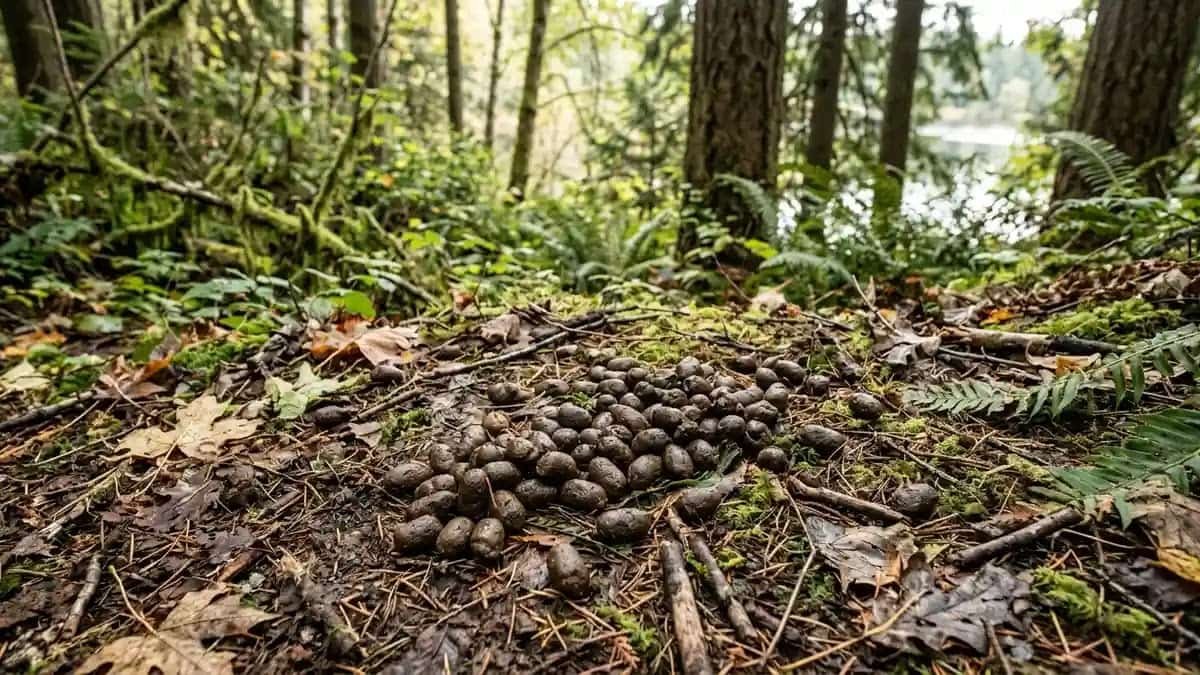
Deer poop usually appears as a cluster of dark, oval pellets with smooth surfaces and a pointed end. Rabbit droppings are generally rounder and show more plant fibres. Shape is a useful starting point, but check nearby tracks and feeding damage before deciding which animal visited.
Finding unfamiliar droppings beside a flower bed or woodland path can raise a simple question: was it a deer, a rabbit, or something else? This guide explains what to look for, how to use photographs and size clues, and how to inspect the area without handling animal waste.
What Does Deer Poop Look Like?
Look at the outline of several droppings, not just one damaged pellet. Typical deer scat consists of elongated pellets gathered together. Their dark colour and relatively smooth appearance can help distinguish them from the rounder, more visibly fibrous pellets associated with rabbits.
However, deer droppings do not always arrive as separate pellets. White-tailed deer can also leave joined or tubular material in which individual pellet shapes remain visible. A clump should therefore prompt a closer visual comparison rather than an immediate rejection of deer as the source.
Write down what you can actually see: separate pellets or a clump, elongated or rounded outlines, and whether most pieces share the same shape. “Small dark droppings” is much less useful than a clear description accompanied by a photograph.
Deer Poop Pictures: What to Compare

When comparing deer poop pictures with your own find, ask:
- Are the individual pieces elongated or nearly circular?
- Are several intact pellets visible?
- Does the photograph show the whole deposit as well as a close view?
- Is there a ruler or another reliable size reference?
- Was the example photographed in a region with the same possible wildlife?
For your own record, take one photograph directly above the droppings and another showing the surrounding ground. If practical, position a ruler nearby without touching the waste. Record the location and date so those details remain available when you ask someone to help identify it.
Do not rely on a close-up that hides scale and surroundings. Two photographs can look similar while representing differently sized deposits.
Deer Poop Size: How Useful Is It?
There is no single measurement that identifies every deer dropping. The animal involved and the condition of the deposit matter; wildlife identification guidance notes, for example, that elk droppings are larger than white-tailed deer droppings.
Treat size as supporting evidence. For a useful observation:
- Measure the length and width of a few intact pellets from your photograph.
- Record measurements in millimetres.
- Distinguish individual pellet size from the width of the whole pile.
- Compare your observations with a regional wildlife guide.
Avoid copying a measurement from an unscaled online image. If you cannot measure safely, record “size not measured” instead of guessing. A local wildlife specialist can work more effectively with an honest description than with an apparently precise but unreliable number.
Deer Poop vs Rabbit Poop
These typical differences help narrow down the possibilities. They are clues rather than a guaranteed identification key.
| Feature | Deer droppings | Rabbit droppings |
|---|---|---|
| Usual outline | Oval or elongated; an end may taper | More rounded |
| Typical surface | Relatively smooth | More visibly fibrous |
| Common colour | Dark brown to almost black | Often yellow-brown or greenish-brown |
| Form | Pellets, sometimes joined together | Usually separate rounded pellets |
| Useful next check | Tracks and browsing damage | Tracks and clipped vegetation |
For a closer look at the other possibility, see our rabbit poop identification guide.
Plant damage adds another clue. University of Minnesota Extension describes rabbit feeding damage as clean, angled cuts, while deer tend to leave ragged or torn edges. Inspect several nearby stems rather than relying on a single broken plant.
If the pellets and plant damage point in different directions, keep both possibilities open. More than one animal may be using the same garden.
Check the Surroundings Before Making a Decision
A photograph of a dropping captures only part of the evidence. Look around without disturbing the site and record:
- Tracks: Photograph any clear prints separately, including a scale if possible.
- Vegetation: Note clipped stems, torn leaves, or browsing higher above the ground.
- Location: Is the deposit beside a feeding area, a path, or a sheltered patch?
- Repeated observations: Have you seen the animal itself or recorded it on an existing wildlife camera?
Avoid inferring an animal’s sex, exact age, or health from a casual inspection of droppings. If you need a confident species identification, send photographs and location details to a local wildlife service.
For broader context, our guide to Norwegian animals and their role in nature explores how wildlife fits into its surrounding environment.
Can You Tell How Fresh Deer Droppings Are?
Appearance alone is not a dependable clock. Record visible qualities such as a glossy surface, dryness, or weathering, but do not turn them into an exact number of hours.
A more useful approach is to document repeat visits to the same area from a distance. If you know a patch was clear during an earlier observation, that provides a time window for a newly noticed deposit. Keep that observation separate from assumptions based on colour.
Likewise, a clumped dropping should not be used by itself to diagnose illness. Scat identification is affected by diet and form, and some deposits remain difficult to identify confidently.
Is Deer Poop Safe to Touch?
Avoid touching wildlife droppings with bare hands. Animals can carry germs even when they appear healthy. After contact with animal waste, contaminated equipment, or soiled footwear, wash your hands with soap and water, especially before eating.
For identification, observation and photographs are usually enough. If removal is necessary, use gloves and a tool rather than picking droppings up directly. Avoid activities that create dust around dried waste. Keep children and pets away while dealing with it.
In a vegetable garden, do not harvest produce visibly contaminated with animal faeces. University of Minnesota Extension identifies wildlife waste as a potential source of produce contamination.
What If Your Dog Eats Deer Poop?
Prevent further access and contact your veterinarian if your dog becomes unwell or repeatedly eats animal waste. Eating another animal’s faeces can expose a dog to health risks, and the behaviour does not automatically mean a nutritional deficiency. Supervision and a trained “leave it” cue can help prevent repeat incidents.
Frequently Asked Questions
Is deer scat the same thing as deer poop?
Yes. “Scat” is a term used for animal droppings. “Deer scat,” “deer droppings,” and “deer poop” refer to the same material.
Can deer droppings stick together?
Yes. White-tailed deer may leave joined or tubular droppings as well as separate pellets. Look for recognisable pellet shapes within the deposit.
Can I identify the animal from one picture?
Sometimes a clear photograph provides useful clues, but it may not support a confident identification. Include scale, the wider setting, nearby tracks, and your location when requesting help.
Are small round pellets definitely rabbit poop?
No. A rounded shape is a useful clue, but it should be assessed alongside texture, location, and other signs. See the comparison table before drawing a conclusion.
Can I tell whether a buck or doe left the droppings?
Do not make that judgement from pellet shape or pile size alone. Record the find as suspected deer droppings unless you have independent evidence identifying the animal.
Should I break droppings apart to inspect them?
No handling is needed for this guide. Photograph visible features and leave uncertain identifications open rather than disturbing waste. Wildlife inspection guidance advises precautions against contact and airborne dust.
What is the most useful next step after finding droppings?
Take clear photographs, record the location, and check for supporting signs. If you later watch for wildlife, follow our guide to responsible wildlife watching in Norway to plan an observation that respects the animals.
One thought on “Deer Poop Identification: Pictures, Size, and Rabbit Poop Comparison”