





Animals that mate for life, or form long-lasting pairs, include swans, albatrosses, sandhill cranes, bald eagles, wolves and beavers. However, a lasting bond does not always mean an animal has only one breeding partner throughout its life. This Viltnemnda guide explains the familiar examples, the surprising exceptions and what researchers mean by a pair bond.
Two birds returning to the same nest each spring make a memorable sight. Yet one season tells us little about their whole lives. Some pairs stay together for decades. Others reunite for several breeding seasons, separate after an unsuccessful year or find a new partner after a death.
The real story is more interesting than a simple list of loyal animals. It involves shared parenting, familiar territories, careful timing and the challenge of raising young in the wild.
What Does “Mate for Life” Really Mean?
In everyday language, mating for life suggests that two animals choose each other once and never separate. Scientists need more precise terms because living together, raising young together and breeding exclusively with each other are different things.
Social monogamy means a male and female form a pair. They may share a territory, maintain a nest or care for young together. However, one or both may sometimes breed outside that pair.
Genetic monogamy means the offspring come from the paired partners rather than from outside partners. Researchers use parentage evidence to investigate this. Observing two animals at a nest cannot establish genetic monogamy on its own.
Seasonal monogamy describes a pairing that lasts for a breeding season. The same two animals may reunite next year, but they may not.
Finally, a long-term pair bond can continue across many seasons, sometimes until one animal dies. This is usually the most useful meaning when discussing animals that mate for life.
Animals That Form Lasting Pairs: Quick List
The species below provide examples of lasting partnerships. The table describes typical patterns, not a promise about every individual.
| Animal | Typical partnership | Detail worth remembering |
|---|---|---|
| Mute swan | Long-lasting breeding pair | A strong bond does not make every pairing permanent |
| Laysan albatross | Pair bond across many breeding seasons | Courtship displays help establish the partnership |
| Bald eagle | Often a lifelong breeding pair | A surviving bird can accept a new mate |
| Sandhill crane | Long-term pair, sometimes lasting decades | Partners usually remain together throughout the year |
| Black vulture | Multi-year, year-round pair bond | Family relationships continue beyond the nesting period |
| Atlantic puffin | Repeated breeding partnership | Often returns to the same burrow and mate |
| Snow goose | Pair bond that can last for life | A pair may remain together within a much larger flock |
| Gray wolf | Breeding partnership within a family pack | Lifelong bonds occur, but pack structure can vary |
| Coyote | Strong, long-term pair bond | Field research has documented pairs staying together until death |
| North American beaver | Established breeding pair | A surviving animal may form a new partnership |
Birds That Mate for Life or Form Long-Term Bonds
1. Mute Swans
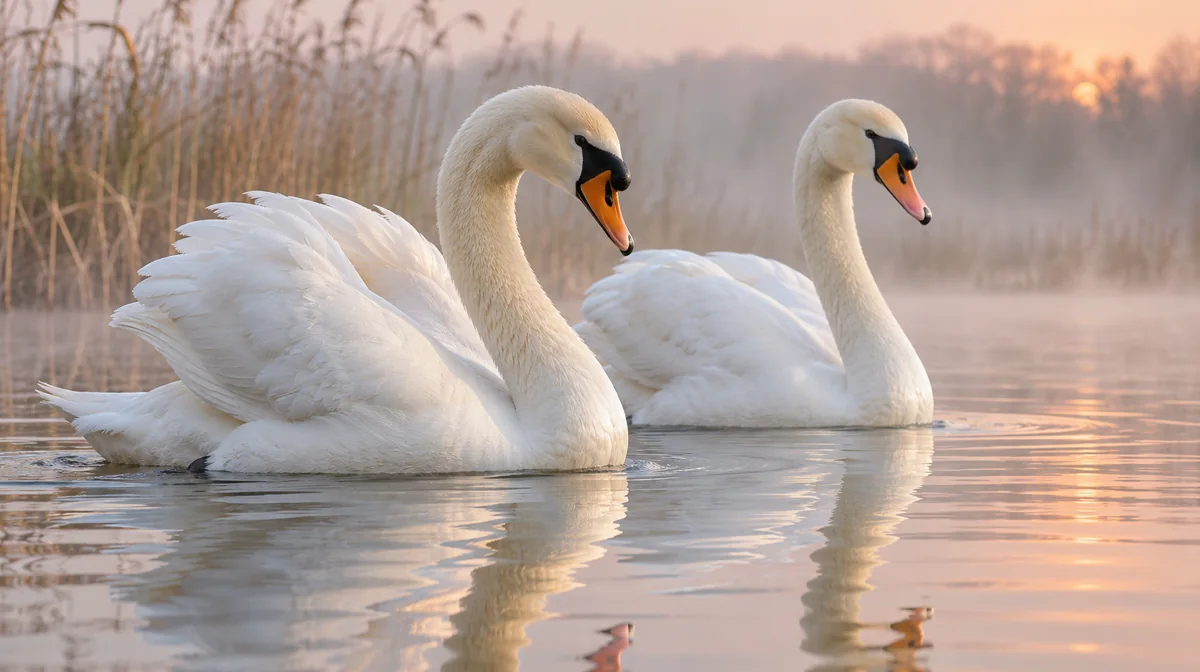
Mute swans are among the best-known examples of birds that mate for life. Their orange bills, white feathers and curved necks have made them a familiar symbol of lasting love.
In nature, the useful fact is that they form long-lasting breeding pairs. Partners defend a breeding area, and their behaviour around a nest can be forceful rather than gentle.
Still, a familiar symbol should not become an absolute rule. A long-term bond is a typical pattern, not proof that every swan keeps the same mate forever. Other swan species also form durable pairs, but individual birds can change partners.
If you watch swans near a nest, give them plenty of space. Approaching for a photograph can interrupt their behaviour and provoke territorial defence.
2. Laysan Albatrosses
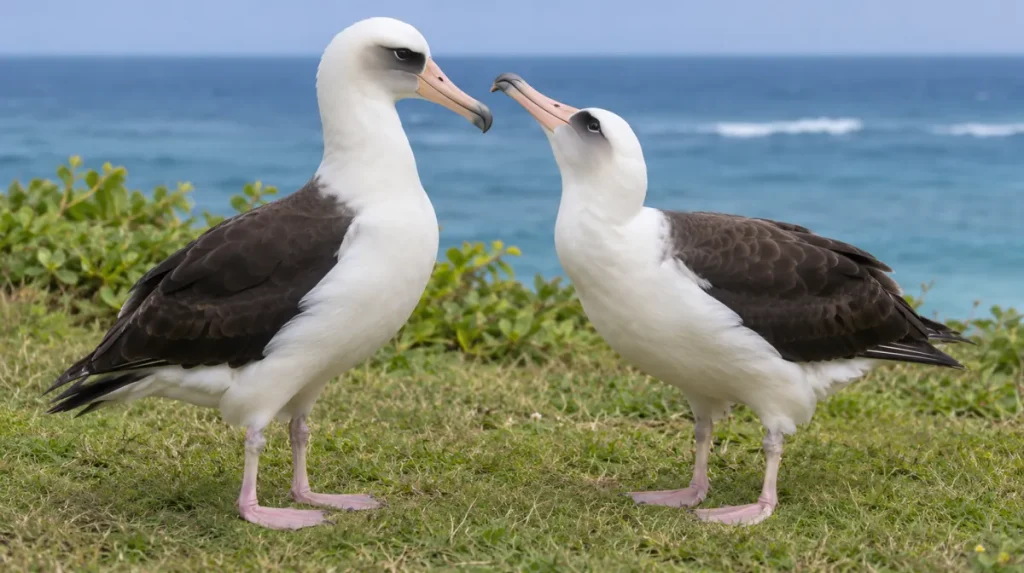
Laysan albatrosses form lasting pair bonds and perform elaborate courtship displays. Birds move their heads, touch bills and use coordinated poses while establishing a partnership.
Their life together centres on breeding, rather than staying side by side every day. Albatrosses travel widely at sea and return to breeding colonies.
A familiar partner and a shared nesting place can be important parts of this demanding cycle. However, even a durable social partnership does not prove complete genetic exclusivity.
Smithsonian’s explanation of pair bonds in ocean animals describes why these relationships deserve more careful wording than a simple romantic label.
3. Bald Eagles
Bald eagles often form partnerships that last for life. The pair may use a nest over several years, adding material as it grows.
Both birds contribute to nest building, although their work is not always equal. Their breeding partnership involves more than the dramatic aerial displays that attract attention in wildlife videos.
There is also a clear answer to a common question: what happens if an eagle’s mate dies? The surviving bird can accept a new partner.
That does not cancel the earlier bond. In wildlife descriptions, “mates for life” often means the partnership lasts while both partners survive, rather than that the survivor remains alone forever.
4. Sandhill Cranes
Sandhill cranes are striking examples of long-term partners. Their bonds can last for two decades or more, and mates usually stay together year-round.
They are also famous for dancing. A crane may bow, spread its wings and leap into the air. These displays make their social lives especially memorable to watch.
The family connection extends to the young. Juveniles can remain close to their parents for many months after hatching.
However, a flock is not one large breeding group. Several pairs and their families may gather in the same place. Seeing birds together does not tell you which individuals are mates.
5. Black Vultures
Black vultures rarely appear on greeting cards, but their family bonds deserve attention. These birds can remain with the same mate for many years and stay paired throughout the year.
Their care for young continues well beyond the first flight. Adults may feed their offspring for months after fledging, and family members maintain strong social ties.
This makes black vultures a useful reminder that lasting partnerships are not limited to birds people find conventionally beautiful.
A pair bond is a feature of an animal’s social and breeding life. It has nothing to do with whether humans find its appearance elegant or its feeding habits appealing.
6. Atlantic Puffins
Atlantic puffins often return to the same breeding burrow with the same partner in later years. Paired birds rub their bills together in a behaviour known as billing.
Their partnership is closely tied to the breeding colony. Outside the breeding season, puffins spend much of their time at sea, so a lasting bond does not mean constant physical closeness.
For this species, “often reunites with the same mate” is more accurate than claiming that every bird has one partner without exception.
Our Atlantic puffin guide explains their nesting, chicks and life offshore. Those details help put the breeding partnership into the context of the bird’s full year.
7. Snow Geese
Snow geese form pair bonds that can last for their entire lives. Unlike an isolated pair on a small pond, they may spend time among large numbers of other geese.
Their example shows that a lasting partnership can exist within a flock. Being socially surrounded by other animals does not prevent two individuals from keeping a particular bond.
It also highlights a common mistake in wildlife watching: assuming that the two nearest birds must be partners. Researchers need individual identification and repeated observations to establish those relationships.
A photograph can show two geese together. It cannot, by itself, reveal how long they have been paired.
Mammals That Form Lasting Partnerships
8. Gray Wolves
Gray wolves can establish lifelong mates. A typical wild pack is a family built around breeding parents and their offspring, sometimes with other members.
The National Park Service describes this family structure while also noting that variations occur. In some larger packs, more than one female may breed.
Raising pups is not always a task for just two adults. Other pack members can help feed and care for the young.
Therefore, the answer to “Do wolves mate for life?” is that they can, and lasting breeding pairs are important in wolf society. However, every pack does not follow an identical family arrangement throughout its existence.
9. Coyotes
Coyotes provide a particularly interesting example because researchers have followed identified pairs over many years.
The Urban Coyote Research Project reported that a Chicago-area pair, known as Coyote 1 and Coyote 115, produced pups for 10 consecutive years. Their partnership ended when Coyote 1 died.
The project uses tracking and genetic information to investigate these relationships. This is stronger evidence than simply seeing two coyotes travelling together.
Even so, observations from one study should not turn into a claim that every coyote everywhere behaves identically. The supported conclusion is that coyotes can form very strong, long-lasting breeding partnerships.
10. North American Beavers
North American beavers form breeding pairs, and their family life is closely connected to their territory and shelter.
One useful detail often disappears from short animal lists: if a mate dies, the surviving beaver may find another partner. A new relationship can follow a long-established one.
This makes beavers another good example of why lifelong pairing does not mean permanent solitude after a loss.
Their young are called kits. Other species use different names, such as cygnets for young swans and pups for young wolves. Our baby animal names guide explains those terms without confusing age groups with separate species.
Do Penguins Mate for Life?
Some penguins reunite with the same partner over several breeding seasons, but penguins as a whole do not follow one lifelong-pairing rule.
Species differ, and individual birds can change partners. Penguins International describes how returning to a breeding site at different times and previous breeding outcomes can affect whether a pair stays together.
This matters because raising a chick requires coordination. One bird may need to remain with the egg or chick while the other finds food. A partner’s return time can have practical consequences.
The useful question is therefore not only “Do penguins mate for life?” It is “Which penguin species, and over how many observed breeding seasons?”
A short video of two penguins greeting each other cannot answer that question. It captures a moment, not their complete breeding histories.
Common Myths About Monogamous Animals
Every pair stays together forever
A species may commonly form lasting pairs while still having individuals that separate. The typical pattern and the exceptions both belong in an accurate account.
A pair bond proves exclusive breeding
Two animals can share a territory or raise young together without being genetically exclusive. Parentage studies investigate a different question from observations of nesting behaviour.
All seahorses have one lifelong partner
Seahorse partnerships vary by species. Some form lasting bonds, while other pairings are shorter. The word “seahorse” covers many species and cannot support one universal answer.
All foxes mate for life
Fox behaviour also varies. Red foxes can form monogamous pairs, but other arrangements occur, including males breeding with more than one female. It is better to identify the species and population than repeat a blanket claim.
A surviving partner must remain alone
Bald eagles and beavers illustrate why this is incorrect. A surviving animal can form another pair after losing its previous mate.
Why Do Some Animals Stay With One Partner?
Lasting partnerships can help animals meet the demands of breeding. However, there is no single explanation that fits every species.
In many birds, two parents can share work such as protecting a nest, incubating eggs or bringing food. A familiar partner may help them coordinate these tasks.
Finding a new mate can also take time. Courtship, competition and establishing a breeding site may all require effort. Keeping a successful partnership can avoid repeating part of that process.
Territory and the distribution of potential mates matter too. For some mammals, the spacing of animals across a landscape helps shape whether pair living is practical.
These are biological explanations, not judgments about loyalty. An animal that changes partners is not behaving badly. Its behaviour reflects the conditions and breeding opportunities it faces.
What Happens When a Mate Dies or Leaves?
The outcome depends on the species, the surviving animal and the availability of another partner.
Some animals form a new pair. Others may remain without a mate for a time. Losing a partner during nesting can also create a different problem from losing one outside the breeding season.
There is no reliable universal waiting period. Statements such as “all swans stay alone for a year” need evidence for the particular species and circumstances.
Researchers sometimes use “divorce” when both former partners survive but breed with different individuals. This describes a change in pairing; it does not tell us that the animals experience separation exactly as humans do.
Likewise, calling a bird heartbroken may express how a scene feels to us. It should not replace an explanation of what someone actually observed.
How Do Scientists Know a Pair Lasts for Life?
Long-term evidence is essential. Researchers may identify animals through bands, tags, natural markings or tracking devices, then record their partners across breeding seasons.
Repeated observations can reveal whether the same adults return to a nest, share a territory or raise offspring together. Genetic samples can help establish parentage.
Each method answers a different question. Tracking shows movements; observations reveal behaviour; genetic evidence helps identify biological parents.
Even a ten-year study does not necessarily cover an animal’s whole life. That is why phrases such as “paired for at least ten years” can be more informative than an unsupported claim of lifelong exclusivity.
When reading an animal fact, look for the species, the type of bond and the period researchers observed.
Frequently Asked Questions
Which animals mate for life?
Examples of animals that can form lifelong or very long-lasting pairs include swans, albatrosses, bald eagles, sandhill cranes, wolves, coyotes and beavers. Individual exceptions and replacement partners can occur.
Do swans find another mate if their partner dies?
They can. A reputation for lifelong pairing does not mean a surviving swan must remain alone. Outcomes depend on the species and individual circumstances.
Do wolves have only one mate?
Wolves can form lasting breeding pairs, but their social arrangements vary. Some larger packs have more than one breeding female, so “every wolf has exactly one mate for life” is too absolute.
Do eagles mate for life?
Bald eagles often do. However, a surviving bird can accept a new partner if its mate dies. It is also important to name the eagle species rather than assume every species behaves identically.
Are penguins monogamous?
Many penguins form pairs during breeding, and some reunite across multiple seasons. This does not mean every penguin keeps the same partner for its entire life.
What is the difference between monogamy and mating for life?
Monogamy can describe a pairing within a particular period, including one breeding season. Mating for life implies a bond continuing across years, potentially until one partner dies.
Which animal is the most loyal?
There is no scientific ranking of loyalty across all animals. Researchers can compare pair duration, partner changes or parentage, but those measures do not create a universal loyalty score.
Lasting Bonds Are More Interesting Than a Simple Label
A crane pair staying together for decades and puffins returning to the same burrow show different forms of lasting partnership. Coyotes, wolves and beavers add examples from mammal family life.
The most useful answer is not that every animal on a list follows the same rule. It is that some species maintain strong bonds, and those bonds have patterns, benefits and exceptions worth understanding.
Explore our wildlife guides for more explanations of animal behaviour, family life and natural habitats.