







A toucan’s beak usually gets your attention first. It looks almost too large for the bird carrying it. Yet that striking bill is more than a colorful feature: it helps the bird reach food and, in the toco toucan, release body heat.
Toucans are birds native to tropical parts of the Americas. They eat mainly fruit, although their diet can also include insects and other animal food. Different species live in different habitats, so one description does not fit every toucan.
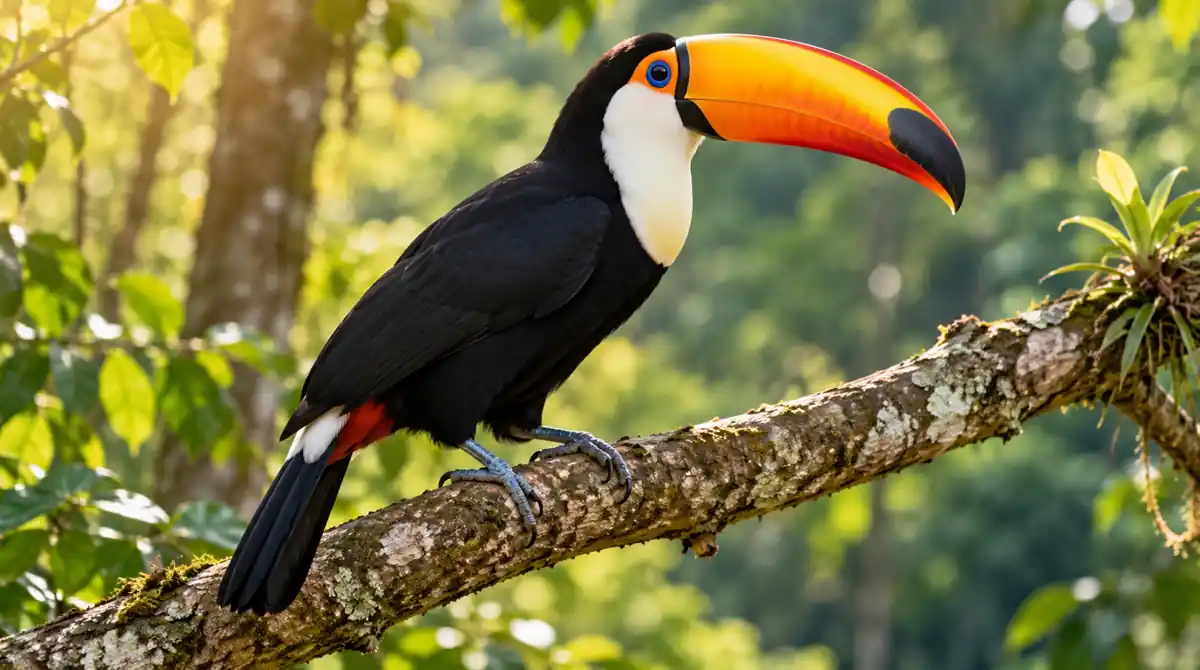
That distinction matters. The familiar bird with a black body, white throat and large orange bill is a toco toucan. It is one member of a much wider family.
What Is a Toucan?
Toucans belong to the bird family Ramphastidae, which also includes toucanets and aracaris. They are not parrots, even though both groups include colorful birds that live among trees.
When reading toucan facts, check whether the information describes the whole family or a particular species. Details such as size, location and appearance can change considerably.
The toco toucan’s scientific name is Ramphastos toco. It is the largest toucan species and one of the easiest to recognize.
How to Recognize a Toco Toucan
Look for these features together:
- A mostly black body.
- A clear white throat.
- A large orange-yellow bill with a dark tip.
- Bright skin around the eye.
An adult toco toucan is roughly 60–66 centimeters long. That measurement includes the bill and tail; it does not mean the bird has a body that long.
Young birds have smaller bills and duller colors. A juvenile may therefore look less dramatic than the adult shown in a wildlife photograph.
Identification works best when you combine appearance with location. A colorful bill alone is not enough to identify every member of the toucan family.
Where Do Toucans Live?
Toucans are native to Central and South America. Many are associated with tropical forests, where trees provide food, shelter and nesting places.
However, not all toucans live deep inside a rainforest.
Toco toucans also use relatively open habitats, including woodland, savanna and areas with scattered trees. Their range includes parts of Brazil, Bolivia, Paraguay and Argentina.
This explains why photographs of wild toucans can show very different settings. A bird in open woodland is not necessarily outside its natural habitat.
For a useful habitat description, ask two questions: which species is it, and where was it seen?
What Do Toucans Eat?
Fruit forms a large part of a toucan’s diet. But calling these birds strict fruit eaters would leave out an important part of their feeding habits.
Depending on the species and available food, toucans may also eat insects, eggs and small animals. Toco toucans are known to take eggs and nestlings from other birds.
| Food | Place in the diet |
|---|---|
| Fruit | A major food source |
| Insects | Part of a varied diet |
| Eggs and nestlings | Taken opportunistically by some toucans |
| Other small animals | Varies with species and opportunity |
A description of wild feeding is not a pet-feeding plan. Finding an item on this list does not mean it should be offered to a captive bird.
How Their Feeding Helps Forests
Toucans can move seeds away from the trees where they ate fruit. Seeds that pass through their digestive system may be deposited elsewhere.
That makes their feeding habits relevant to the wider forest, not just to the birds themselves. For more examples of how animals interact with their surroundings, explore the wildlife articles on Viltnemnda.
Why Is a Toucan’s Beak So Big?
The large bill helps a toucan reach fruit without moving its entire body onto a narrow branch.
Its appearance can be misleading. A toucan’s bill is not a solid, heavy block. It has a lightweight internal structure supported by thin bony elements, with an outer covering of keratin—the material also found in human fingernails.
The bill also has a role in temperature control. Research on toco toucans shows that they can adjust blood flow to the bill, allowing heat to escape.
These are different functions: reaching food and releasing heat. Neither requires the bill to be a heavy weapon.
For additional background on toucan anatomy and feeding, see the San Diego Zoo’s toucan guide.
Can Toucans Fly?
Yes, toucans can fly. Their large bills do not make them flightless.
Toco toucans also spend time hopping between branches. Watching a bird move around a tree may therefore show plenty of hopping before it takes flight.
It helps to separate two questions: whether an animal can fly, and how it chooses to move during a particular activity. A bird searching nearby branches for food does not need to fly every time it changes position.
Are Toucans Nocturnal?
Toucans are generally active during the day and rest at night.
Morning feeding is part of their daily routine. At a resting place, a toucan can fold its body into a surprisingly compact position, turning its bill backward and bringing its tail up.
If you are comparing daytime and nighttime wildlife, our guide to nocturnal animals and their habits explains the difference.
How Do Toucans Nest and Raise Their Young?
Toucans nest in cavities rather than building the open cup-shaped nests many people picture when thinking about birds.
For toco toucans, a typical clutch contains two to four eggs. Both parents help incubate them. France’s national natural history museum gives an incubation range of around 16–20 days for this species.
A baby toucan does not hatch with an adult-sized bill. The bill develops as the bird grows.
What Is a Baby Toucan Called?
A baby toucan is called a chick. “Nestling” describes a young bird still in the nest, while “fledgling” describes a later stage when it leaves the nest and begins developing its independence.
These words describe life stages, not separate species. Our baby animal names guide covers more names for young animals.
How Long Do Toucans Live?
There is no single lifespan that applies equally to every toucan.
The French national natural history museum lists a lifespan of up to 20 years for the toco toucan. Treat “up to” as a possible upper figure, not a promise that every bird will reach that age.
Species and living conditions matter. When comparing lifespan estimates, check whether the source is discussing a particular species, birds in expert care, or birds in the wild.
How to Watch Toucans Responsibly
If you have a chance to observe toucans, give them space to continue their normal activity.
Use binoculars or a camera’s zoom rather than moving closer to a feeding bird. Avoid placing food on a branch to arrange a photograph, and keep away from occupied nesting cavities.
For a useful sighting record, note:
- The location and habitat.
- The bird’s bill and throat colors.
- Whether it was feeding, resting or moving.
- Whether other birds were nearby.
These details make the observation more informative than a photograph alone. A clear record also helps distinguish what you actually saw from what you assumed.
Frequently Asked Questions
Is a toucan a parrot?
No. Toucans and parrots belong to different bird groups. Bright colors and life in trees do not make them the same type of bird.
Do toucans only eat fruit?
No. Fruit is important, but toucans can also eat animal food. The exact diet depends on the species and what is available.
Do all toucans have orange beaks?
No. The orange-yellow bill is a familiar feature of the toco toucan. Other members of the family have different colors and patterns.
Is a toucan’s beak heavy?
It is lighter than its size suggests. Its internal structure provides support without making it a solid mass.
Do toucans live only in rainforests?
No. Toco toucans also live in woodland, savanna and other relatively open areas with trees.
Are baby toucans born with huge beaks?
No. Young toucans have smaller bills that grow as they develop.