





A garden can look empty in daylight and become busy after sunset. Hedgehogs search beneath leaves, foxes follow quiet paths, and bats fly out to feed. These animals use hours that many people spend indoors, which is why their activity often goes unnoticed.
Nocturnal animals are animals that are mainly active at night. They use the darkness to find food, travel, search for mates, or care for their young. Many rest in sheltered places during the day, although their daily schedules are not always fixed.
This Viltnemnda guide includes a nocturnal animals list, explains how nighttime adaptations work, and answers common questions about cats, rabbits, foxes, raccoons, bears, and possums.
Nocturnal Animals Meaning: What Does the Word Describe?
Nocturnal describes an animal’s usual activity pattern. It tells you when the animal is most active, rather than what it eats, how large it grows, or where it lives.
For example, a nocturnal predator may hunt after dark. Another night-active animal may search for fruit, insects, or leaves. Both can be nocturnal even though their diets and ways of finding food are different.
The word mainly matters. A nocturnal animal does not have to remain asleep throughout every daylight hour. Food availability, weather, disturbance, and caring for young can affect when an individual moves around.
Likewise, seeing an animal once at night does not prove that its species is nocturnal. A useful description looks at its usual behaviour across many observations.
What Are 10 Nocturnal Animals?
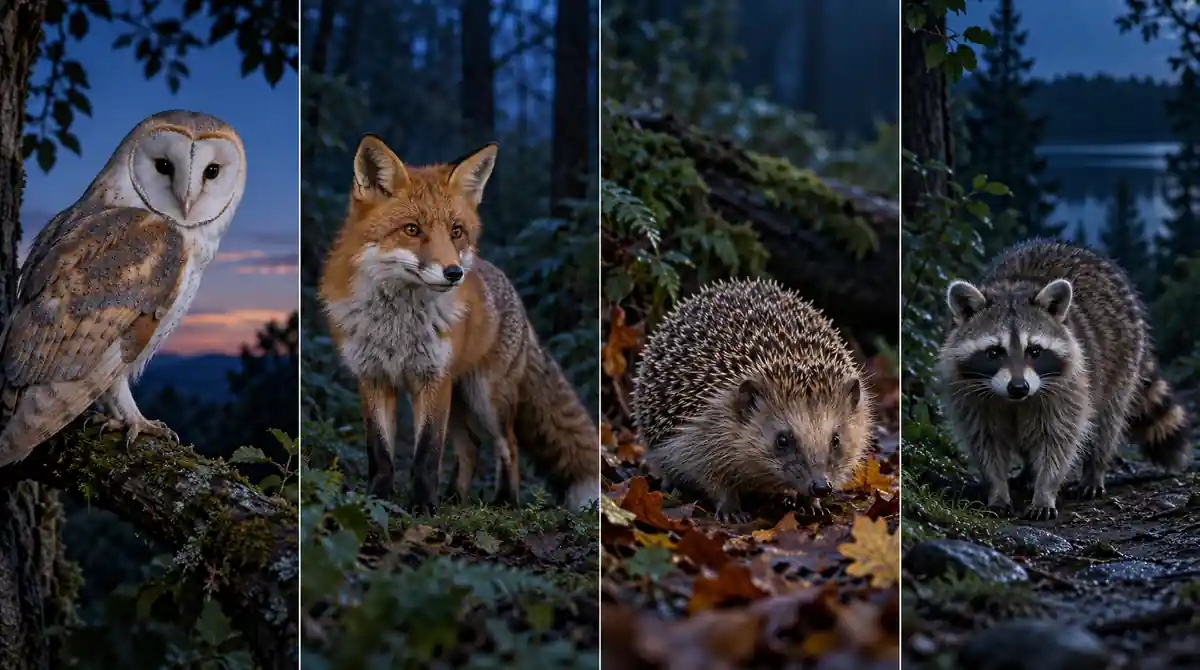
Ten examples are American barn owls, many bats, European hedgehogs, red foxes, fennec foxes, raccoons, Eurasian badgers, skunks, Virginia opossums, and common brushtail possums.
Some of these animals are also active around dawn and dusk. The table explains that overlap instead of suggesting that every species follows the same timetable.
| Animal | Typical activity | What to know |
|---|---|---|
| American barn owl | Mainly nocturnal | Hunts over open ground after dark |
| Many bat species | Mainly nocturnal | Feeding methods differ between species |
| European hedgehog | Mainly nocturnal | Searches for food at ground level |
| Red fox | Nocturnal and crepuscular | Often active at night and around twilight |
| Fennec fox | Mainly nocturnal | Shelters from daytime desert heat |
| Raccoon | Mainly nocturnal | Usually forages after dark |
| Eurasian badger | Nocturnal, with twilight activity | Activity can peak around dusk and dawn |
| Skunks | Generally nocturnal | Search for a range of foods |
| Virginia opossum | Mainly nocturnal | A North American marsupial |
| Common brushtail possum | Nocturnal | An Australian marsupial that shelters during daylight |
This list of nocturnal animals includes species from different regions. They are not all animals you would expect to find in the same garden, country, or habitat.
Nocturnal Animal Examples Explained
American Barn Owl
The American barn owl usually rests in a concealed place during daylight and hunts at night. Open fields and meadows provide hunting areas where it can search for small prey.
However, owls do not all share one activity pattern. Burrowing owls can hunt during the day. It is therefore more accurate to name a particular owl species than to assume that every owl is strictly nocturnal.
Bats
Many bats leave their roosts around evening and feed during the night. Some catch insects, while others eat fruit or drink nectar. Their feeding habits depend on the species.
Many insect-eating bats use echolocation: they produce sounds and interpret the returning echoes. This helps them detect objects and prey while flying. Bats also have vision, so using echolocation does not mean they are blind.
European Hedgehog
European hedgehogs are mainly active at night. They search close to the ground for food such as beetles, earthworms, and other small creatures.
Their sense of smell and hearing help them investigate vegetation and leaf litter. You might hear movement before seeing the animal itself. However, rustling alone is not enough to identify a hedgehog, because other visitors can make similar sounds.
Red Fox
Red foxes can be nocturnal or crepuscular, meaning active at night or around twilight. They travel between feeding areas, resting places, and dens.
A fox seen during daylight does not automatically contradict that pattern. The animal may be moving between locations or responding to an immediate need. Record the sighting as it happened rather than treating one observation as the complete daily routine of the species.
Fennec Fox
The fennec fox spends much of the day sheltered in a burrow and emerges around dusk to search for food. This schedule helps it avoid the intense heat of its desert environment.
Its large ears help with hearing and heat loss. Nighttime activity is therefore part of a wider set of adaptations, alongside shelter and physical features. It is not simply a preference for darkness.
Raccoon
Raccoons are mainly nocturnal. They often search for food after sunset, which helps explain why people may notice evidence of a visit before seeing the animal.
Still, a disturbed bin or a noise outside does not confirm that a raccoon was responsible. Identification should come from a clear view, useful camera footage, or several matching signs—not the time of the disturbance alone.
Eurasian Badger
Eurasian badgers are nocturnal, with activity that can peak around dusk and dawn. Their behaviour shows why nighttime and twilight categories sometimes overlap.
A brief evening visit may not reveal whether badgers use an area. Quiet observation over time is more informative. Avoid approaching or disturbing their shelter to make an animal appear.
Skunks
Skunks are generally nocturnal and eat a variety of foods. They may spend nighttime hours moving through suitable habitat and searching near the ground.
If you see a skunk, allow it space to continue. You can record its appearance and direction of travel without approaching closely. A useful wildlife observation does not require a close-up photograph.
Virginia Opossum
The Virginia opossum is a mainly nocturnal marsupial found in North America. People often shorten its name to “possum,” especially in informal conversation.
That common wording can create confusion because Australian possums are different animals. When reading about behaviour or identifying a visitor, check which animal the source means.
Common Brushtail Possum
The common brushtail possum is nocturnal. During the day, it shelters in places such as tree hollows and other dark spaces.
It is an Australian marsupial, not another name for the Virginia opossum. Both belong in a discussion of night-active animals, but they should have separate entries because their identities and habitats differ.
Nocturnal vs Diurnal vs Crepuscular Animals
These terms describe when animals are usually active. Understanding the difference helps answer many questions about pets and wildlife.
| Term | Meaning | Useful example |
|---|---|---|
| Nocturnal | Mainly active at night | American barn owl |
| Diurnal | Mainly active during daylight | Many daytime birds |
| Crepuscular | Most active around dawn and dusk | Domestic rabbits |
| Cathemeral | Activity occurs during both day and night | A pattern that depends on the species and circumstances |
Crepuscular is the term most often confused with nocturnal. Dawn and dusk are transition periods, with lower light than midday but different conditions from the middle of the night.
An animal can also show a flexible pattern. These words describe tendencies, not a rule that prevents movement at other times.
Are Cats Nocturnal Animals?
Domestic cats are generally described as crepuscular, with activity peaks around dawn and dusk. They can also be active during other parts of the day or night.
This explains why an energetic cat in the early morning is not necessarily following a strictly nocturnal schedule. Twilight activity and nighttime activity can look similar when a person is trying to sleep.
For a wildlife reference, avoid listing every cat as nocturnal. Domestic cats and different wild cat species do not all follow the same routine. Name the species and describe its usual pattern.
Are Bunnies Nocturnal Animals?
Pet rabbits are generally crepuscular, meaning they are most active around dawn and dusk. They may also move, feed, and explore during the night, so crepuscular does not mean completely inactive after dark.
“Bunny” is an informal word for a rabbit. It does not identify a different animal with a separate activity pattern.
For a simple answer, describe rabbits as mainly active around twilight rather than saying they sleep all day and stay awake all night. The RSPCA describes this dawn-and-dusk pattern in its rabbit guidance.
Are Foxes Nocturnal Animals?
Many foxes are active at night, but the answer depends on the species. Red foxes show nocturnal and crepuscular activity, while fennec foxes are mainly nocturnal.
The setting also matters when interpreting a sighting. A fox crossing a garden in the afternoon tells you when that particular visit happened. It does not establish that all foxes in the area follow a daytime schedule.
For a clear description, “red foxes are often active at night and around twilight” captures the usual pattern without making it absolute.
Are Raccoons Nocturnal Animals?
Yes. Raccoons are mainly nocturnal, and much of their foraging takes place at night.
However, nocturnal is not the same as “never seen during the day.” A daylight sighting alone is not enough to determine the animal’s condition or explain why it is active.
Keep observations factual. Note what the animal is doing, where it is moving, and whether you can identify it clearly. Avoid drawing conclusions from the clock alone.
Are Bears Nocturnal Animals?
Bears do not have one universal activity schedule. Their behaviour varies with species, location, food, season, and human activity.
For example, the US National Park Service describes American black bears as active during daylight in natural habitats, with more nighttime activity possible in places with substantial human presence. Katmai’s brown bears are mostly active during the day, although they can also be active at night.
This makes “all bears are nocturnal” an inaccurate statement. A better answer identifies the bear species and the population being discussed.
Bears are also a good example of why an animal should not be added to a nocturnal animals list solely because a photograph shows it after dark.
Are Possums Nocturnal Animals?
Yes, familiar examples such as the common brushtail possum are nocturnal. The Virginia opossum, often casually called a possum in North America, is also mainly nocturnal.
However, possum and opossum are not interchangeable names for the same animal worldwide. Australian possums and American opossums belong to different groups.
If you are researching an animal visiting your garden, start with location. Then compare the animal’s appearance and local species information. The name used in a general online question may not identify the animal found in your region.
Why Are Some Animals Active at Night?
Different species gain different advantages from nighttime activity. There is no single explanation that fits every nocturnal animal.
Escaping Daytime Heat
In hot environments, nighttime can provide cooler conditions for movement and feeding. The fennec fox is a useful example because it combines daytime shelter with activity beginning around dusk.
Its burrow and physical adaptations also matter. Nighttime behaviour works alongside these features rather than solving every challenge of desert life on its own.
Finding Food
Animals may be active when their food is available. A night-hunting predator can search for prey that is also moving after dark.
Other nocturnal animals forage rather than hunt. The darkness can contain many feeding opportunities, from small creatures among fallen leaves to fruit available in trees.
Reducing Some Encounters
Activity after dark can reduce encounters with certain daytime predators or with people. However, night is not free from danger.
Nocturnal predators share that period with potential prey. The benefit depends on the species and its surroundings, rather than darkness being automatically safe.
Nocturnal Animal Adaptations
Animals active at night use different combinations of sight, hearing, smell, and other senses. They do not all have the same equipment.
Vision in Low Light
Some animals have eyes suited to collecting and using limited light. Features such as large pupils and light-sensitive retinal cells can help them function when conditions are too dim for people to see clearly.
However, low-light vision still needs light. It does not allow an eye to form an image in complete darkness.
Sensitive Hearing
Sound can reveal movement that is difficult to see. Fennec foxes use sensitive hearing to help locate prey, while owls also rely on hearing during hunting.
Not every nocturnal animal needs large visible ears. The importance and structure of hearing vary between species.
A Strong Sense of Smell
Smell can help an animal locate food or investigate its surroundings without a clear view. Hedgehogs are a familiar example of animals that use scent while searching near the ground.
For these animals, the environment contains information that a person watching from a distance cannot easily detect.
Echolocation
Many bats emit sounds and interpret the returning echoes. These echoes provide information about nearby objects and prey.
Echolocation is not another word for night vision. It uses sound. Nor does every nocturnal animal use it; it is one of several ways animals function after dark.
What Do Nocturnal Animals Eat?
Nocturnal describes timing, not diet. Some nocturnal animals eat other animals, while others eat plant material or a mixture of foods.
American barn owls hunt prey. Hedgehogs search for small ground-dwelling creatures. Different bats feed on insects, fruit, or nectar, depending on the species.
This variety is why “nocturnal animals are carnivores” is incorrect. To understand an animal’s food, look up its species rather than using its activity period as a shortcut.
Where Do Nocturnal Animals Go During the Day?
Many rest in sheltered places, but the type of shelter varies. Fennec foxes use burrows. Bats may roost in trees, caves, or suitable structures. Brushtail possums often use dark spaces such as tree hollows.
Shelter can protect an animal from disturbance, weather, or predators. A place that looks unused during a quick visit may still be an important resting site.
Avoid opening a hollow, entering a den, or disturbing a roost to check for wildlife. Let the animal choose when to emerge.
How Artificial Light Affects Nighttime Wildlife
Natural darkness is part of the habitat for many animals. Artificial lighting can alter feeding, movement, and other behaviour.
The effects vary between species. Lighting that makes a path easier for people to see can also change the conditions experienced by animals nearby.
The US National Park Service’s explanation of why animals need darkness describes how artificial light can affect wildlife. Around a home, reducing unnecessary lighting and directing needed light toward the intended area can help preserve darker spaces.
How to Observe Nocturnal Animals Responsibly
Choose a safe observation point and allow time for wildlife to appear. A quiet view from a window may reveal more than repeatedly walking around a garden.
Record the approximate time, location, and behaviour. Keep confirmed sightings separate from guesses. “An unidentified small mammal beside the hedge” is a useful note when the view is unclear.
Tracks can offer another clue. Our deer tracks identification guide explains how to compare footprints and surrounding evidence. Remember that finding a track in the morning does not prove it was made overnight.
If a young animal appears, our baby animal names guide explains terms such as fox kit and owlet. Use these labels only when the species and life stage are reasonably clear.
Keep your distance, leave escape routes open, and avoid attracting wildlife with food. Do not shine bright lights directly at an animal or disturb its shelter for a photograph.
Frequently Asked Questions
What Are Some Nocturnal Animals?
Examples include American barn owls, many bats, European hedgehogs, fennec foxes, raccoons, skunks, Virginia opossums, and common brushtail possums. Red foxes and Eurasian badgers also show nighttime and twilight activity.
Do Nocturnal Animals Sleep All Day?
Many rest for much of the day, but they do not necessarily sleep through every daylight hour. Nocturnal describes their usual activity pattern rather than a fixed rule.
Are All Owls Nocturnal?
No. American barn owls are mainly nocturnal, while burrowing owls can hunt during daylight. The answer should be based on the owl species.
Can Nocturnal Animals See in Complete Darkness?
Vision requires light. Some animals see well in dim conditions, while others also use hearing, smell, touch, or echolocation to gather information.
Are Nocturnal Animals Blind During the Day?
Being nocturnal does not mean being blind in daylight. Activity pattern and visual ability are different traits, and both vary between species.
What Is the Difference Between Nocturnal and Diurnal Animals?
Nocturnal animals are mainly active at night. Diurnal animals are mainly active during the day. Crepuscular animals are most active around dawn and dusk.
Are Nocturnal Animals Always Predators?
No. Some hunt, but others eat fruit, nectar, leaves, or mixed diets. The term describes when an animal is active, not what it eats.
Can an Animal Be Active During Both Day and Night?
Yes. Some animals have flexible activity patterns, and circumstances can change when they move or feed. A single daytime or nighttime sighting is not enough to define the species’ usual schedule.


One thought on “Nocturnal Animals List: 10 Examples, Meaning and Nighttime Habits”