






There is nothing on Earth quite like the first time you see the night sky ignite with ribboned waves of emerald, violet, and crimson. The aurora borealis in Norway isn’t just a travel destination checklist item; it is a profound, bucket-list experience.
Norway’s unique combination of accessible Arctic infrastructure, dramatic coastal geography, and prime positioning under the auroral oval makes it arguably the best place on the planet to witness this celestial dance. In this comprehensive guide, we will break down the absolute best locations, optimal viewing times, photography secrets, and practical itineraries to help you successfully witness the northern lights in Norway.
Why Norway Is One of the Best Places to See the Northern Lights
What Are the Northern Lights?
The aurora borealis is a natural light display triggered by solar activity. Charged particles from the sun collide with Earth’s magnetic field and enter the atmosphere. When these particles smash into atmospheric gases, they release energy in the form of vibrant, glowing light.
Why the Aurora Is So Strong in Norway
Norway sits directly beneath the auroral oval—the ring around Earth’s magnetic poles where solar activity is most intensely focused. Thanks to the Gulf Stream, Norway’s coastal Arctic regions enjoy significantly milder winter temperatures than inland Siberia or northern Canada at the same latitude, making extended hours of night-sky viewing far more comfortable.
The Arctic Circle and Polar Night Explained
Crossing the arctic circle in norway (roughly $66^\circ 33’\text{ N}$) unlocks the phenomenon of the polar nights in norway. From late November to mid-January, the sun never rises above the horizon in the far north. This prolonged, deep twilight creates a massive window of darkness, drastically increasing your daily chances of catching an active display.
Why Northern Norway Offers the Best Viewing Conditions
Northern Norway boasts a fragmented coastline cut by deep fjords and flanked by towering peaks. This geography creates microclimates. If coastal clouds obscure the sky, a quick 30-minute drive inland toward the microclimates of the mountain valleys often reveals perfectly clear, starlit skies.
Best Time to See Northern Lights in Norway
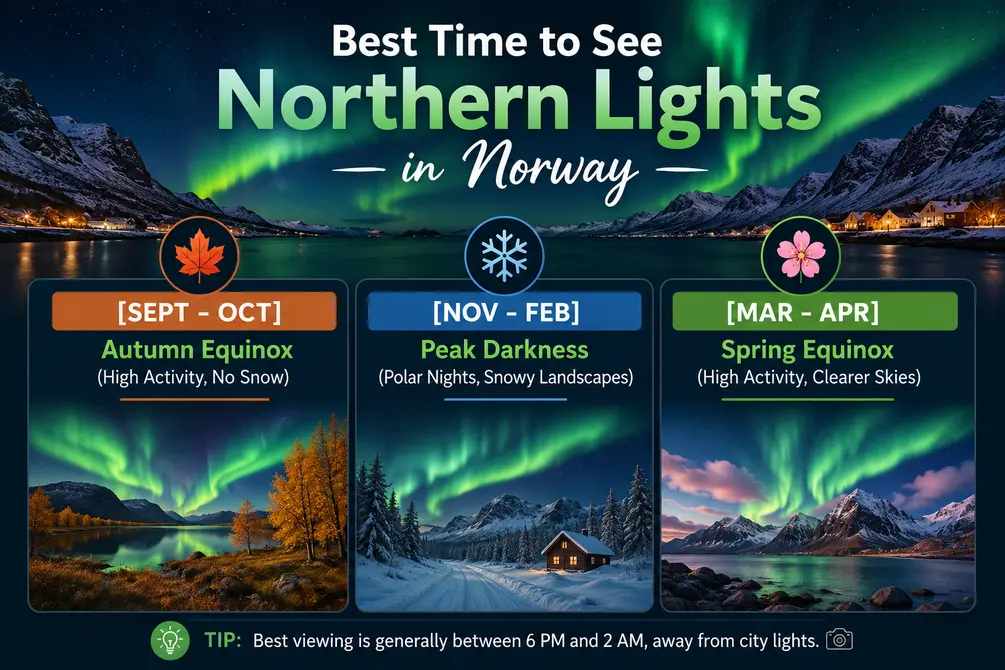
[SEPT - OCT]      --> Autumn Equinox (High Activity, No Snow)
[NOV - FEB]      --> Peak Darkness (Polar Nights, Snowy Landscapes)
[MAR - APR]      --> Spring Equinox (High Activity, Clearer Skies)
Northern Lights Season in Norway
The official aurora season norway runs from late September to early April. Outside of these months, the Arctic experiences the Midnight Sun or extended daylight, making the night sky too bright for the aurora to be visible.
Best Months for Aurora Viewing
- September & October: Great for travelers who want to avoid the freezing cold. The autumn equinox often triggers high geomagnetic activity, and open water reflects the green lights beautifully before the winter freeze.
- November, December, & January: Darkest months. Experiencing the northern lights norway december or northern lights norway january means capitalizing on the Polar Night. You can see the lights as early as 4:00 PM.
- February & March: Often considered the sweet spot. You get plenty of nighttime hours, but daytime brings stunning blue-hour light and plenty of snow for winter activities.
Best Time of Night to See the Northern Lights
While the aurora can appear anytime it is dark, peak viewing hours typically fall between 10:00 PM and 2:00 AM, when the sky is at its absolute darkest.
Weather and Cloud Conditions
Your biggest enemy isn’t solar activity—it’s cloud cover. Even a massive solar storm won’t be visible through a thick layer of clouds. Always prioritize regions with a reputation for clear microclimates, or be prepared to chase the clear skies inland.
Interactive Map of the Best Places to See Northern Lights in Norway
Below is a geographical breakdown of the primary hubs covered in this guide, charting your path from the bustling Arctic capitals to the remote northern edges of Europe.
                  [ Svalbard ] (Far North)
                       |
                       v
         [Hammerfest]--[North Cape]
               |             |
  [Tromsø] ----+             +---- [Kirkenes]
     |         |             |
  [Senja]   [Alta]       [Finnmark]
     |         |
[Lofoten] -- [Narvik]
     |
  [Bodø]
15 Best Places to See Northern Lights in Norway
1. Tromsø – The Northern Lights Capital of Norway
Tromsø is the ultimate staging ground for an Arctic adventure. It offers the perfect blend of city culture and wild nature.
- Best viewing locations: Telegrafbukta beach, the top of the Fjellheisen Cable Car, and Ersfjordbotn.
- Tours and activities: Hundreds of professional aurora-chasing minivans head out from the city center daily.
- Accommodation recommendations: The Radisson Blu Hotel (a classic tour departure hub) or the boutique Clarion Hotel The Edge.
2. Lofoten Islands – Aurora Above Dramatic Peaks
Lofoten offers jaw-dropping scenery where jagged mountain peaks rise straight out of the turquoise sea. Seeing the green lights twist above these dramatic vertical walls is a photographer’s dream.
3. Alta – The City of Northern Lights
Alta has a historically stable climate with clear skies, making it a reliable stronghold for viewing. It is home to the world’s first Northern Lights Observatory, built at the end of the 19th century.
4. Senja – Norway’s Hidden Aurora Gem
Often called “Norway in miniature,” Senja offers all the dramatic landscapes of Lofoten but with a fraction of the tourists. Head to Tungeneset for epic views of the lights over the devil’s jaw peaks.
5. Svalbard – Experience the Polar Night
Located halfway between mainland Norway and the North Pole, Svalbard experiences total darkness for weeks on end. Here, you can actually see the rare “daytime aurora” right in the middle of lunch.
6. Kirkenes – Remote Arctic Adventure
Slightly west of the Russian border, Kirkenes features an incredibly stable, dry inland climate. It is perfect for combining aurora viewing with a stay in a snow hotel.
7. Narvik – Mountains and Aurora Views
Surrounded by deep fjords and high mountains, you can take the Narvikfjellet cable car up into the sky to watch the aurora dance directly above the lights of the harbor town below.
8. Bodø – Gateway to Arctic Norway
Located just north of the Arctic Circle, Bodø offers an accessible entry point to the north. Its coastal forts and nearby Saltstraumen whirlpool make for excellent, unobstructed dark-sky vantage points.
9. Lyngen Alps – Stunning Winter Landscapes
If you want to escape all light pollution, the Lyngen Alps offer raw wilderness. Watch the aurora cascade over monumental glaciers and towering mountain ranges.
10. Finnmark – Norway’s Dark Sky Paradise
The vast, open plateau of the Finnmark region offers an immense, sweeping horizon. This wide-open layout gives you a panoramic, 360-degree view of the sky, maximizing your chances of spotting faint activity.
11. Andøya – Northern Lights and Whale Watching
Andøya combines two bucket-list items: it’s one of the best places in the world to go winter whale watching during the day and spot the aurora over the ocean by night.
12. Hammerfest – One of the World’s Northernmost Cities
Steeped in polar history, Hammerfest offers a raw look at life in the deep Arctic. Its high latitude means even weak solar storms produce visible displays right above the town.
13. Vesterålen Islands – Quiet Aurora Viewing
The quieter neighbor to Lofoten, Vesterålen features white sand beaches and quiet fishing villages that offer a peaceful, solitary connection with the night sky.
14. North Cape (Nordkapp) – Europe’s Northern Edge
Stand on a 307-meter-high cliff at the very northernmost tip of continental Europe. With nothing but the Arctic Ocean between you and the North Pole, the northern lights look entirely otherworldly here.
15. Reine, Lofoten – Norway’s Most Photogenic Aurora Spot
Reine features classic red rorbuer (fisherman’s cabins) nestled at the foot of Reinebringen. When the aurora arches over this exact cove, it forms one of the most famous and beautiful compositions in landscape photography.
Best Northern Lights Tours in Norway
If you want to maximize your odds, booking a tour is highly recommended. Local guides track weather patterns and cloud movements in real-time.
Guided Aurora Tours
Minivan or bus expeditions leave nightly from hubs like Tromsø and Alta. Guides communicate with each other via radio to track down clear patches of sky, sometimes driving all the way into Finland if necessary.
Northern Lights Cruises
Sailing away from the coast on an electric catamaran or a traditional Hurtigruten ship eliminates artificial city light pollution completely, giving you a perfectly dark backdrop over the open ocean.
Dog Sledding Under the Aurora
Mush your own team of Alaskan Huskies through the quiet Arctic wilderness under the glow of the green sky. It is an exhilarating, immersive way to experience the night.
       /\_/\
     =( °.° )=  ~* Dog Sledding under the green sky is *~
      /  \        ~* an unforgettable Arctic rush. *~
Snowmobile Safaris
For thrill-seekers, dashing across inland plateaus or frozen fjords on a nighttime snowmobile tour gets you out into the wilderness fast, far away from light pollution.
Sami and Reindeer Experiences
Combine an aurora hunt with an educational visit to a traditional Sami camp. Sit inside a cozy lavvu (teepee) around a crackling fire, eat reindeer stew, listen to joik (folk songs), and watch the skies.
Best Places to Stay for Northern Lights Viewing
Where you sleep can be part of the adventure. Norway has leaned into unique Arctic architecture designed specifically for stargazing.
- Glass Igloos & Domes: Places like the Sorrisniva Igloo Hotel in Alta or Lyngen North feature transparent roofs so you can watch the aurora from the comfort of a warm, plush bed.
- Luxury Arctic Hotels: The Wolf Lodge or Storfjord Hotel offer high-end Nordic design, private chefs, and massive floor-to-ceiling windows framing the wilderness.
- Cozy Northern Cabins: Renting a traditional waterfront rorbu (fisherman’s cabin) in Lofoten offers an authentic, self-catering base with porches looking straight out onto the water.
- Budget-Friendly Accommodation: Hi Hostel networks and local guesthouses across Northern Norway offer clean, communal spaces that won’t break the bank while keeping you close to nature.
How to Photograph the Northern Lights
Modern smartphones are getting better, but a dedicated camera setup is still the best way to capture the magic.
Camera Settings
To capture the movement without blowing out the image, use these base settings as your starting point:
$$\text{Mode: Manual (M)}$$
$$\text{Focus: Manual (Set to Infinity }\infty\text{)}$$
$$\text{Aperture: Lowest possible (e.g., f/1.4 – f/2.8)}$$
$$\text{ISO: 1600 – 3200}$$
$$\text{Shutter Speed: 2 – 8 seconds (Fast moving) or 8 – 15 seconds (Faint aurora)}$$
Best Lenses
A wide-angle lens (14mm to 24mm equivalent) with a fast aperture of at least $f/2.8$ is crucial. This allows your camera sensor to gather as much light as possible in a short timeframe.
Photography Tips for Beginners
- Use a sturdy tripod: Long exposures require your camera to be completely still. Arctic winds will ruin a shaky setup.
- Turn off image stabilization: On a tripod, stabilization mechanisms can introduce artificial camera shake.
- Set a shutter delay: Use a 2-second timer so pressing the shutter button doesn’t vibrate the camera.
Best Photography Locations in Norway
- Ersfjordbotn (Tromsø): Perfectly frames the lights between two steep mountain walls.
- Hamnøy (Lofoten): Captures iconic red cabins, a dark bridge, and the sweeping mountains under the green glow.
7-Day Northern Lights Itinerary for Norway
Here is a highly efficient, action-packed route designed to give you diverse landscapes and optimal viewing opportunities over the course of one week.
[Day 1-2: Tromsø] --> [Day 3-4: Senja] --> [Day 5-6: Lofoten] --> [Day 7: Alta]
- Day 1–2: Tromsø – Arrive and explore the Arctic Capital. Take a professional minivan chase on night one to secure a sighting early. Visit the Arctic Cathedral and enjoy local seafood.
- Day 3–4: Senja – Rent a car and drive down to the quiet, dramatic coast of Senja. Stay in a fjord-side cabin and enjoy zero light pollution right outside your front door.
- Day 5–6: Lofoten Islands – Explore iconic fishing villages like Reine and Hamnøy. Photograph the aurora reflecting off the open winter surf at Haukland Beach.
- Day 7: Alta – Conclude your journey in the City of Northern Lights. Celebrate your last night with a luxury stay in a glass dome or an ice hotel.
Essential Tips for Seeing the Northern Lights
📌 Pro-Tip: The aurora requires patience. It can look like a faint grey cloud for hours before exploding into brilliant shades of green and purple within seconds. Never look away for too long!
- Use an aurora forecast app: Download Aurora Forecast, My Aurora Forecast, or check the local Norwegian site Yr.no to monitor solar wind speeds and the Kp-index.
- Avoid cities and light pollution: Walk or drive away from streetlights. The darker your surroundings, the brighter the colors will appear to your eyes.
- Stay at least four nights: Weather in the Arctic is highly unpredictable. Booking a trip of 4 to 7 nights heavily skews the mathematical odds of clear skies in your favor.
- Dress for Arctic temperatures: Think layers. Thermal wool base layers, a fleece mid-layer, and a windproof, waterproof outer shell. Don’t forget chemical hand warmers and insulated boots.
- Check weather forecasts: Keep a constant eye on cloud cover maps rather than just temperature. Clear skies are your gold standard.
Northern Lights in Norway – Cost Breakdown
Norway is widely known as a premium, higher-cost destination. Planning ahead can help you manage your budget effectively.
| Expense Category | Budget-Conscious (Per Day) | Luxury Experience (Per Day) |
| Flights | $400 – $800 (Economy round-trip) | $1,500+ (Business Class) |
| Hotels / Lodging | $90 – $140 (Hostels / Guesthouses) | $400 – $900+ (Glass Domes / Luxury Lodges) |
| Tours | $100 (Big bus aurora chase) | $350+ (Private boat/sledding safaris) |
| Food | $30 – $50 (Self-catering / Grocery stores) | $120+ (Fine dining / Arctic tasting menus) |
Frequently Asked Questions
Can you see the Northern Lights every night in Norway?
If the solar activity is present and the sky is perfectly clear and dark, yes. However, weather and cloud cover change quickly, so you will rarely get clear skies every single consecutive night.
What is the best month to visit Norway for the Northern Lights?
March and October are fantastic due to the equinoxes causing higher solar activity, while December and January provide the maximum hours of darkness.
Is Tromsø the best place to see the Aurora Borealis?
Tromsø is excellent due to its flight connections, robust tour infrastructure, and strategic location inside the aurora zone. However, more remote locations like Alta or Finnmark offer less light pollution.
How many days should I stay in Norway?
You should aim for at least 4 to 7 days in the Arctic region to give yourself a safety cushion against overcast weather.
Are the Northern Lights guaranteed?
No. Because they are a natural phenomenon relying on solar activity and local weather, nothing is 100% guaranteed. However, choosing the right time and location drastically increases your odds.
Is Norway expensive for a Northern Lights trip?
Yes, Norway has a high cost of living. However, you can manage costs by cooking your own food, choosing public transit where available, and booking your accommodations well in advance.
Conclusion
Chasing the northern lights in Norway is a transformative travel experience. By positioning yourself under the Arctic Circle, planning around the dark winter months, and staying mobile to beat the cloud cover, you give yourself the best possible chance to witness this natural wonder.
The green lady is waiting for you. Stop scrolling and start packing—your ultimate Arctic adventure is just a flight away!
Read More Blogs,
Disclaimer
This disclaimer applies to the discussion of Northern Lights viewing in Norway. This article provides general travel information only. Prices, opening hours, availability, routes, entry rules, and local conditions may change. Verify details with official authorities and service providers before booking. Activities depend on weather and personal circumstances, and no particular experience or sighting is guaranteed.