


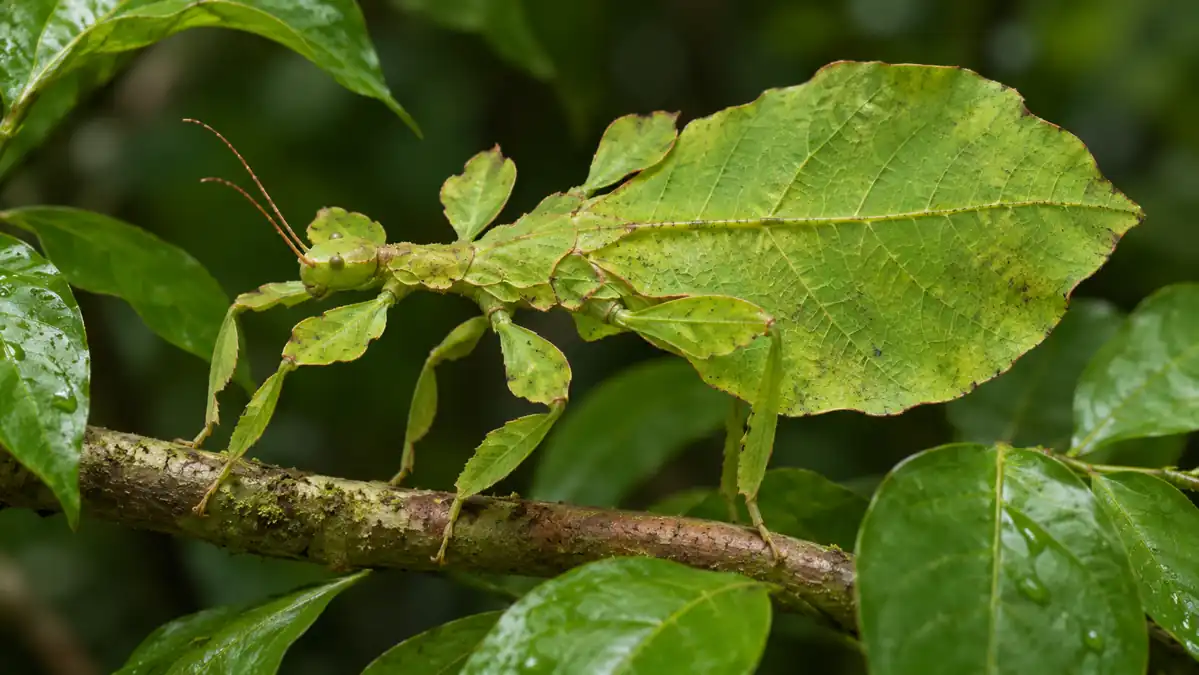
A leaf with legs sounds like something from a cartoon. In a forest, it might be an insect sitting right in front of you.
Some animals resemble fresh leaves. Others look like dry twigs, broken bark or pale flower petals. Underwater, a fish can disappear among seaweed without burying itself or swimming away.
Animals that look like plants include leaf insects, stick insects, orchid mantises, leaf-mimicking katydids and leafy sea dragons. Their colours, body shapes and behaviour can make them difficult to recognise. Some use these disguises to avoid being eaten. Others use them to get close to food.
This guide from Viltnemnda explores nine examples, explains how their disguises work and points out the small details that give them away.
Animals That Look Like Plants at a Glance
Some entries below describe a species. Others describe a group containing several species with similar disguises.
| Animal | What it resembles | A clue that reveals it |
|---|---|---|
| Leaf insect | A fresh or damaged leaf | Jointed legs and antennae |
| Stick insect | A twig or thin branch | Legs folded along the body |
| Orchid mantis | A pale flower | Triangular head and grasping front legs |
| Ghost mantis | A curled, dry leaf | Eyes and folded hunting legs |
| Leaf-mimicking katydid | A green leaf | Long antennae and large hind legs |
| Moss-mimicking katydid | A patch of moss | Body segments hidden among projections |
| Leaf-tailed gecko | Leaves or tree bark | Eyes, toes and a flattened tail |
| Leaf butterfly | A dead leaf | Antennae and legs beneath closed wings |
| Leafy sea dragon | Seaweed | A long snout and tiny moving fins |
1. Leaf Insects: Leaves That Can Walk
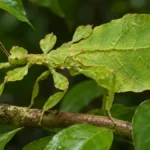
Leaf insects are among the clearest examples of animals that look like leaves. Their broad, flat bodies resemble foliage, while flattened parts of their legs help hide the usual insect outline.
The disguise includes more than green colouring. Depending on the species, the body may have brown patches, uneven edges or markings that resemble leaf veins. Real leaves are rarely perfect, so these details can make the resemblance more convincing.
A resting insect may appear to be another leaf attached to a branch. Movement can reveal the animal, although some leaf insects also sway as they move.
Look for the head first. Two antennae and a set of jointed legs are better clues than colour. A brown patch alone tells you very little: it could belong to either an insect or a real leaf.
Leaf insects remain animals. Their leaf-like appearance does not allow them to make food from sunlight.
2. Stick Insects: A Different Kind of Plant Disguise
Stick insects take a narrower approach. Rather than copying a broad leaf, many resemble twigs or small branches.
Their long bodies can blend into a network of stems. When the legs are held close to the body, the outline becomes even harder to separate from the background.
This is why searching only for bright colours often fails. A stick insect may be plain brown or green, with nothing that immediately draws the eye.
Instead, look for an unusual arrangement of joints. A twig does not normally have several matching limbs attached along its length. Antennae may also reveal where the head begins.
Stick insects and leaf insects belong to the same broader insect order, Phasmatodea. Their appearances differ, but both show how closely an animal’s shape can resemble the vegetation around it.
3. Orchid Mantises: A Flower-Like Hunter
The orchid mantis, Hymenopus coronatus, looks very different from a brown twig mimic. Its pale colouring and broad, petal-like leg parts give it a flower-like appearance.
That resemblance can help it catch food.
Experiments have shown that orchid mantises can attract insect pollinators. An approaching insect may respond to the mantis as though it were a flower, bringing it within reach of the predator’s front legs.
However, the name can be misleading. The mantis does not need to be a perfect copy of one orchid species. Research supports a more general resemblance to flowers.
To recognise one, look beyond the pink or white “petals.” The triangular head, eyes and folded grasping legs reveal the hunter.
This example shows why camouflage is not always about disappearing. Sometimes a useful disguise encourages another animal to come closer.
4. Ghost Mantises: The Look of a Dry Leaf
The ghost mantis, Phyllocrania paradoxa, resembles a dry, curled leaf rather than a fresh flower.
Its irregular body outline and leaf-like projections make it difficult to read as an insect. Dark and light markings can even create the appearance of folds or creases.
The result is a different kind of hiding. A predator may see the shape but fail to recognise it as something worth eating. The same disguise can help the mantis remain unnoticed by approaching prey.
Look for the face and the folded front legs. Once those become visible, the rest of the body is easier to follow.
The Natural History Museum’s guide to animal camouflage includes the ghost mantis among its examples of animals that imitate objects in their surroundings.
5. Leaf-Mimicking Katydids: Wings With Leaf-Like Details
A katydid can look like a leaf resting at an unusual angle. In many species, the forewings form a broad green surface with lines that resemble veins.
Some katydids have an even more weathered appearance. Their markings and wing edges can suggest damaged, ageing or partly eaten leaves.
They are not the same animals as walking leaf insects. Katydids belong to a different insect group and typically have long, fine antennae and prominent hind legs.
Those features provide useful identification clues. If your “leaf” has antennae extending far beyond its body, take a closer look without touching it.
The common garden katydid is one example of a leaf-mimicking species. Its green body and leaf-like wings help it remain hidden among foliage during the day.
6. Moss-Mimicking Katydids: Disguised as a Whole Patch
Not every plant-like animal copies one leaf. Some moss-mimicking katydids resemble a small section of moss-covered bark.
Researchers describing a katydid in the Colombian Andes recorded green projections on its legs and body. Together with its colours and stillness, these features made it exceptionally difficult to detect among moss.
The disguise works at several levels. From a distance, the animal can blend into the background. Closer up, its irregular outline makes the body difficult to separate from the surrounding growth.
Even after noticing part of it, an observer may mistake a leg for another piece of moss.
The best clue is the arrangement of the body parts. Look for repeated joints, paired limbs or antennae rather than expecting to see a clear insect silhouette.
7. Leaf-Tailed Geckos: A Reptile Hidden Against Bark
Plant-like camouflage is not limited to insects. Leaf-tailed geckos from Madagascar have flattened bodies, patterned skin and distinctive tails.
Different species have different appearances. Some strongly resemble dead leaves, while others blend especially well against tree bark.
The giant leaf-tailed gecko has fringed skin along parts of its body. When it rests against a surface, this helps obscure the boundary between the gecko and the background.
Its disguise becomes easier to understand when you stop looking for a typical upright lizard. Search for a flat shape pressed against a trunk, then look for eyes and toes.
Leaf-tailed geckos are nocturnal. Their daytime hiding behaviour fits the wider pattern explained in our guide to nocturnal animals.
8. Leaf Butterflies: The Disguise Depends on the Wings
Leaf butterflies show how much posture can change an animal’s appearance.
With their wings closed, the visible undersides can resemble a dead leaf. Brown shades, vein-like lines and a central marking help create the effect.
When the wings open, a different surface becomes visible. A butterfly that seemed dull and leaf-like may suddenly show much brighter colours.
This is an important distinction: it has not instantly changed its pigment. It has changed which side of its wings you can see.
Look near the base of the supposed leaf for legs, antennae and a body. Avoid disturbing a resting butterfly just to make it open its wings. A photograph taken from a respectful distance can reveal details that are easy to miss at first.
9. Leafy Sea Dragons: Fish That Resemble Seaweed
The leafy sea dragon, Phycodurus eques, brings this disguise underwater.
This fish lives in coastal waters off southern and western Australia. Its branching, leaf-like appendages help it blend into seaweed and seagrass habitats.
Despite its appearance, it is not a plant. It is related to seahorses and pipefish and feeds on small animals, including mysid shrimp.
The decorative appendages are mainly part of the disguise. Small fins provide movement, while the narrow snout is used for feeding.
To spot one, look for a recognisable head and a long, tube-like mouth among the frills. Watching carefully may reveal the fins moving.
“Plant-like” is a visual description here. Seaweeds are algae, while seagrasses are flowering plants. The sea dragon can resemble elements of this underwater scenery without belonging to either group.
Why Do Animals Look Like Plants?
A disguise can make the difference between being noticed and being ignored.
However, several related processes are involved:
| Term | Simple meaning |
|---|---|
| Background matching | Colours or patterns blend into the surroundings |
| Disruptive colouring | Markings make the body outline harder to recognise |
| Masquerade | An animal is mistaken for something else, such as a twig |
| Aggressive mimicry | A resemblance helps a predator deceive potential prey |
These terms can overlap in the same animal.
A leaf-like insect might match the green background and also be mistaken for an actual leaf. An orchid mantis presents another possibility: its flower-like appearance can attract prey.
These traits developed through evolution over many generations. An individual insect does not decide to grow leaf-shaped legs because it sees a nearby plant.
Why Colour Alone Is Not Enough
Imagine placing a bright green toy on a green leaf. The colours match, but the toy’s outline may still make it obvious.
Animal camouflage can involve shape, texture, posture and behaviour as well as colour. A narrow body resembles a twig more effectively when it rests in line with a branch. A leaf-like wing becomes more convincing when its markings resemble the irregular details of real foliage.
Stillness also matters. A convincing disguise can become easier to notice when an animal moves.
This explains why the same creature may be obvious in a close-up photograph yet difficult to find in its natural surroundings. The photograph has already done part of the searching for you.
How to Spot Plant-Like Animals Without Disturbing Them
Slow down and examine a small area instead of scanning an entire tree.
Look for details that do not quite fit:
- A leaf with paired, jointed limbs.
- Antennae extending from a “twig.”
- A visible eye among bark patterns.
- A shape that moves differently from nearby leaves.
- A small body beneath folded butterfly wings.
Use a camera’s zoom rather than pulling apart vegetation. Do not move an animal onto a clearer background for a photograph.
Also check where the species naturally lives. A convincing image on social media does not mean the animal occurs in your garden—or in Norway. Many examples in this article come from tropical forests or Australian coastal waters.
Our wildlife section includes more guides to animal features and the places they live.
Frequently Asked Questions
What animal looks most like a leaf?
Leaf insects are among the clearest examples. Their flat bodies and leaf-like leg parts create a strong resemblance. Leaf butterflies, katydids and some leaf-tailed geckos also resemble leaves, but in different ways.
What insect looks like a flower?
The orchid mantis is a well-known example. Its pale colouring and petal-like structures give it a flower-like appearance that can attract insect prey.
Are leaf insects and katydids the same?
No. Both can resemble leaves, but they belong to different insect groups. Long antennae and large hind legs are useful clues when recognising many katydids.
Can these animals turn into plants?
No. Their resemblance is a disguise. They remain animals with animal body structures and feeding needs.
Do all animals that look like plants change colour?
No. A convincing disguise does not require rapid colour change. Body shape, fixed patterns, posture and stillness can all help an animal remain unnoticed.
Why does a dead leaf butterfly look colourful when it flies?
Its upper and lower wing surfaces look different. Closing the wings exposes the leaf-like underside. Opening them reveals the upper surface.
Is a leafy sea dragon a fish or a plant?
It is a fish. Its leaf-like appendages help it blend into underwater vegetation, but it feeds on small animals rather than making food like a plant.
Does camouflage make an animal impossible to find?
No. Camouflage reduces the chance of detection; it does not guarantee invisibility. Movement, the wrong background or a close view can reveal the animal.
A Leaf Is Not Always Just a Leaf
These animals show how much can be hidden in an ordinary-looking patch of nature.
Some resemble a single leaf. Others borrow the appearance of twigs, bark, flowers or seaweed. Their disguises may work through stillness, an unusual body shape or tiny details that make them difficult to recognise.
The next time a leaf seems to have an odd outline, look carefully. The detail that gives it away might be an eye, an antenna—or a leg.