







Tablets have been one of the most familiar supplement formats for decades. They are convenient, widely available, easy to manufacture at scale, and suitable for many different ingredients. However, changing consumer preferences have encouraged supplement companies to explore alternative delivery formats.
One such option is the oral strip. Also called an oral thin film or dissolving film, this format is designed as a thin sheet that dissolves in the mouth.
Comparing oral strips with tablets is not simply about deciding which format is better. Each has different characteristics, advantages, and formulation considerations.
What Are Tablets?
Tablets are solid dosage forms produced by compressing powders or granulated ingredients into a defined shape and size.
They are widely used for vitamins, minerals, nutraceutical ingredients, and pharmaceutical products.
Tablets can provide accurate serving quantities and are generally straightforward to package and transport. However, they normally need to be swallowed, and some people find larger tablets difficult or uncomfortable to consume.
The experience can also depend on whether the consumer needs water to take the product.
What Are Oral Strips?
Oral strips are thin films containing selected active ingredients and other formulation components.
Instead of being swallowed as a solid unit, the strip is placed in the mouth, where saliva hydrates the film and allows it to dissolve.
This creates a different consumption experience from a conventional tablet.
The format is particularly suited to products where convenience, portability, and ease of consumption are important considerations.
Ease of Consumption
One major difference between the two formats is how they are consumed.
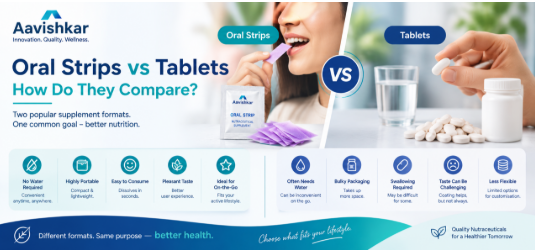
Tablets generally need to be swallowed. Some consumers have no difficulty with this, while others may find swallowing pills uncomfortable.
Oral strips provide an alternative approach because the film is designed to dissolve in the mouth.
This can make the format interesting for consumers who prefer not to swallow conventional pills.
However, the suitability of an oral strip depends on its formulation and intended use. It should not be assumed that every ingredient or dosage can simply be transferred from a tablet into a strip.
Water Requirements
Many tablets are commonly consumed with water. Although water availability is rarely a problem in many everyday situations, it can become inconvenient while travelling, commuting, exercising, or spending time outdoors.
Oral strips are generally designed as a water-free format.
This makes them particularly relevant to consumers looking for portable supplement options.
A small strip can be stored in compact packaging and consumed without preparing a drink.
Dosage Considerations
One important area where tablets and oral strips can differ is the amount of ingredient that can practically be incorporated into the format.
Tablets can accommodate relatively large quantities of powders or active ingredients depending on their size and formulation.
Oral films have physical limitations related to film thickness, surface area, ingredient concentration, taste, and mechanical properties.
For this reason, formulation specialists need to determine whether an ingredient is suitable for film delivery.
This is one of the key considerations for an oral strip manufacturer developing products for supplement brands.
Flavor and Sensory Experience
Tablets can be coated or formulated to reduce unpleasant tastes because they are generally swallowed whole.
Oral strips are different because the formulation comes into contact with the mouth during dissolution.
Taste, aroma, mouthfeel, and aftertaste therefore become important considerations.
Manufacturers may use flavors and other formulation approaches to create a more acceptable sensory experience.
This can be particularly relevant for products containing ingredients with naturally strong or bitter flavors.
Portability
Both tablets and oral strips can be portable, but their packaging formats can be quite different.
Tablets are often sold in bottles, jars, blister packs, or pouches. Oral strips can be individually packaged or placed into compact strip packs.
For consumers who want to carry only a few servings, individually packed oral strips can offer a practical solution.
The packaging also needs to protect the product from moisture and environmental exposure.
Manufacturing Considerations
Manufacturing tablets generally involves processes such as blending, granulation where required, compression, coating, and packaging.
Oral film manufacturing involves a different set of processes. Ingredients must be incorporated into a film-forming system, followed by controlled processing, drying, cutting, inspection, and packaging.
An oral dissolving film manufacturer therefore needs specialized knowledge of film formulation and processing.
Quality checks may include weight, dimensions, appearance, ingredient uniformity, mechanical properties, moisture, dissolution characteristics, and packaging integrity.
Which Format Is Right for a Supplement Brand?
The answer depends on the product and target market.
Tablets may be appropriate when:
- A higher ingredient load is needed
- Consumers already prefer conventional supplements
- The formulation is well suited to compression
- Cost-efficient mass production is a priority
Oral strips may be attractive when:
- Portability is important
- Water-free consumption is desired
- A brand wants a different delivery format
- Ease of consumption is part of the product proposition
- The product is suitable for film-based delivery
Neither format is universally suitable for every supplement.
The Role of Manufacturing Technology
Advances in oral film manufacturing are giving brands more options for developing specialized products.
Aavishkar Oral Strips Pvt Ltd, for example, focuses on oral dissolving film technology and private-label manufacturing. Its ThinSol™ platform is designed to support customized oral strip formulations.
For brands, this type of manufacturing expertise can be valuable because product development involves more than producing a thin film. Ingredient compatibility, flavor, stability, packaging, and production consistency all need to work together.
Looking Beyond the Format
The comparison between tablets and oral strips ultimately comes down to product requirements and consumer needs.
A tablet may be the most practical choice for one formulation, while an oral strip may be more suitable for another. Factors such as ingredient quantity, stability, sensory properties, intended audience, packaging, and usage occasion all influence the decision.
The growing interest in oral strips does not necessarily signal the end of tablets. Instead, it reflects a broader supplement market where consumers have more choices.
As formulation and manufacturing technologies continue to develop, oral strips can provide brands with another way to deliver selected nutrients in a compact, convenient format.
Disclaimer
This article is for informational and educational purposes only. It does not constitute medical, dietary, or formulation advice. Supplement brands and consumers should consult qualified medical or formulation specialists to determine the safety, dosage, and suitability of specific delivery formats for individual health needs or product developments.