






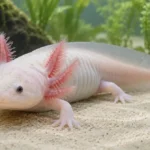
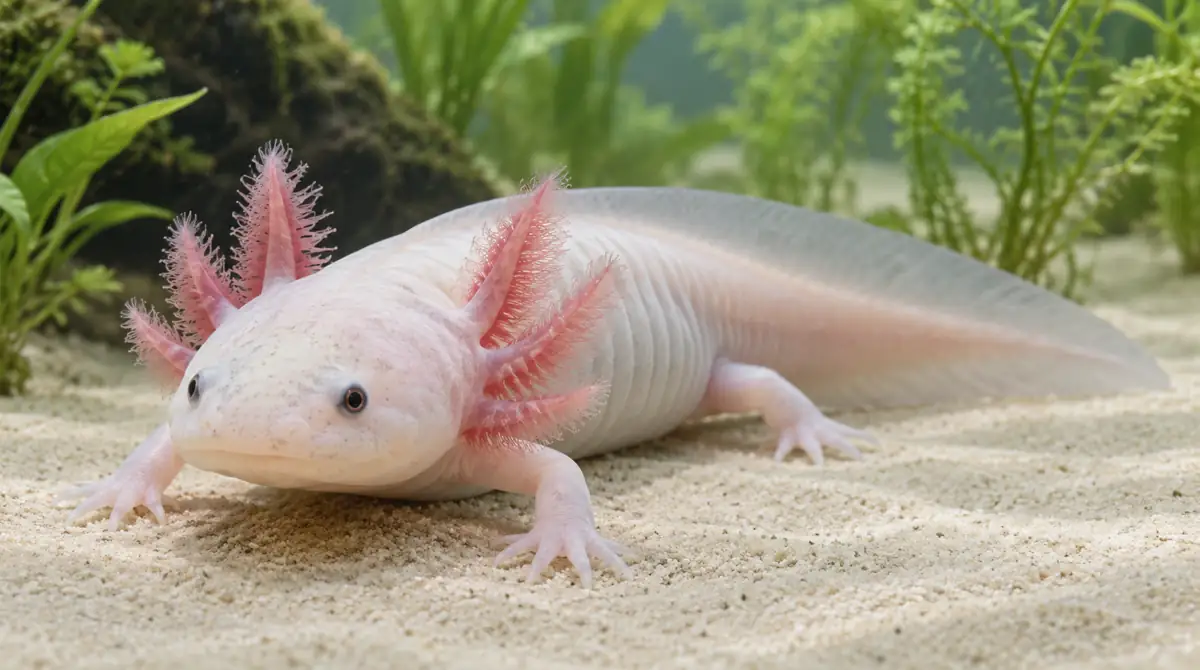
Two pale axolotls sit beside each other in a photograph. Both have pink gills and almost white skin, so it would be easy to call them the same color. Look at their eyes, though, and you may spot the difference: one has dark eyes, while the other has pale, reddish eyes.
That small detail helps separate a leucistic axolotl from a white albino. Body color alone can be misleading.
Axolotls come in brown, olive, pinkish-white, golden, gray, black and copper tones. This guide from Viltnemnda explains the main varieties and how to make sense of names such as melanoid, lavender and wild type.
What colors can axolotls be?
The familiar pale pink axolotl is only one possibility. Dark, mottled animals and golden varieties belong to the same species, Ambystoma mexicanum.
Their appearance depends on pigment cells and cells that reflect light. Inherited differences affect these cells, producing the colors and patterns seen in captive axolotls.
Here are the main names you are likely to encounter.
| Name | Usual appearance | What to look for |
|---|---|---|
| Wild type | Brown, olive or dark mottled coloring | Reflective flecks and mixed tones |
| Leucistic | Pale pinkish-white | Dark eyes; sometimes freckles |
| White albino | White or translucent-looking | Pale or reddish eyes |
| Golden albino | Yellow to gold | Golden body without dark melanin |
| Melanoid | Dark gray or black | No reflective iridophores |
| Copper | Warm brown or copper tones | A documented inherited pigment trait |
| Lavender | Silvery or grayish-purple | A descriptive name used in the pet trade |
The chart is a starting point. It cannot show every combination, and photographs may hide the features needed for a confident identification.
What does “morph” mean?
A morph is a variation in appearance within a species. In axolotl discussions, the word often refers to color or pattern.
The terminology becomes confusing because people use it quite loosely. A seller may describe a genetic trait, an unusual pattern or a particular shade as a morph. Those descriptions do not all carry the same meaning.
For example, melanoid refers to an established pigment trait. Lavender describes an appearance used in pet-trade naming. Neither name makes the animal a different species.
There are three main cell types behind axolotl coloring. Melanophores contain dark pigment, xanthophores contribute yellowish tones, and iridophores create reflective shine. You do not need to memorize those names, but they explain why dark coloring and shiny flecks are separate features.
Wild-type axolotls: Brown, olive and mottled
Wild-type axolotls generally have dark bodies with mottling. Their exact shade varies, and a photograph may show brown, olive or nearly black coloring.
“Wild type” does not mean the animal was caught in the wild. Captive-bred axolotls can have this appearance too.
University of Kentucky stock descriptions separate wild-type animals from albino, melanoid and axanthic varieties. In other words, the name describes more than a rough body color.
If a dark axolotl looks almost black, examine it under ordinary neutral lighting. Mottling and reflective flecks may become easier to see. Avoid relying on a heavily shaded photograph or one taken under a colored aquarium lamp.
Leucistic axolotls: The familiar pink variety
A leucistic axolotl usually has a pale body and dark eyes. This is the pinkish-white animal many people picture when they hear the word axolotl.
Its coloring results from differences in pigment-cell distribution. It can still produce dark pigment, which explains the dark eyes and occasional freckles.
Some individuals develop more visible speckling as they grow. A few dark marks on a pale axolotl therefore do not automatically make it a rare variety.
“Pink” and “white” are also imperfect descriptions. The same leucistic animal may look pink in one photograph and cream-colored in another. Check the eyes before deciding what you are looking at.
White albino or leucistic? Start with the eyes
White albinos lack dark melanin pigment. Their eyes are pale and may look pinkish or reddish, unlike the dark eyes of a leucistic axolotl.
This distinction is useful when the bodies look almost identical.
Suppose a seller describes an animal simply as a “white axolotl.” That leaves the identification open. Ask for a clear photograph of the eyes and any known information about its parents.
Even then, a photograph has limits. Reflections can obscure the eyes, and camera settings may wash out their color. If the feature is not visible, leave the identification uncertain rather than guessing.
Golden albino axolotls
Albinism does not always produce a white animal. When dark melanin is absent but other coloring remains, an axolotl can appear yellow or golden.
Golden albinos are a good example. Their shade may also develop as they grow, so a young animal may look paler than an adult.
University of Kentucky descriptions show that different combinations of pigment traits produce different albino appearances. This is one reason a list of colors can become longer than expected: several genetic combinations may sit beneath familiar names.
For someone choosing or identifying an animal, its age is useful information. A juvenile photograph does not guarantee the precise shade it will have later.
Black and dark gray axolotls
Melanoid axolotls are usually dark gray or black. They lack iridophores, the cells responsible for reflective shine.
That feature helps distinguish them from dark wild types. A wild-type animal may be nearly black while still showing reflective flecks.
The eye can provide another clue. A reflective ring around the pupil is associated with non-melanoid animals, while melanoids lack it. This can be difficult to judge in a small or blurry image.
A sensible description might therefore be “dark axolotl, possibly melanoid” until the relevant details are visible. The darkest animal in a photograph is not necessarily the one with the melanoid trait.
Copper axolotls
Copper axolotls have warm brown or copper-toned coloring. Unlike some descriptive pet-trade names, copper has been investigated genetically.
A 2024 study identified a mutation in the Tyrp1 gene as the cause of the copper trait studied by the researchers. The gene is involved in melanin production.
You do not need genetic terminology to appreciate the color. It does help explain why a documented trait is different from a seller deciding that an animal looks “bronze” under warm lighting.
Ask for unfiltered photographs if you are comparing copper animals. Brown skin can look warmer or cooler depending on the light.
Lavender, freckles and unusual patches
Some axolotl names describe markings as much as color.
Lavender is used for a silvery or grayish-purple appearance, sometimes with darker spots. You may also encounter the name silver Dalmatian. Expect a subtle shade; a bright purple photograph may be strongly affected by lighting or editing.
Speckled leucistic animals have dark freckles on a pale background. Piebald descriptions usually refer to more noticeable dark patches.
Names such as mosaic and chimera appear in discussions of mixed-color animals. A patchy or split-color photograph alone cannot confirm the animal’s genetic makeup or how it developed.
When a label is unclear, ask the seller to explain it. A plain description of the eyes, body and markings is often more informative than an impressive-sounding name.
What is the rarest axolotl color?
There is no reliable worldwide rarity ranking established by the sources used for this guide.
A breeder may rarely produce a particular pattern. Another breeder may regularly work with that line. An unusual individual also differs from a trait that can be predictably inherited.
Before paying more for a “rare” axolotl, ask what supports the claim. Is there documented breeding information? Does the name refer to a genetic trait or simply an unusual appearance?
Price is not evidence of rarity, and rarity is not evidence of health. The animal’s condition and care history deserve more attention than the label.
Do some axolotls glow?
Some axolotls carry green fluorescent protein, usually called GFP. It allows tissues to fluoresce under suitable excitation light.
This is different from producing light in complete darkness. A GFP animal can look quite ordinary under normal lighting, and the trait can occur alongside different body colors.
Treat fluorescence as an additional characteristic, rather than a separate paint-like shade of green. There is no reason to repeatedly expose a pet to bright light just to demonstrate it.
How many axolotl colors are there?
An exact total depends on what the list counts.
One guide may separate golden albino and white albino. Another may add every spotted variation, fluorescent trait and descriptive breeder name. Both lists may be discussing the same species but organizing the information differently.
It is more useful to learn the main distinctions than to memorize a fixed number. Start with wild type, leucistic, albino and melanoid, then look at other traits and patterns.
This also explains why “all axolotl colors” lists sometimes disagree. Their categories are not always equivalent.
Can axolotls change color?
Their appearance can change with growth. Speckling may become more noticeable, and some varieties develop a different shade as they mature.
That does not mean the animal has switched from one genetic morph to another.
Before assuming a real change has happened, compare the lighting. A new aquarium lamp, darker background or different camera exposure can make a noticeable difference.
If you want to follow the changes, take occasional photographs from the same angle under similar lighting. Keep the images unfiltered and record the date. A consistent photo record is more useful than comparing two pictures taken months apart under completely different conditions.
For more information about terminology used for young animals, our baby animal names guide explains the differences between several common life-stage names.
When to ask a veterinarian
Sudden discoloration deserves attention if it comes with damaged skin, sores, reduced appetite or unusual behavior.
Poor water quality can contribute to skin problems in axolotls. Check the aquarium with a suitable water test kit and contact a veterinarian experienced with amphibians if the animal appears unwell.
Useful information includes when the change began, recent tank changes, test results and clear photographs. Avoid choosing medication or salt treatments from a color description alone.
This article can help you describe an appearance. It cannot diagnose the cause of a new skin or gill change.
Real axolotl colors and Minecraft colors
Minecraft lists five axolotl variants: lucy, wild, gold, cyan and blue.
These names belong to the game. They are not a complete classification of real axolotl color traits.
Some game appearances resemble familiar real animals, such as pale leucistic or golden axolotls. Others should not be used as evidence that a matching pet variety exists.
If you arrived here after searching for Minecraft axolotl colors, use real animal photographs and reliable morph descriptions when identifying a pet. A game screenshot cannot verify a seller’s claim.
A practical way to identify an axolotl
Look at the eyes first, then the body shade, markings and reflective flecks.
A pale animal with dark eyes suggests leucistic coloring. A pale animal with unpigmented-looking eyes suggests an albino appearance. With a dark animal, look more closely for shine before deciding between wild type and melanoid.
Write down what you can actually see. “Pale body, dark eyes, freckles on the head” is a useful description even before you attach a name.
Further animal guides are available in the Viltnemnda blog.
Frequently asked questions
What colors do axolotls come in?
They can appear pinkish-white, white, golden, brown, olive, gray, black and copper-toned. Patterns and combinations of traits add more variation.
Are pink axolotls albino?
Some pale animals are albino, but the familiar pink axolotl with dark eyes is usually leucistic. Eye pigment is an important difference.
Are all black axolotls melanoid?
No. Some wild-type axolotls are very dark. Reflective flecks can help distinguish them from melanoids.
Is lavender a different species?
No. Lavender is a name used for a particular appearance in axolotls, not a separate species.
Can a baby axolotl look different when it grows?
Yes. Shade and markings can develop with age. Ask how old an animal is when comparing photographs.
Does a rare color require better care?
Every axolotl needs appropriate care. Rarity and price do not reduce the need for suitable water conditions, food and veterinary attention when necessary.
Can you identify the exact genetics from a photograph?
Usually not. A photograph may support an appearance-based identification, but it cannot reveal every inherited trait.
How many Minecraft axolotl colors are there?
The game’s documented variants are lucy, wild, gold, cyan and blue: five in total.