




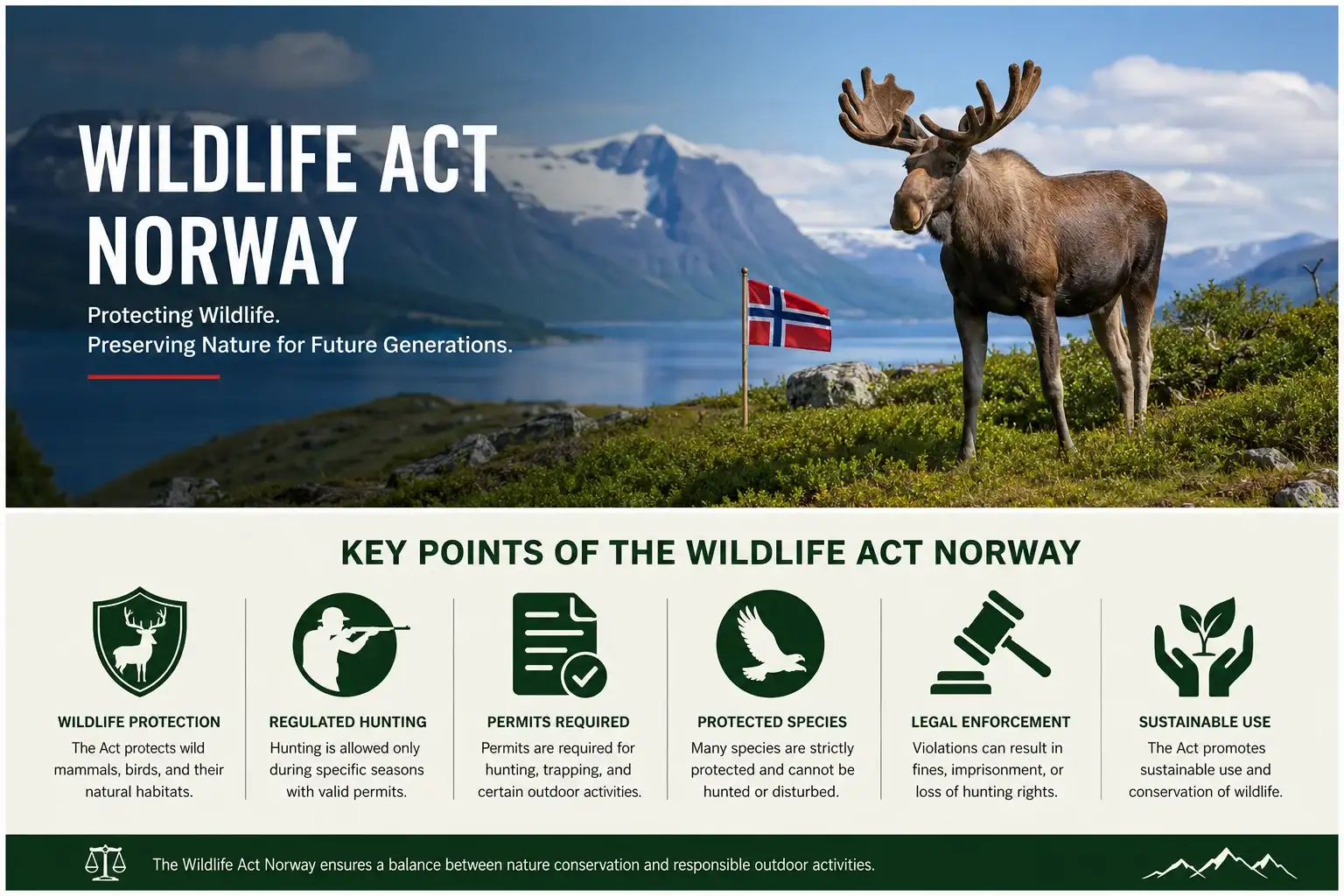
Norway is home to some of Europe’s richest wildlife populations, but strict laws protect these natural resources. Whether you are a hunter, landowner, tourist, researcher, or outdoor enthusiast, understanding the Wildlife Act Norway is essential.
Many people struggle to understand Norwegian wildlife laws because official documents contain complex legal language. This guide explains the Wildlife Act in simple words, covering hunting rights, species protection, permits, penalties, and practical examples.
What Is the Wildlife Act Norway?
The Wildlife Act Norway (Viltloven) is the main law governing wildlife conservation, hunting, trapping, and sustainable management of wild species in Norway. It aims to ensure that wildlife populations remain healthy while allowing regulated hunting and outdoor activities.
Key Points:
- Protects wild mammals, birds, reptiles, and amphibians.
- Regulates hunting seasons, quotas, and methods.
- Requires specific permits and registrations for certain activities.
- Prohibits illegal hunting, poaching, and unnecessary disturbance.
- Supports long-term biodiversity conservation.
- Imposes strict fines and legal penalties for violations.
What Is the Wildlife Act Norway?
Purpose of the Act
The fundamental principle of the Wildlife Act is that all wild mammals and birds (including their eggs and nests) are protected unless the law specifically states otherwise. The primary purpose is to manage wildlife populations sustainably, ensuring that species survive for future generations while facilitating regulated harvesting for hunters and landowners.
History and Development of Norwegian Wildlife Law
Historically, wildlife management in Norway focused primarily on maximizing game meat production and eradicating large predators. However, over the late 20th and early 21st centuries, the law evolved into a holistic conservation framework. The modern iteration of the Act strictly aligns with international environmental treaties like the Bern Convention, shifting the focus from mere “game management” to ecosystem-based biodiversity conservation.
Which Animals Are Covered?
The Act covers all wild terrestrial mammals, birds, reptiles, and amphibians living free in Norwegian territory or within the economic zone. It does not cover marine mammals (like whales and seals) or fish, which are managed under separate maritime and fisheries legislation.
Key Government Authorities Responsible for Enforcement
- Norwegian Environment Agency (Miljødirektoratet): The central authority that sets national hunting quotas, manages protected areas, and issues comprehensive Norwegian Environment Agency wildlife regulations.
- County Governors (Statsforvalteren): Responsible for regional wildlife management, adjusting local hunting dates, and overseeing predator control guidelines.
- Municipal Wildlife Boards (Kommunale viltnemnder): Local bodies that handle practical wildlife issues, such as dealing with sick or injured big game, setting local moose quotas, and managing human-wildlife conflicts.
How Does the Wildlife Act Work in Practice?
Who Can Hunt in Norway?
To hunt in Norway, you must meet strict age and training requirements. For small game hunting, you must be at least 16 years old (with training options from age 14). For big game hunting, the minimum age is 18. All hunters must carry proof of identification, their hunting license, and specific permits while in the field.
Hunting Licenses and Registration Requirements
Before stepping into the woods, every hunter must pass a mandatory Hunter Qualification Examination (Jegerprøven) and register in the National Hunter Register (Jegerregisteret). Additionally, an annual hunting license fee must be paid to the state. Big game hunters must pass an annual shooting proficiency test using their specific rifle and ammunition.
Landowner Rights and Hunting Rights
In Norway, the right to hunt belongs to the landowner. This applies to both private land and state-owned public lands managed by entities like Statskog. If you want to hunt, you must buy a hunting permit (jaktkort) directly from the landowner or lease the hunting rights for a specific area.
Hunting Seasons Explained
Hunting is strictly seasonal. The Norwegian Environment Agency defines general hunting seasons for allowed species based on breeding patterns and population health. For example, the highly regulated moose hunting season generally runs in the autumn, while specific small game hunting Norway seasons occur over the autumn and winter months.
Protected Species Rules
Any species not explicitly listed with an open hunting season is automatically protected. Distorbing, injuring, or destroying the nests, dens, or eggs of protected species is a severe violation of environmental legislation.
Rules for Foreign Hunters Visiting Norway
Foreigners are welcome to hunt in Norway, but they must complete specific paperwork. If you hold a valid hunting license in your home country, you can apply to be registered in the Norwegian Hunter Register without retaking the exam. You must still pay the annual hunting fee and secure written permission or a permit from the landowner.
Firearms and Safety Regulations
The Wildlife Act works hand-in-hand with Norway’s strict weapons laws. Semi-automatic rifles are heavily restricted, and fully automatic weapons are strictly banned for hunting. Lead shot is prohibited for most hunting forms to protect the environment from toxic residue.
Step-by-Step Guide to Hunting Legally in Norway
[Step 1: Complete Hunter Education]
      │
      ▼
[Step 2: Register in the National Hunter Register]
      │
      ▼
[Step 3: Obtain Permission/Permit From Landowner]
      │
      ▼
[Step 4: Purchase Annual Hunting License]
      │
      ▼
[Step 5: Follow Species-Specific Regulations & Quotas]
Step 1: Complete Hunter Education Requirements
Pass the 30-hour Jegerprøven course and exam (or submit foreign equivalence documents to the Register).
Step 2: Register in the National Hunter Register
Ensure your name is active in the Jegerregisteret database and print your digital hunter card.
Step 3: Obtain Permission From Landowners
Purchase a localized hunting ticket (jaktkort) via platforms like Inatur or secure a private lease.
Step 4: Purchase Hunting License
Pay the annual state hunting fee (jegeravgift) online to validate your status for the current season.
Step 5: Follow Species-Specific Regulations
Verify the exact hunting dates, local quotas, weapon restrictions, and mandatory shooting tests for your target species.
Wildlife Protection and Conservation Measures
Biodiversity Protection Goals
The Wildlife Act functions as a core pillar of Norway’s broader commitment to biodiversity conservation. The law ensures that hunting never threatens the long-term survival of a species or alters the natural balance of localized ecosystems.
Endangered Species Protection
Species listed on the Norwegian Red List for Species receive intense legal protections. The government can temporarily close whole regions to outdoor activities if an endangered bird species is nesting or a vulnerable mammal population is rearing its young.
Habitat Conservation Requirements
While the Act focuses mainly on the animals themselves, it contains provisions that penalize actions destroying critical wildlife habitats, such as draining wetlands or clearing ancient nesting forests during breeding seasons.
Predator Management Policies
Managing protected predators—specifically wolves, bears, lynx, and wolverines—is one of the most debated topics in Norwegian law. The state employs a strict predator management Norway policy, setting exact regional population targets. Licences for “licensed culling” (lisensfelling) are occasionally issued to manage livestock damage, but these quotas are heavily regulated and frequently challenged in court.
Climate Change and Wildlife Management
As warming temperatures shift migration patterns and alter northern ecosystems, the Wildlife Act permits rapid regulatory changes. Authorities can dynamically cut hunting seasons short if wild populations experience climate-driven stressors, such as lack of winter forage or sudden disease outbreaks.
Sustainable Use Principles
Every regulation in the Act is anchored in the concept of sustainable hunting. Populations are treated as renewable natural resources; only the surplus of a healthy population is harvested, leaving the core breeding stock untouched.
Species Protected Under Norwegian Law
The table below outlines how common wildlife species groups are treated under the current legal framework.
| Species Group | Protection Status | Hunting Allowed? | Key Condition / Season |
| Large Predators (Wolves, Bears) | Highly Protected | Limited / Strictly Controlled | Requires emergency state-issued licensing |
| Moose | Regulated | Yes | High seasonal quotas, strict local municipal controls |
| Wild Reindeer | Regulated / Vulnerable | Yes | Limited quotas, highly protected alpine habitats |
| Lynx & Wolverines | Controlled | Limited | Subject to annual regional culling quotas |
| Birds of Prey (Eagles, Falcons) | Fully Protected | No | Complete ban on hunting, trapping, or disturbing |
| Small Game (Grouse, Hares) | Regulated | Yes | General autumn/winter open seasons |
Hunting Regulations Under the Wildlife Act Norway
Big Game Hunting Rules
Big game hunting Norway focuses primarily on moose, red deer, wild reindeer, and roe deer. Hunters must work in registered teams (jaktlag), adhere to specific municipal quotas, and have a certified tracking dog (ettersøkshund) available within two hours to locate wounded animals.
Small Game Hunting Rules
Small game hunting Norway includes willow grouse (rype), black grouse, mountain hares, and waterfowl. While individual quotas (bag limits) are less rigid than big game, regional landowners often place daily limits to prevent local over-harvesting.
Trapping Regulations
Trapping is legal but highly restricted. The Wildlife Act specifies the exact types of traps allowed, mandatory daily inspection frequencies, and strict measures to prevent catching non-target species or causing unnecessary animal suffering.
Prohibited Hunting Methods
Norway completely prohibits methods that cause undue suffering or give hunters an unfair advantage. Banned practices include:
- Using motor vehicles (boats, snowmobiles, cars, or aircraft) to pursue or distract wildlife.
- Artificial light sources (except under strict wild boar or predator tracking exceptions).
- Using chemical substances, explosives, or poisons.
- Hunting with bows and arrows or crossbows.
Use of Dogs During Hunting
Dogs are widely used for both tracking and flushing game. However, Norway enforces strict leashing laws (båndtvang) from April 1 to August 20 to protect vulnerable young wildlife. Outside these dates, hunting dogs can roam off-leash only under the direct command of an active hunter.
Night Hunting Restrictions
Hunting during dark hours is generally illegal if safety cannot be guaranteed or if artificial light is required. Limited exceptions exist for hunting roe deer or wild boars from fixed positions, provided natural moonlight or specialized snow illumination is sufficient.
Real Examples of Wildlife Law Enforcement in Norway
Case Study 1: Illegal Moose Hunting Penalties
In a recent case in Eastern Norway, a group of hunters shot a moose cow outside their allocated municipal quota area. Because they failed to immediately report the mistake and attempted to tag the animal under a different zone, the local court confiscated their hunting rifles, issued a combined fine of 50,000 NOK, and banned the individuals from hunting for three years.
Case Study 2: Protected Predator Violations
Poaching a protected predator carries severe prison sentences in Norway. In a landmark case investigated by the Norwegian economic and environmental crime unit (Økokrim), individuals involved in the illegal tracking and shooting of a wolf inside a designated wolf zone received unconditional prison terms ranging from 6 to 12 months, highlighting how seriously the state treats wildlife offences Norway.
Case Study 3: Successful Reindeer Population Management
Norway holds Europe’s last remaining wild tundra reindeer populations. Following a chronic wasting disease (CWD) outbreak in the Nordfjella region, wildlife authorities successfully utilized the Wildlife Act’s emergency provisions to isolate the herd, adjust regional hunting quotas, and safely regenerate a healthy, disease-free population through data-backed wildlife management practices.
Common Violations and Penalties
Non-compliance with the Wildlife Act carries severe consequences. Økokrim and local police forces actively monitor hunting grounds.
Illegal Hunting (Poaching)
Hunting outside designated seasons, killing protected species, or exceeding your allocated quota is classified as poaching. This routinely results in heavy criminal fines and prison sentences up to 2 years (or up to 6 years for organized environmental crime).
Hunting Without Permission
Trespassing and hunting on private or state land without a valid jaktkort or landowner agreement constitutes a major violation, resulting in immediate fines and the forfeiture of harvested game.
Disturbing Protected Species
Intentionally approaching, photographing too closely, or disrupting the breeding sites of sensitive wildlife—such as muskoxen in Dovrefjell or nesting golden eagles—violates the protection clauses and carries steep financial penalties.
Illegal Trapping
Using unregistered traps, non-approved mechanism sizes, or failing to check live-traps within the legally mandated timeframes leads to weapon/trap confiscation and animal cruelty charges.
Fines and Criminal Penalties
- Minor infractions: Fines ranging from 5,000 to 20,000 NOK.
- Serious violations: Confiscation of firearms, vehicles, and hunting licenses for multiple years or a lifetime.
- Severe offenses: Long-term prison sentences and a permanent criminal record.
Common Myths About the Wildlife Act Norway
- Myth #1: Anyone can hunt on public land.Reality: Public land managed by the state (Statskog) still requires you to purchase a specific hunting permit and possess a valid national hunter registration. There is no “free hunting” in Norway.
- Myth #2: Foreign tourists do not need permits for small game.Reality: Foreigners must fulfill the same basic licensing, fee, and landowner permission rules as Norwegian citizens.
- Myth #3: Protected predators can never be controlled.Reality: The government regularly issues specialized licenses for lethal predator management if a specific animal poses an immediate, documented threat to sheep herds or domestic reindeer.
- Myth #4: Landowners automatically own the wild animals on their property.Reality: Landowners own the right to hunt on their property, but the wildlife itself is considered a resource belonging to the state/public until it is legally harvested.
Wildlife Act Norway vs. Nature Diversity Act
While both laws protect Norway’s natural environment, they serve distinct primary functions.
| Feature | Wildlife Act (Viltloven) | Nature Diversity Act (Naturmangfoldloven) |
| Primary Focus | Management, hunting, and harvesting of wild mammals and birds. | Broad conservation of all ecosystems, habitats, plants, and genetic diversity. |
| Species Protection | Comprehensive rules for game species and birds. | Overarching protection framework for all living organisms. |
| Hunting Rules | Extensive, highly detailed operational regulations. | Minimal; delegates operational hunting rules to the Wildlife Act. |
| Habitat Protection | Limited to immediate nesting/den protection. | Extensive; establishes National Parks, nature reserves, and landscape areas. |
Expert Tips for Staying Compliant
- Always verify annual hunting regulations: Quotas and season dates change every year based on population surveys. Never rely on last year’s data.
- Check municipality-specific restrictions: Local councils frequently issue sudden fire bans or temporary off-leash dog extensions that override general guidelines.
- Keep documentation while hunting: Always carry a digital or physical copy of your hunter’s card, weapon license, shooting test certification, and local hunting permit.
- Monitor updates issued by authorities: Bookmark the Norwegian Environment Agency website to receive fast alerts on dynamic quota closures or wildlife health warnings.
Frequently Asked Questions
Is hunting legal in Norway?
Yes, hunting is perfectly legal in Norway but it is highly regulated. Anyone hunting must meet age requirements, pass a national qualification exam, pay an annual fee, and secure a localized permit from the landowner.
Can foreigners hunt in Norway?
Yes. Foreigners who hold a valid hunting license in their home country can register in the Norwegian Hunter Register. Once registered and the annual fee is paid, they can purchase hunting permissions like any local resident.
What animals are protected in Norway?
By default, all wild mammals, birds, reptiles, and amphibians are protected under Norwegian law. They can only be hunted if the Norwegian Environment Agency has explicitly opened a designated hunting season for that specific species.
What happens if someone hunts illegally?
Illegal hunting triggers severe penalties, including thousands of kroner in fines, confiscation of firearms and hunting gear, revocation of hunting licenses, and potential prison time for serious or organized offenses.
Do landowners own wildlife in Norway?
No. Wild animals are a shared public resource managed by the state. However, landowners possess the exclusive right to control and sell hunting access on their land.
Is trapping legal under Norwegian law?
Yes, trapping is legal for certain small game and predator species. However, you must use state-approved trap types, register your activities locally, and inspect the traps at strict daily intervals to prevent animal suffering.
Which authority enforces wildlife laws?
The primary regulatory authority is the Norwegian Environment Agency, working alongside County Governors and Municipal Boards. On the ground, compliance is enforced by the police, Økokrim, and the State Nature Inspectorate (Statens naturoppsyn).
How often are hunting regulations updated?
General hunting seasons are reviewed every few years, but local quotas, specific harvest numbers, and predator management boundaries are adjusted annually based on updated wildlife population counts.
CTA: Bookmark this guide and check official updates regularly to stay fully compliant with Norwegian wildlife laws.
Disclaimer
This disclaimer applies to the discussion of Norwegian wildlife legislation. This article provides general information about wildlife conservation and management, not legal advice or an official decision. Laws, responsibilities, access rules, and conservation conditions may change and differ by location. Check current legislation and guidance from the responsible municipality or public authority before acting.