





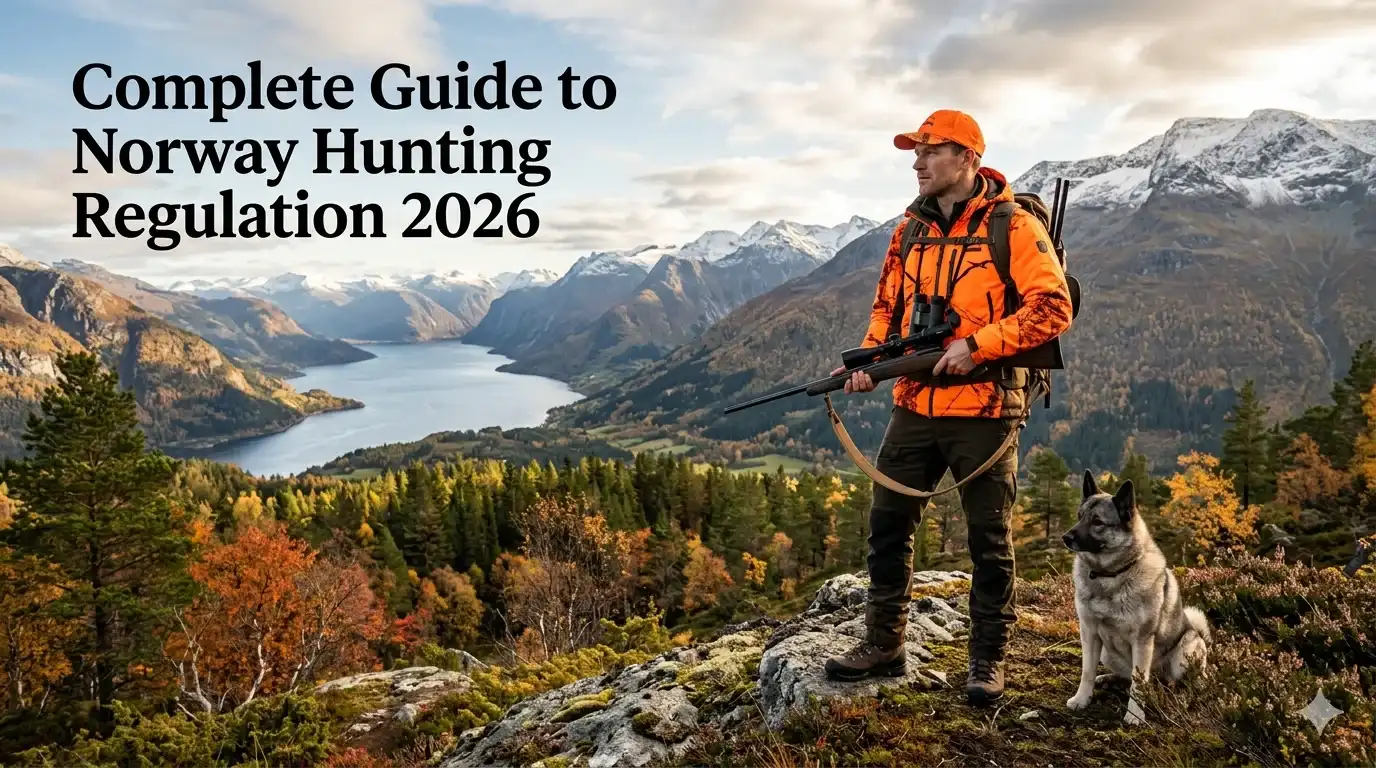
Norway is famous across the globe for its expansive wilderness, pristine mountain plateaus, and deep boreal forests. It stands as a top destination for ethical hunting in Europe. However, tracking game across this rugged landscape requires total alignment with strict Norwegian hunting laws.
The Norwegian government manages its wilderness through a complex mix of environmental legislation and localized quotas. For any sportsman planning a trip, understanding the legal framework is not just about avoiding penalties—it is essential for protecting the ecosystem. This comprehensive guide covers everything from licensing and weapon laws to landowner rights and explicit rules for foreign hunters in Norway.
Quick Answer: What Are Norway Hunting Regulations?
Norway hunting regulations require all participants to hold a registered hunter status, pass an annual proficiency test for large game, pay an annual hunting tax, and obtain written permission from the private or public landowner. Non-resident hunters can skip the standard Norwegian hunting exam if they hold equivalent, valid licenses from their home countries.
Key Rules at a Glance
- Pass the hunter education exam (or register foreign equivalents).
- Pay the annual hunting tax (jegeravgift) to the Norwegian Register of Hunters.
- Get explicit, paid hunting permission from the specific landowner or public authority.
- Follow rigid, species-specific hunting season dates.
- Respect regional hunting quotas and mandatory harvest reporting protocols.
- Comply strictly with firearm registration and transportation laws.
Why Does Norway Have Strict Hunting Regulations?
Wildlife Conservation Goals
Norway’s regulatory framework is anchored by the Norwegian Nature Diversity Act and the Wildlife Act. These laws ensure that native species remain viable components of the ecosystem. The rules prevent overexploitation and ensure that hunting never undermines the biodiversity of the Nordic landscape.
Sustainable Population Management
Every year, the Norwegian Environment Agency (Miljødirektoratet) evaluates scientific data to determine harvest quotas. Biologists track birth rates, winter mortality, and habitat health. For species like the wild reindeer, quotas are adjusted dynamically to prevent overgrazing on delicate mountain tundra.
Protecting Endangered Species
Norway shares its landscape with large carnivores like wolves, wolverines, brown bears, and Eurasian lynx. These predators are heavily protected. Licenses to cull these animals are issued sparingly under emergency frameworks to protect domestic livestock, requiring real-time quota tracking by hunters.
The Role of Hunters in Norway’s Ecosystem
In the absence of large apex predator populations across many regions, hunters serve as the primary tool for population control. For example, managed moose hunting prevents overpopulation, which would otherwise lead to massive forest degradation and a surge in vehicle collisions on rural highways.
Who Can Legally Hunt in Norway?
Requirements for Norwegian Citizens
To hunt legally, a Norwegian citizen must complete a 30-hour certified course, pass the state hunting exam (jegerprøve), and register inside the official online Hunter Register (Jegerregisteret). They must also maintain an active digital hunting card (jegerkort).
Rules for Foreign Hunters
Foreign hunters do not need to take the Norwegian state exam if they can provide documented proof that they have the legal right to hunt the same category of game in their home country. This documentation must be submitted to the Brønnøysund Register Centre for formal validation before arrival.
Minimum Age Requirements
Norway sets strict age tiers based on the classification of the targeted game species:
- Small Game Hunting: You must be at least 16 years old to hunt independently. You can participate in supervised training hunts starting at age 14.
- Big Game Hunting: You must be at least 18 years old to hunt species like moose, red deer, and wild reindeer. Supervised training hunts are permitted from age 16.
Resident vs Non-Resident Hunters
While residents can easily apply for public land lotteries, non-resident hunters face tight restrictions on certain species. For instance, wild reindeer hunting on state-managed land is generally reserved for residents, meaning foreign hunters must typically purchase access via private estates or specialized outfitters.
Required Documentation
When out in the field, every hunter must carry three documents at all times:
- A valid identity document (Passport or national ID).
- A digital or printed Norwegian hunting card proving payment of the annual hunting fee.
- A valid firearm permit or European Firearms Pass matching the weapon in use.
How to Get a Hunting License in Norway
Navigating the licensing pipeline requires following a precise sequence of steps. Skipping any part of this workflow renders your hunt illegal.
1.Complete Hunter Education Training:30 Hours Required.
New residents must attend the mandatory 30-hour classroom and field course. Foreigners must bypass this by uploading an official certificate from their home country’s wildlife authority to the Jegerregisteret online portal.
2.Pass the Hunter Examination:Written Test.
For residents, this is a 50-question electronic exam covering species identification, safety regulations, and hunting ethics. A score of 80% or higher is required to pass.
3.Register in the Hunter Register:Jegerregisteret.
Upon passing the exam or gaining foreign approval, you are assigned a unique, permanent Norwegian Hunter Number within the official national database.
4.Pay the Annual Hunting Fee:Valid until March 31.
Log into your digital portal profile and pay the annual hunting tax. For the 2026 season, the baseline fee is NOK 420 for small game or NOK 540 if hunting big game.
5.Obtain Landowner Permission:Final Step.
Secure your localized hunting permit (jaktkort) for a specific zone. You cannot legally harvest any animal until this area permit is linked to your hunting card.
Real-World Example: Dieter, a seasoned hunter from Germany, wants to plan a moose hunt in Norway. He skips the Norwegian 30-hour course by uploading his German Jagdschein to the Jegerregisteret website. Within a week, the agency validates his credentials and issues him a Norwegian hunter number. Dieter logs in, pays his NOK 540 big game fee online, prints his digital card, and is legally clear to purchase a moose tag from a private estate in Innlandet.
Read This Article: Norway Wildlife Management: Smart & Simple Guide
What Hunting Permits Are Required in Norway?
General Hunting Permit
The baseline hunting card allows you to harvest species that do not fall under strict tag systems, provided you have local ground access.
Big Game Hunting Permit
Big game species—primarily moose (elg), red deer (hjort), and wild reindeer (villrein)—require individual tags assigned to a specific property quota. You cannot simply go out looking for a moose; you must be part of an authorized hunting team assigned a specific age and sex quota for that plot of land.
Small Game Hunting Permit
Small game permits are typically sold as area passes valid for a day, week, or entire season. They dictate which birds or small mammals you can harvest within a defined geographic territory.
Special Species Permits
Large carnivore hunting, such as lynx or wolverine culling, requires individual registration on a text-alert roster system managed by the local Governor (Statsforvalteren). Hunters must check daily to ensure the regional quota has not closed.
Local Municipality Regulations
Individual municipalities (kommuner) retain the right to impose secondary restrictions. They can cut seasons short or ban specific hunting gear if local wildlife counts drop below targeted conservation thresholds.
Norway Hunting Seasons Explained
Hunting season dates are strictly enforced and vary by geographic region. The table below outlines the standard, baseline hunting windows across Norway:
| Species | Typical Season | Special Restrictions |
| Moose (Alces alces) | Sept 25 – Dec 23 | Limited to strict local property quotas. |
| Red Deer (Cervus elaphus) | Sept 1 – Dec 23 | High-visibility clothing mandatory in dense brush. |
| Wild Reindeer (Rangifer tarandus) | Aug 20 – Sept 30 | Only permitted in specific high-alpine tundra zones. |
| Roe Deer (Capreolus capreolus) | Aug 10 – Dec 23 | Buck-only season runs early from August 10 to September 24. |
| Willow Ptarmigan (Rype) | Sept 10 – Last day of Feb | Daily bag limits change yearly based on spring counts. |
| Black Grouse | Sept 10 – Dec 23 | Hens are highly protected in specific municipal zones. |
Hunting Rights and Landowner Permission in Norway
Who Owns Hunting Rights?
Unlike countries where hunting rights are separate from land ownership, in Norway, the right to hunt is legally tied to the land. The property owner owns the exclusive right to harvest wildlife on their territory.
Public Land vs Private Land
- Public Land: Managed primarily by Statskog, the state forestry enterprise. Permits are distributed via public lotteries or over-the-counter sales on portals like Inatur.
- Private Land: Managed by individual farmers, families, or local cooperatives (Utmarkslag). These groups pool land together to create cohesive, contiguous zones large enough to satisfy big game quota laws.
How Foreign Hunters Obtain Access
Foreigners can easily browse and purchase small game permits directly from Inatur.no. For big game, the most reliable path is booking an all-inclusive package with a licensed Norwegian outfitter who already leases quota rights from private landowners.
Hunting Leases Explained
Long-term hunting leases are common among local clubs. A group will lease a valley for five years, taking full responsibility for hitting management targets, clearing trails, and reporting scientific samples to state biologists.
Expert Tip: Never rely on Norway’s right-to-roam law (allemannsretten) for hunting. While you have the legal right to hike, ski, and camp anywhere in the wild unhindered, this freedom completely excludes harvesting any plants, fish, or animals for commercial or personal use.
Firearm Regulations for Hunting in Norway
Approved Hunting Firearms
Rifles and shotguns are the only legal hunting weapons in Norway. Shotguns can hold a maximum of two shells: one in the chamber and one in the magazine. Semi-automatic rifles are legal only if they appear on an explicit list approved by the Norwegian Police Directorate. Handguns, bows, crossbows, and air guns are entirely banned for hunting.
Importing Firearms into Norway
To bring your hunting rifle across the border, you must submit a declaration to the Norwegian Customs authority (Tollvesenet).
Storage and Transportation Rules
When traveling by vehicle, firearms must be unloaded and completely concealed from public view, preferably locked inside a hard case or weapon vault. If you leave your vehicle unattended, you must remove a vital component—such as the bolt assembly—and carry it with you to prevent theft.
Rules for Foreign Hunters Bringing Rifles
EU citizens must travel with a valid European Firearms Pass paired with a written hunt invitation. Non-EU residents must apply for a temporary weapon import permit from the Norwegian police district where they plan to enter the country, accompanied by a fee payment.
Ammunition Restrictions
Big game rifle hunting requires expanding, soft-nose, or copper-deformation bullets. Solid target ammunition is completely illegal for big game. For moose and red deer, the ammunition must meet minimum kinetic energy requirements:
$$\text{Minimum Energy} = 2200 \text{ Joules at } 100 \text{ meters (for bullets weighing } \ge 9 \text{ grams)}$$
$$\text{Minimum Energy} = 2700 \text{ Joules at } 100 \text{ meters (for bullets weighing between 10-11 grams)}$$
Big Game Hunting Rules in Norway
Moose Hunting Regulations
Moose hunting is highly structured. Teams operate inside designated terrain sectors. Every harvested moose must be physically examined, its weight recorded, and specific biological samples (like jawbones or tissue) submitted to local wildlife management offices for age verification and health tracking.
Reindeer Hunting Regulations
Wild reindeer hunting occurs exclusively on foot in open, rocky, high-alpine environments. Vehicles, including ATVs and snowmobiles, are strictly banned for spotting or transport. Stealth, spotting scopes, and patience are mandatory.
Red Deer Regulations
Red deer are typically hunted using ambush methods from tree stands or via active stalking through dense timber along the dramatic western fjords. Due to the steep terrain, hunters must be in peak physical condition.
Mandatory Shooting Tests
Every rifle hunter targeting big game must pass the annual shooting test (storviltprøve). The test requires firing 30 practice rounds over a minimum of two separate days. After completing the practice tracks, you must fire five consecutive shots into a 30-centimeter circle at 100 meters using your designated hunting ammunition.
Quotas and Harvest Reporting
Every animal harvested under a big game quota must be logged electronically within 24 hours of the kill. Local councils keep real-time tallies to ensure regional limits are not breached.
Small Game Hunting Rules in Norway
Ptarmigan Hunting
The willow ptarmigan (rype) is the most sought-after small game bird in Norway. Hunters walk miles across tundra slopes, often utilizing pointing dogs to locate birds hidden in dwarf willow brush.
Hare Hunting
Mountain hares turn completely white in winter, offering a challenging target for hunters tracking them through pine forests or low valleys.
Grouse Hunting
Capercaillie (storfugl) and black grouse (orrfugl) hunting involves navigating deep coniferous forests during late autumn before heavy snow blankets the interior.
Waterfowl Hunting
Sea duck and goose hunting are popular along coastal shores and agricultural fields. Lead shot is completely banned across all shooting ranges and wetland zones to prevent environmental contamination.
Bag Limits and Restrictions
Small game bag limits are variable. Landowners look at late summer population counts and set strict daily caps (e.g., maximum two birds per hunter per day) to keep the harvest sustainable.
Hunting Ethics and Animal Welfare Laws
Humane Hunting Requirements
Norwegian law dictates that any shot taken must offer a high probability of an instant, clean kill. Haphazard long-range shooting or firing into moving herds of animals is heavily condemned by the hunting community and can lead to prosecution under animal welfare laws.
Tracking Wounded Animals
If you wound a big game animal, you must instantly stop hunting and dedicate all resources to locating it. By law, hunting parties tracking moose, red deer, or roe deer must have immediate access to an officially certified tracking dog (ettersøkshund) to trace blood trails.
Use of Hunting Dogs
Dogs are integral to Norwegian hunting culture. However, leash laws (båndtvang) protect wildlife during nesting seasons. Hunting dogs can only run off-leash during specific, approved hunting dates when active seasons are open.
Prohibited Hunting Methods
Illegal methods include using artificial light sources, electronic calls, thermal scopes for active targeting, poisons, traps that cause prolonged suffering, and any motorized vehicles to pursue or herd game.
Environmental Responsibilities
Hunters are expected to leave no trace behind. All trash, spent cartridge casings, and non-biodegradable waste must be packed out of the wilderness.
Common Mistakes Foreign Hunters Make
- Assuming a License Equals Access: Many foreign hunters believe that paying the national hunting tax gives them the right to hunt anywhere. Without a localized land permit (jaktkort), you are trespassing and poaching.
- Ignoring Landowner Boundaries: Property borders in the mountains are rarely fenced. Failing to use digital mapping apps to track real-time boundary markers often results in accidental incursions into adjacent private zones.
- Firearm Documentation Errors: Arriving at customs without an official invitation letter or missing a valid police import permit will result in immediate weapon seizure at the border.
- Failing the Shooting Test on Arrival: Many travelers do not practice shooting from field positions beforehand. Failing the 5-shot verification test on arrival will ruin a big game trip before it starts.
Norway vs Sweden vs Finland Hunting Regulations
While all three Nordic nations boast incredible wilderness, their legal approaches to managing hunting access and firearms differ clearly.
| Feature | Norway | Sweden | Finland |
| Rifle Silencer Permits | Not required (over-the-counter) | Explicit permit required | Noted directly on license |
| Big Game Test Validity | Valid for 1 year only | Valid for 1 year only | Valid for 3 years |
| Shotgun Shell Capacity | Max 2 shells (1+1) | Max 3 shells (2+1) | Max 3 shells (2+1) |
| Primary Public Land Manager | Statskog / FeFo | Sveaskog | Metsähallitus |
| Lead Shot Restrictions | Banned in wetlands/ranges | Highly restricted | Banned in wetlands |
Recent Updates to Norway Hunting Regulations in 2026
New Wildlife Management Policies
The 2026 season sees closer integration between regional wildlife boards and the central Norwegian Environment Agency. Management policies now prioritize mitigating habitat fragmentation caused by expanding holiday cabin infrastructure.
Updated Hunting Quotas
Due to targeted management of Chronic Wasting Disease (CWD) in mountain reindeer populations, quotas in southern alpine zones like Hardangervidda are strictly monitored. Testing head and brain samples from harvested animals remains mandatory in designated containment zones.
Digital Registration Changes
The Jegerregisteret system has shifted entirely to real-time digital synchronization. Physical paper hunting cards are phased out; all credentials, test results, and paid fees must display inside the official Min jegerdokumentasjon mobile application.
Expert Tips for Hunting Legally in Norway
- Tip #1: Research Local Municipality Rules. Always contact the local hunting council (fjellstyre) before your trip to check for sudden, emergency quota closures or specific equipment bans.
- Tip #2: Book Hunting Rights Early. Prime territories for wild reindeer and ptarmigan operate via competitive lotteries that close in early spring. Secure your positioning months in advance.
- Tip #3: Verify Firearm Documentation. Check that the serial numbers stamped on your rifle receiver match your customs declaration forms perfectly to avoid lengthy processing delays.
- Tip #4: Keep Digital and Offline Permitting Copies. Cellular reception drops entirely inside deep mountain valleys. Download all app credentials and save PDF maps directly to your device for offline verification.
- Tip #5: Report Harvests Promptly. Submit your mandatory hunting statistics through the Altinn portal immediately following your trip. Forgetting to file before the spring deadline results in a financial penalty on your next registration cycle.
FAQ
Do foreigners need a hunting license in Norway?
Yes. Foreigners must register with the Norwegian Hunter Register and pay the annual hunting fee. However, they can bypass the physical Norwegian state exam by providing proof of their home country’s hunting credentials.
Can tourists hunt in Norway?
Yes, tourists can hunt legally by completing foreign registration, acquiring a temporary firearm import license, and purchasing localized hunting permits through online platforms like Inatur.
Is moose hunting legal in Norway?
Yes. Moose hunting is a cornerstone of Norwegian hunting culture, highly regulated via strict property-specific quotas during the autumn season.
Can I bring my own rifle to Norway?
Yes. EU citizens require a European Firearms Pass and a valid written hunt invitation. Non-EU citizens must submit a formal application for a temporary firearm import permit via the Norwegian police authority.
What is the annual hunting fee?
For the 2026 hunting season, the standard annual hunting fee is NOK 420 for small game or NOK 540 for all game including big game species.
Do I need landowner permission?
Yes. Hunting rights belong exclusively to the landowner in Norway. You must always purchase a localized hunting permit (jaktkort) for the specific private or public property you intend to traverse.
What animals can be hunted legally?
Commonly hunted species include big game like moose, red deer, roe deer, and wild reindeer, alongside small game such as willow ptarmigan, black grouse, waterfowl, and mountain hares.
Are hunting seasons the same across Norway?
No. Season dates fluctuate based on the specific species, terrain types, and individual municipal health indices to safeguard local breeding stocks.
Conclusion
Hunting in Norway offers unparalleled access to Europe’s remaining wild landscapes. However, this privilege demands complete obedience to local laws, meticulous conservation ethics, and rigorous structural compliance. By securing your hunter registration, validating your firearms properly, and respecting private landowner rights, you contribute directly to the rich tradition of sustainable wildlife management that defines the Nordic wilderness.
Disclaimer
This disclaimer applies to the discussion of Norwegian hunting rules. This article provides general information about wildlife conservation and management, not legal advice or an official decision. Laws, responsibilities, access rules, and conservation conditions may change and differ by location. Check current legislation and guidance from the responsible municipality or public authority before acting.