






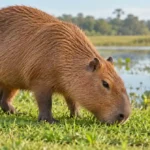

A capybara eating a slice of melon makes an entertaining video. Watching one work its way through a patch of grass is less dramatic, but it gives a better picture of its everyday diet.
Capybaras mainly eat grasses and aquatic plants. They are herbivores, and their food choices change with the plants available around them. Fruit and other crops may be eaten when accessible, but they do not tell the whole story.
This guide from Viltnemnda covers what capybaras eat in the wild, how zoo diets differ, and what young capybaras feed on as they grow.
What do capybaras eat in the wild?
Wild capybaras feed on vegetation around wetlands, rivers and grassy areas. Grasses and water plants form the main part of their diet, with other plant foods becoming available in different habitats and seasons.
They do not follow a single menu throughout their range. A group feeding beside a wetland may have different choices from animals near farmland.
| Food group | Role in a wild capybara’s diet |
|---|---|
| Grasses | A major source of food |
| Aquatic plants | Important around water |
| Leaves and other vegetation | Eaten according to local availability |
| Reeds and tougher plants | Part of their changing seasonal diet |
| Fruits and crops | May be eaten where available |
This describes feeding behavior in the wild. It is not a shopping list for feeding a captive animal.
Do they eat any plant they find?
Being a herbivore does not mean eating every plant in reach. Capybaras select among the plants available to them.
Their food choices also reflect the conditions around them. Fresh growth during a wet period offers different options from the tougher or scarcer vegetation of a dry season.
For a wider view of the animals sharing some of these environments, explore our Amazon rainforest animals guide.
How does their diet change with the seasons?
During wetter periods, grasses and aquatic vegetation may be plentiful. As water levels and plant growth change, capybaras adjust their feeding.
Sacramento Zoo describes a seasonal shift that can include roots, squash and melons during drier conditions. These examples help explain their flexibility, but they should not be treated as a menu followed by every wild group.
Location matters as much as season. A capybara cannot eat a particular crop unless it can reach it.
When reading a claim about a favorite food, ask where the observation was made. A zoo feeding session, a farm-edge sighting and a wetland study describe different circumstances.
Why is grass so important?
Capybaras are built to process fibrous plant material. Their front teeth cut vegetation, while their back teeth help crush it during chewing.
Like other rodents, their incisors continue growing. Chewing suitable plant material helps wear them down.
Their digestive system also relies on microbial fermentation to process plant fiber. This helps explain why a bowl of soft produce is not an adequate picture of their nutritional needs.
The Association of Zoos and Aquariums’ care manual emphasizes a complex plant-based diet and professional diet planning for animals in managed care. A complete feeding plan must consider the individual animal as well as the species.
How much do capybaras eat?
San Diego Zoo gives an example of an adult consuming roughly 6–8 pounds, or 2.7–3.6 kilograms, of grass per day.
That figure describes grass intake. It should not be copied as an allowance for pellets, fruit or dried hay. These foods contain different amounts of water and nutrients.
There is also no single daily portion appropriate for every capybara. Size, age, body condition and reproductive status affect an animal’s needs.
For general wildlife reading, the useful point is that grazing supplies a substantial amount of food. For an animal in care, quantities need a properly formulated diet.
What do capybaras eat at zoos?
Zoo feeding plans use available ingredients to meet the animal’s nutritional needs. They do not simply reproduce a list of wild plants.
San Diego Zoo reports feeding its capybaras Bermuda grass hay, low-starch high-fiber biscuits, vegetables and greens.
That is an example from one institution, not a universal recipe. Another facility may use different ingredients within a professionally managed feeding program.
A public feeding demonstration also shows only a small part of the day. The food offered during an encounter may be chosen because it is easy for keepers to portion and present. It does not necessarily represent the animal’s main intake.
Do capybaras eat fruit?
Yes, capybaras can eat fruit when it is available. Chester Zoo includes fruit among the additional foods in its description of their diet.
The distinction is between something an animal eats and the food that forms the basis of its diet. Seeing a capybara accept a piece of fruit answers the first question. It does not establish how often or how much it should receive.
This matters when watching videos. A short clip cannot show the complete feeding plan, the portion already eaten that day, or the keeper’s reason for offering that food.
What about watermelon, apples and carrots?
These are common questions because produce is easy to recognize in feeding videos. However, a useful answer needs more context than “it ate a piece.”
For an animal in managed care, the keeper or veterinary nutrition team should decide which produce fits its diet and in what amount. A general wildlife article cannot provide a portion suitable for every capybara.
At a zoo or sanctuary, offer only the food supplied or explicitly approved by staff. Do not bring extra snacks or feed an animal through a fence.
Do capybaras eat meat or fish?
Capybaras are classified as herbivores. Fish and meat are not normal components of the plant-based diet described by the zoo sources reviewed here.
Living beside water does not make an animal a fish eater. For capybaras, water is closely connected with their habitat and access to aquatic vegetation.
If you see a surprising feeding claim, check the original source. A caption or edited clip may leave out details needed to understand what happened.
Why do capybaras eat their own droppings?
Capybaras re-ingest some of their fecal material, a behavior called coprophagy. It helps them obtain more nutritional value from their plant-based food.
Fibrous vegetation is difficult to break down. Re-ingestion allows additional use of material that has already passed through the digestive system.
Although the behavior may look unusual to a human observer, it is part of capybara feeding biology. By itself, seeing it does not show that the animal is starving or being poorly cared for.
What do baby capybaras eat?
Baby capybaras drink milk and begin grazing while still young.
Sacramento Zoo reports that pups can graze within a week of birth, while nursing continues until roughly three to four months. Eating grass early therefore does not mean a pup has already been fully weaned.
The Natural History Museum also describes young capybaras nursing from females within the group, rather than only their own mother.
A young capybara is called a pup. Our baby animal names guide explains more names used for young mammals and other animals.
Hand-rearing is a separate specialist task. An orphaned pup needs professional assessment; an adult food list is not a milk-replacement or feeding plan.
When do capybaras feed?
Capybaras often graze around dawn and dusk, but their schedule is flexible.
Sacramento Zoo notes that food availability, habitat and pressure from predators can affect whether animals are active during the day or at night. San Diego Zoo also describes nighttime feeding when animals feel threatened.
A photograph taken in daylight does not contradict a report of nighttime grazing. Both can reflect normal activity under different conditions.
If you are observing capybaras, record what they are doing and when. “Grazing beside the water shortly before sunset” is more useful than assuming that all groups follow the same timetable.
Watching capybaras feed responsibly
Grazing offers plenty to observe without providing food yourself. Watch how an animal selects a patch, lowers its head and moves on after feeding.
Keep enough distance for it to continue normally. If it stops feeding to monitor you, give it more room.
At managed facilities, follow the keeper’s instructions. In the wild, leave feeding to the animal. This also makes your observations more meaningful: you are seeing its own choices instead of its response to a snack.
Frequently asked questions
Are capybaras herbivores?
Yes. Their diet is based on plant material, especially grasses and aquatic vegetation.
What is a capybara’s main food?
Grass is a major food source, alongside aquatic plants. The exact plants eaten depend on habitat and season.
Do capybaras eat hay?
Yes. Hay is used in managed diets. San Diego Zoo lists Bermuda grass hay among the foods offered to its capybaras.
Do capybaras eat fruit every day?
Wild feeding depends on availability, and captive feeding depends on the facility’s diet plan. A video of fruit feeding does not establish a daily requirement.
Do capybaras eat fish?
Fish are not a normal part of the herbivorous diet described in the reviewed zoo guides.
What do baby capybaras eat?
They nurse and start grazing early. Milk remains important even after they begin eating vegetation.
Why do capybaras eat their own poop?
Re-ingestion helps them recover nutritional value from fibrous plant food. It is a recognized part of their feeding behavior.
Can visitors feed capybaras?
Only during an approved activity and with food authorized by the facility. Do not offer personal snacks or feed wild capybaras.