









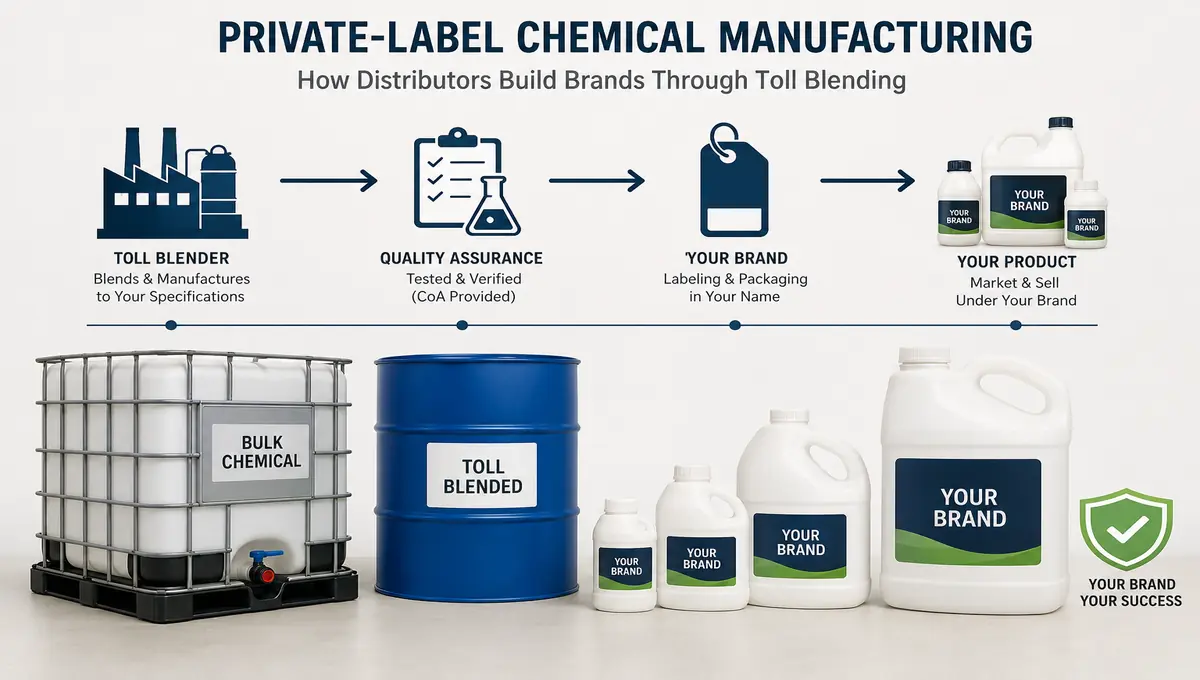
For many chemical distributors, growth eventually reaches a ceiling.
Reselling someone else’s products means competing on price, working within someone else’s product portfolio, and relying on margins you don’t control.
Building your own brand changes that equation, but manufacturing chemicals in-house isn’t practical for most businesses.
That’s where private-label chemical manufacturing through toll blending comes in. It allows distributors to launch exclusive products under their own brand without investing in production facilities. However, success depends on more than choosing the right chemical blending services.
You need to understand formulation ownership, contract terms, quality requirements, and regulatory responsibilities before your product ever reaches the market.
Today, we delve into how private-label chemical manufacturing works, why distributors are increasingly choosing this model, and the key considerations that will help you build a profitable and scalable chemical brand.
What Does Private-Label Chemical Manufacturing Mean?
Private label and white label are terms that get used interchangeably, but they are not the same thing in the chemical industry.
- White label chemical blending means a toll blender produces a standard, pre-formulated product that multiple distributors can buy and brand under their own name. The formula is the blender’s, and everyone gets the same product.
- Private label chemical manufacturing means the formulation is developed specifically for one distributor. The formula may be created by the distributor, developed jointly with the blender, or licensed, but the key point is exclusivity. No other company is selling that exact product under their label.
- Toll blending private label arrangements put the production in the blender’s hands. The blender manufactures the product using agreed-upon raw materials and specifications. The distributor handles branding, labeling, and sales.
In these arrangements, the distributor owns the customer relationship and brand identity. The toll blender is the production partner operating behind the scenes.
Formulation ownership in private label deals depends entirely on what the contract says. If you bring the formula, you own it. If the blender develops it for you, you need a written assignment of IP rights to actually own it. Never assume.
Why Do Distributors Choose Private-Label Over Reselling?
The economics of private label industrial chemicals are straightforward. Here is why distributors make the switch:
- Higher margins: Branded products command a price premium that generic resale products cannot. When you own the brand, you own the pricing power.
- Differentiation in a commodity market: Reselling the same product as ten other distributors is a race to the bottom on price. Private label industrial chemicals give you a product the competition cannot directly copy or undercut.
- Control over customer relationships: When a customer buys a named product from you, the loyalty is to your brand. That is harder for a competitor to poach than a customer who is buying a commodity chemical anyone can supply.
- Pricing and positioning flexibility: You set the price, you decide the positioning, and you choose which segments to target. Resellers are always at the mercy of their supplier’s pricing decisions.
How to Structure a Private-Label Toll Blending Agreement?
The contract is where private label deals either succeed or fall apart. Get these four areas right before you sign anything.
1. Formulation IP Ownership and NDA Terms
Your contract needs to explicitly state who owns the formula, who can use it, and what happens if the relationship ends.
A strong NDA (non-disclosure agreement) should cover the formula, raw material sources, and production specifications.
If the blender developed the formula, insist on a written IP assignment clause so ownership transfers to you clearly.
2. Minimum Order Quantities and Pricing Tiers
Toll blending private label arrangements almost always have minimum order quantities (MOQs).
Understand the MOQ structure before you commit, and negotiate pricing tiers so your per-unit cost decreases as your volume grows. Lock in raw material pricing where possible, especially for volatile ingredients.
3. Labeling, Packaging, and Branding Responsibilities
Decide upfront who is responsible for label design, regulatory compliance on labels (GHS/OSHA requirements), and applying labels to finished product.
Some blenders handle all of this. Others hand you a pallet of unlabeled containers. Know exactly what you are getting and what it costs.
4. Quality Assurance and Certificate of Analysis Requirements
Every batch of private label industrial chemicals should come with a Certificate of Analysis (CoA) confirming the product meets your agreed specifications.
Define the test parameters, the acceptable ranges, and what happens if a batch fails. Build in your right to reject non-conforming product and require re-blending at no additional cost.
Common Pitfalls to Avoid in Private-Label Chemical Deals
Even experienced distributors make these mistakes when entering private-label chemical manufacturing for the first time.
- Vague IP ownership clauses: If the contract says something like “formulation developed in partnership,” that is not enough. Without a clear written assignment, you may not legally own the formula you paid to develop. Have a lawyer review any IP-related clause before you sign.
- Underestimating labeling and regulatory compliance costs: GHS labeling requires a compliant Safety Data Sheet, proper hazard classification, and accurate label content for every SKU.
If you are entering a new product category, factor in the cost of SDS authoring, label review, and regulatory verification. These costs add up faster than most first-time private label distributors expect.
- Failing to lock in raw material pricing terms: Chemical prices fluctuate. If your contract allows the blender to pass through raw material cost increases without limit or notice, your margins can disappear overnight.
Negotiate price adjustment mechanisms with caps, notice periods, and your right to approve any increase above a set threshold.
- Skipping a reference sample approval process: Always require an approved reference sample before full production begins. This protects you from receiving a finished product that technically meets spec on paper but does not look, smell, or perform the way you expected.
Final Thought
Private label chemical manufacturing through toll blending is one of the most effective ways for distributors to build margin, differentiate, and create lasting brand equity in the chemical industry.
The model works when the contract is tight, the IP is protected, and the right production partner is in place. Invest the time upfront to get those three things right, and white-label chemical blending can become a genuine competitive advantage for your business.
Disclaimer
This disclaimer applies to the discussion of private-label chemical manufacturing. This article is for general information only and does not replace a qualified engineering or safety assessment. Equipment performance, costs, and potential savings depend on specifications, installation, maintenance, and operating conditions. Verify supplier claims and current safety and regulatory requirements, and use trained professionals for selection, installation, or repair.