







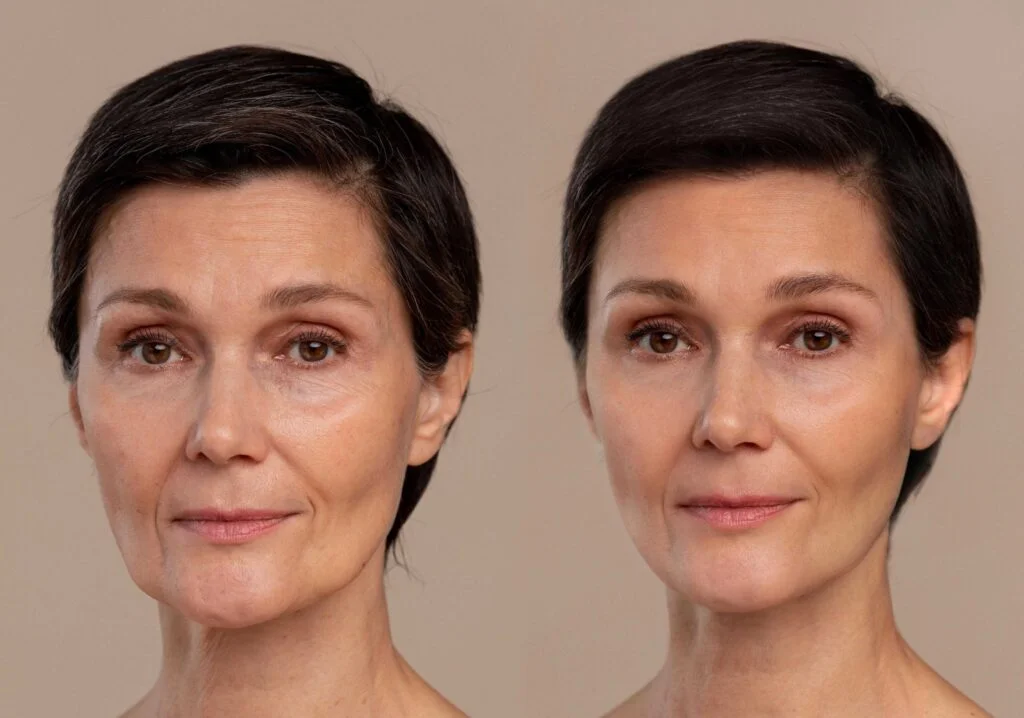
Somewhere in your fifties, the foundation you have worn happily for years can start behaving like a stranger. It sinks into the lines around your mouth by mid-morning. It looks heavier in daylight than it did in the bathroom mirror. Or it leaves your face sitting a shade apart from your neck, no matter how carefully you blend.
Nothing about your routine has changed. Your skin has. Mature skin holds less moisture, has a finer surface texture and reflects light differently than it did at thirty, and a great many foundations are still formulated with thirty-year-old skin in mind. Choosing well after 50 has far less to do with price than with understanding what your skin now asks of a product, and how you apply it.
Why Foundation Behaves Differently After 50
Your skin holds less water than it used to
Skin that is drier will pull moisture out of whatever you put on top of it. That is why a foundation which felt light in your forties can look dusty or tight a few years later, and why the same product can perform beautifully in a humid Brisbane summer and badly in a dry Melbourne winter. Hydration underneath the makeup matters more than the makeup itself.
Surface texture has become less even
Fine lines, softened pores and a little unevenness in tone all create tiny channels and shadows across the face. Foundation is a liquid or a powder, and both will migrate into whatever low points exist. A heavier product does not fix this. It simply gives more product to migrate.
Light bounces differently
Younger skin tends to reflect light evenly. Older skin reflects it in patches, which reads as dullness in some areas and shine in others. A completely flat matte finish can flatten the face further, while a very dewy finish can settle into texture and emphasise it. The sweet spot for most women over 50 sits somewhere between the two.
What to Look for in a Foundation for Mature Skin
Buildable coverage, not maximum coverage
There is a real difference between a foundation that offers good coverage in a thin layer and one that only achieves coverage by sitting thickly on the skin. You want the first. A formula you can apply lightly across the whole face and then build slightly in the places that need it, such as around the nose or over pigmentation, will always look more like skin than a single heavy pass.
A finish with a little softness in it
Look for words like natural, satin or soft-focus rather than full matte. A finish that diffuses light softens the appearance of lines without adding shine to the centre of the face. If a formula photographs well under flash, that is usually a good sign it is not sitting in a chalky layer on the surface.
A shade matched to your jawline, not your hand
Skin tone shifts with age, and the shade you wore a decade ago may now be too warm or too deep. Test along the jaw and down onto the neck, in daylight, and choose the shade that disappears. Many women over 50 also find their skin runs slightly cooler or more sallow than it once did, so a shade one step off can be the difference between polished and mask-like.
Comfort across a full day
A foundation for mature skin has to survive glasses, a scarf, a warm room and a long afternoon. If a product feels tight or itchy at the two-hour mark, it will not improve at the six-hour mark, and no amount of setting spray will convince it otherwise.
The Application Habits That Make the Biggest Difference
Most complaints about foundation on older skin are actually complaints about application. A few adjustments tend to change the result more than switching products does.
- Prep properly. Moisturise and give it a few minutes to sink in before anything else goes on. Foundation applied over damp or freshly applied skincare will slide and separate.
- Use less than you think, then build. Start with a small amount through the centre of the face where redness and unevenness usually sit, and blend outward. The perimeter of the face rarely needs the same coverage as the middle.
- Work the product into the skin rather than over it. A dense brush pressed and buffed, or a slightly damp sponge tapped in, presses colour into the surface instead of laying it across the top where it can catch in lines.
- Be strategic with powder. Powder only where you actually get shine, usually the T-zone. Powder across the cheeks and under the eyes is the fastest route to a dry, creased look by lunchtime.
- Touch up by pressing, not by adding. If your foundation has shifted in the afternoon, press it back into place with a sponge or clean fingertips before reaching for more product.
The Mistakes Worth Unlearning
Reaching for more coverage to hide pigmentation is the most common one. Heavy foundation across the whole face draws attention to texture, while a lighter base with concealer used precisely on the spots that bother you looks far more natural.
Sticking with a shade out of habit is the second. Skin changes with sun exposure, hormones and time, and a shade that suited you five years ago may be quietly ageing you now.
Applying foundation over untended skin is the third. Gentle exfoliation once or twice a week gives makeup a smoother surface to sit on, and does more for the finish than any primer.
A Formula Worth Knowing About
Australian brand Thin Lizzy has built a large part of its following among women over 40, and its Flawless Complexion Liquid Foundation is a reasonable example of what to look for in this category. It is a liquid-to-powder formula, which means it goes on with the ease of a liquid and settles to a soft, non-shiny finish, and it is designed to be applied thinly and built where needed rather than layered on. It comes in a wide shade range with a colour-matching guide, which matters when you are buying online and cannot swatch in person.
It is worth noting that the brand sits in the mid-price range rather than the premium one, and it is widely available across Australia.
Frequently Asked Questions
Should women over 50 wear liquid or powder foundation?
Liquid tends to suit drier, more mature skin because it adds a little moisture and moves with the face. Powder foundation can work well for oilier skin or as a light touch-up over liquid, but used alone it can emphasise dryness and texture.
Why does my foundation settle into my lines?
Usually one of three things: too much product, not enough hydration underneath, or too much powder set on top. Try halving the amount you use and skipping powder anywhere other than the T-zone for a week and see what changes.
How do I stop my foundation looking different to my neck?
Match the shade along the jawline in daylight rather than on the back of your hand, and carry a small amount of product down under the jaw. If your face and neck are genuinely different tones, choose the shade that matches the neck.
Do I still need primer after 50?
Not necessarily. A well-hydrated face often does the same job. Primer is most useful if you have visible pores or find your foundation shifts through the day, and least useful if your skin is already dry.
The Short Version
The right foundation for skin over 50 is a light one applied thoughtfully, in a shade that matches your neck, over skin that has been given something to drink first. Coverage is something you build in the two or three places that need it, not something you spread edge to edge. Get those things right and almost any decent formula will look better on you than an expensive one applied out of habit.