








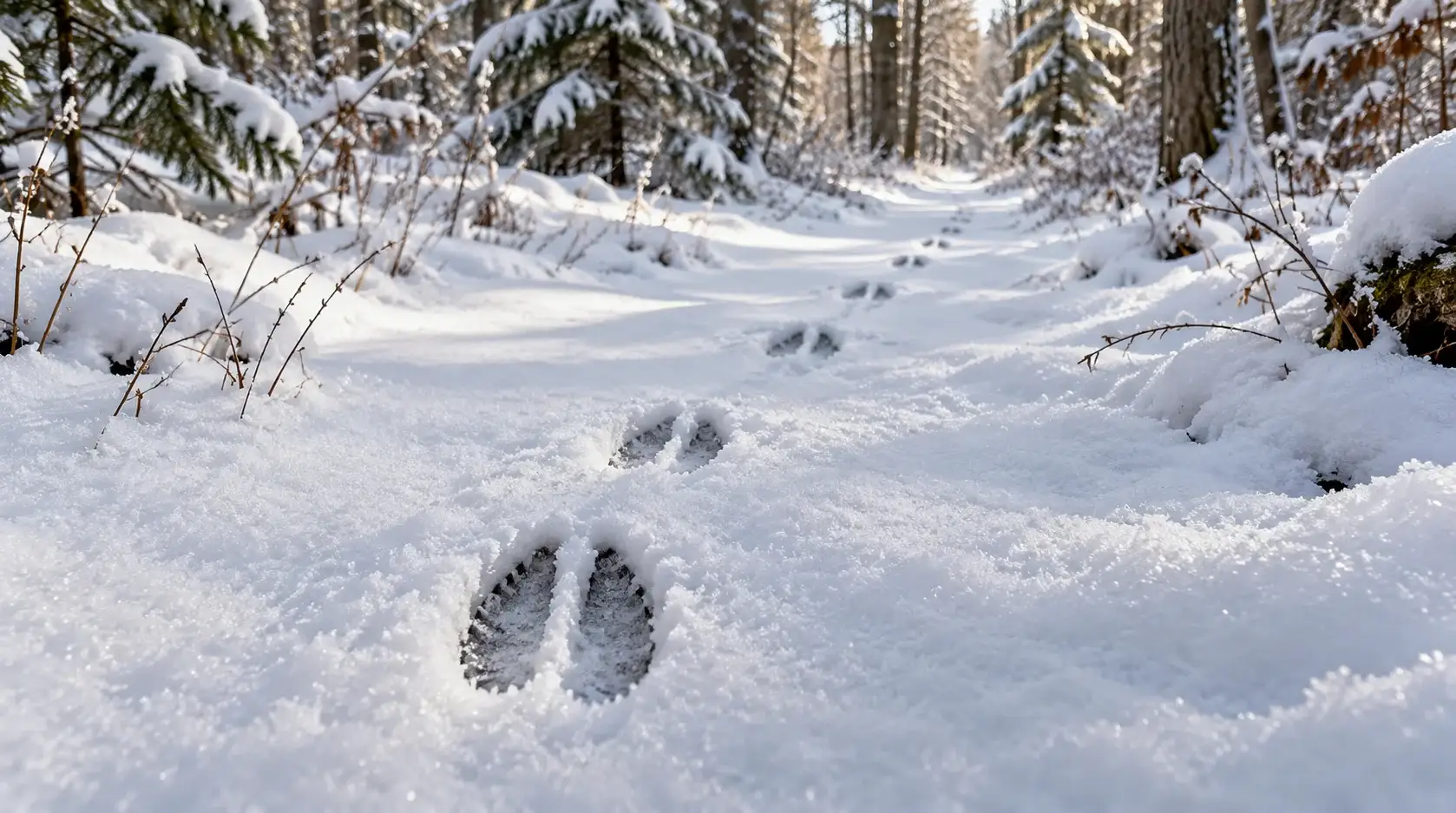
A trail of hoof prints across a snowy path or muddy garden can reveal wildlife activity you would otherwise miss. This Viltnemnda guide explains how to recognise deer tracks, measure them, work out the likely direction of travel, and compare them with similar animal footprints.
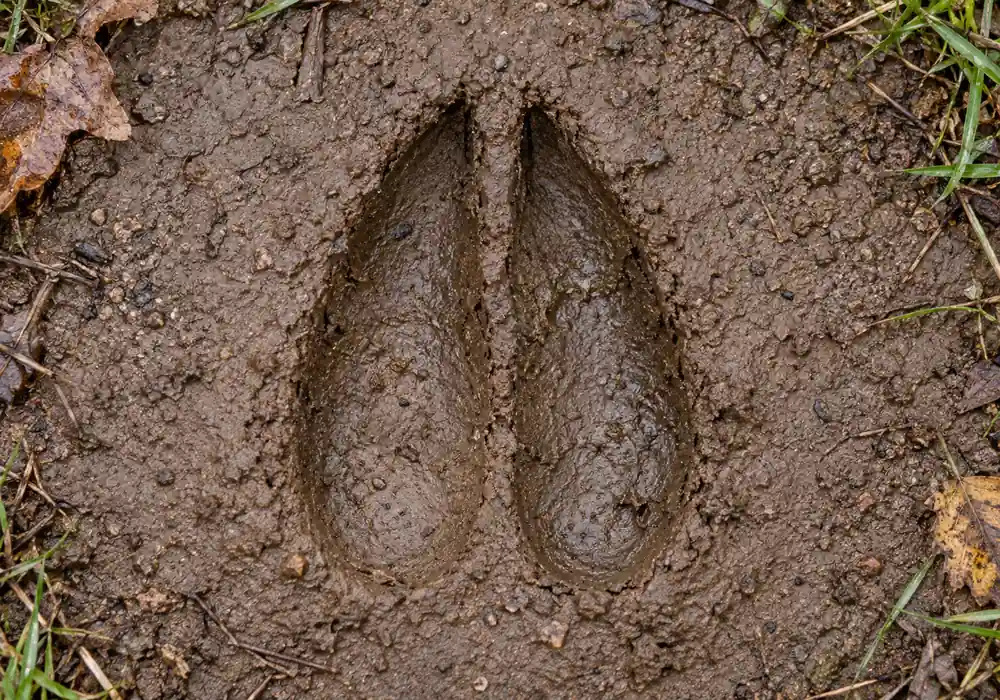
Deer tracks usually have two elongated hoof impressions that narrow toward the front, forming a roughly heart-shaped outline. The pointed ends indicate the front of a clear print. Two smaller marks, called dewclaw impressions, may appear behind the main hooves in soft ground or snow.
The challenge is that real footprints rarely look as neat as the drawings in a field guide. Snow melts, mud shifts, and one animal may step over another animal’s trail. A reliable identification comes from several clues together.
What Do Deer Tracks Look Like?
Look for two hoof halves separated by a narrow gap. In a well-preserved impression, each half is longer than it is wide, with a narrower front and a broader rear.
The outline can change with movement. A running deer may spread its hooves, leaving a wider print. Soft surfaces can also record smaller parts of the foot that do not appear on firm ground. These differences explain why two prints from the same trail may look surprisingly different.
Before deciding what made a mark, look for another clear footprint nearby. One damaged impression is a weak starting point; several consistent prints provide a much better comparison.
Understanding the Hoof and Dewclaws
The two main hoof halves create the most obvious part of the footprint. Dewclaws sit higher on the foot and may touch the surface when the animal sinks into soft ground or moves quickly.
Our deer anatomy guide explains how the legs and hooves fit into the animal’s body structure. Understanding those parts makes it easier to recognise which marks belong to the main hoof and which are additional impressions.
Use this checklist when examining a print:
| Feature | What to look for |
|---|---|
| Main hoof marks | Two elongated impressions beside each other |
| Front ends | Narrower tips in an intact print |
| Overall shape | Often heart-shaped, although imperfect prints vary |
| Dewclaws | Smaller impressions behind the main hooves |
| Nearby prints | Repeated shapes along the same trail |
| Surface condition | Melting snow, soft mud, firm soil, or loose sand |
Deer Track Size: How to Measure It
New Mexico State University gives a general adult deer track length of 2⅜–3¼ inches, approximately 6–8.3 cm, for the deer covered by its North American guide. It lists a typical fawn print at around 1⅜ inches, or 3.5 cm. These are useful reference measurements rather than universal limits.
To record your own find, measure the main hoof impression from the front of the toes to its rear edge. Measure its width as well, and record dewclaw marks separately.
Place the ruler beside the print at ground level. Photograph it directly from above so the scale remains useful. If the edge has collapsed or melted, record the measurement as approximate.
For example, a note saying “about 7 cm long, two narrow hoof halves, wet mud” gives someone more information than “large deer footprint.” The description preserves what you actually observed without assuming the animal’s age, sex, or weight.
Deer Tracks in Snow
Snow can make a trail easy to spot while hiding the details needed to identify it. Maryland’s Department of Natural Resources notes that deep and melting snow can make footprints deceptive.
Start by scanning several metres of the trail. Look for a section where the surface preserved individual impressions. The biggest or deepest hole is not necessarily the most informative one.
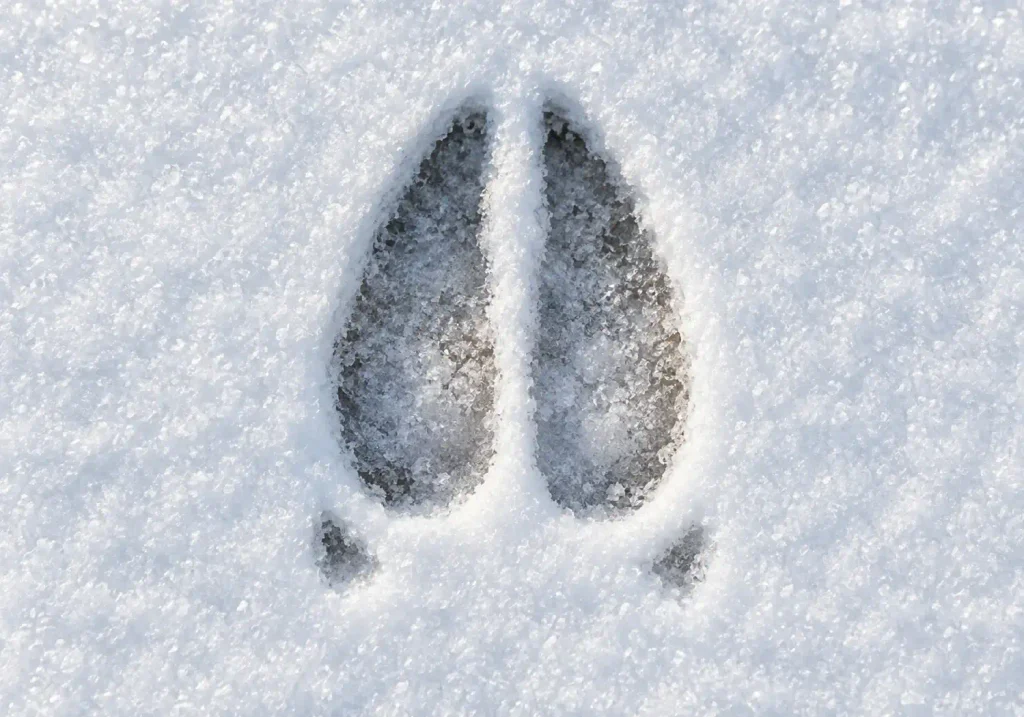
What Do Deer Tracks Look Like in Shallow Snow?
In a clear impression, you may be able to see the paired hoof marks and the gap between them. Photograph those details before walking closer.
If the outline is incomplete, compare it with nearby prints. One may show the toe ends, while another preserves the rear of the hoof more clearly. Together, they can offer a better picture than either does alone.
Deer Tracks in Deep Snow
Deep powder may leave depressions with little visible hoof detail. Alaska’s Department of Fish and Game explains that direction can also become difficult to determine when the actual footprint is hidden inside a depression.
Take a wider photograph showing the sequence of marks. Then look for a clearer impression where the animal crossed a shallower patch.
If the details remain unclear, record a possible deer trail rather than forcing a definite identification. Uncertainty is part of reading wildlife signs.
How Melting Changes Footprints
A print can become larger and lose its shape as snow warms. New Mexico State University specifically identifies this distortion as a problem when interpreting tracks.
Check the surface around the footprint. Is the snow softening? Have nearby human footprints also lost their edges? These observations help explain why the animal’s print may no longer reflect the original hoof size.
Deer Tracks in Mud
Mud can preserve a useful combination of shape, depth, and extra impressions. It can also leave messy marks that are difficult to interpret.
Choose the clearest print you can find. Look at the outline of both hoof halves, then check whether the surrounding ground has slumped into the impression. A shallow, complete footprint may be more useful than a deep print with broken edges.
Before taking a close-up, photograph the surrounding patch. Other footprints may help explain the sequence, and you could accidentally step on them while approaching.
For a useful record, note:
- Whether the mud was wet, firm, or drying.
- Whether the hoof outline was complete.
- Whether smaller marks appeared behind it.
- Whether other animals or people had crossed the same area.
- Whether rain had fallen since the previous time you checked.
These notes give the photograph context without requiring you to make an immediate identification.
Deer Tracks Direction: Which Way Was It Going?
In a clear deer print, the narrowing toe ends point toward the front of the foot. Use those ends as your first direction clue, then check whether nearby impressions show the same orientation.
Avoid judging direction from a single distorted hole. If you cannot recognise the hoof itself, a mound of snow or a broken edge may be misleading.
A simple recording method is to photograph the print and note a fixed landmark: “toes pointing toward the gate,” for example. This remains understandable even if the photograph is rotated later.
Inspect the trail from the side so you preserve the evidence. You do not need to follow it all the way to the animal.
Hog Tracks vs Deer Tracks
Deer and feral hogs both leave split-hoof impressions, which makes them easy to confuse in poor conditions.
Virginia Tech describes hog tracks as rounder than deer tracks, with blunter toe ends and dewclaws set farther apart. These features are useful when several complete prints are available.
| Feature | Deer tracks | Feral hog tracks |
|---|---|---|
| Typical outline | More tapered or heart-shaped | More rounded |
| Toe ends | Usually narrower | Usually blunter |
| Dewclaw placement | Often closer to the width of the main print | Often wider apart |
| Best way to compare | Examine several intact prints | Examine several intact prints |
Dewclaws alone do not establish that a hog made the print. Missouri’s Department of Conservation explains that both deer and hogs can leave these marks when running or stepping on soft surfaces. Their presence also does not identify the animal’s sex.
If shape, size, and extra marks do not agree, keep the identification open. A partial footprint is not enough to support a confident conclusion.
Mule Deer Tracks vs Whitetail Deer Tracks
Mule deer and white-tailed deer footprints can be too similar to distinguish reliably. New Mexico State University groups their tracks together in its guide because separation is not always possible.
Location can narrow the possibilities, but independent evidence is more helpful. A clear sighting or a wildlife-camera image may connect a species with a particular visit.
When that evidence is missing, “deer tracks” can be the most accurate description. There is no need to assign a species simply because an online illustration appears to match.
Deer Tracks vs Elk Tracks
In this section, elk refers to the North American wapiti. Some European sources use “elk” for the animal called moose in North America, so check the terminology before comparing guides.
Salt Lake City’s winter tracking guide describes elk footprints as larger and rounder than deer footprints, giving typical lengths of about 4–4.75 inches.
Use size as one clue alongside shape and location. A distorted print, an incomplete impression, or a young animal can complicate a simple comparison.
Ask two questions before settling on elk: does the complete footprint fit, and does that animal occur in the area?
Look for Other Signs Near the Trail
Footprints become more useful when considered with nearby evidence. Nebraska’s wildlife-tracking guidance recommends examining the trail pattern, measurements, surrounding vegetation, and other animal signs.
If you find pellets beside the prints, photograph them separately. Our deer poop identification guide explains how to compare droppings with other possible garden visitors.
Keep the connection tentative. Droppings and footprints close together may have been left during different visits.
You can also record damaged vegetation, an established path, or a clear view of the animal. Describe each observation separately before deciding how the pieces fit together.
Common Identification Mistakes
Choosing the Largest Print
The largest mark may be damaged or distorted. Choose a complete impression with recognisable edges before relying on measurements.
Deciding From One Footprint
An isolated mark may hide important details. Look for a repeated pattern and compare several prints whenever possible.
Treating Dewclaws as Proof of a Buck
Dewclaw impressions do not provide a reliable buck-versus-doe identification. Ground conditions and movement affect whether they register.
Guessing an Exact Time
A sharp-looking edge does not establish the hour the animal passed. Known events, such as snowfall or a previous photograph of the same patch, provide a better time window.
Following Tracks Too Closely
You can learn from footprints without approaching wildlife. Keep your distance if an animal is visible, and avoid damaging the trail while examining it.
How to Photograph Tracks Clearly
Take one close photograph from directly above and another showing the wider trail. Include a ruler beside the print, along with the date and location in your notes.
Keep the original image even if you make an annotated copy. Drawing over faint edges can turn an uncertain feature into something that looks definite.
A short observation record might look like this:
| Field | Example |
|---|---|
| Location | Woodland path beside the garden |
| Surface | Damp soil |
| Main print length | Approximately 7 cm |
| Visible features | Two narrowing hoof impressions |
| Additional marks | Two faint impressions behind the hoof |
| Confidence | Possible deer; species unknown |
The example shows how to record a find. It is not a measurement standard or proof of a particular species.
Frequently Asked Questions
What do deer tracks look like?
A clear print usually has two elongated hoof impressions with narrowing front ends. Together, they often form a heart-shaped outline. The appearance changes when the print is incomplete or distorted.
Why do some deer tracks show four marks?
Two larger impressions come from the main hooves. Two smaller marks may come from dewclaws, particularly on soft surfaces or during running.
Can you identify a deer’s sex from its tracks?
Do not assign sex from a single footprint or from dewclaw marks. Those clues alone are not dependable.
Are tracks easier to identify in snow or mud?
Either surface can preserve useful details. Choose the clearest complete print available and record the condition of the ground.
How do you work out the direction of travel?
Find the narrowing toe ends in a clear print, then compare their orientation with several nearby impressions. If the toes are not visible, leave direction uncertain.
Can a photograph confirm the species?
Sometimes it can help, but include scale, location, and a wider view. Closely related deer may leave footprints that cannot be separated confidently.
What should you do if the tracks remain unclear?
Save your photographs and notes, then compare them with a regional wildlife guide or ask a local wildlife specialist. An uncertain identification is more useful than a confident guess.



2 thoughts on “Deer Tracks: Identification Guide for Snow and Mud”