






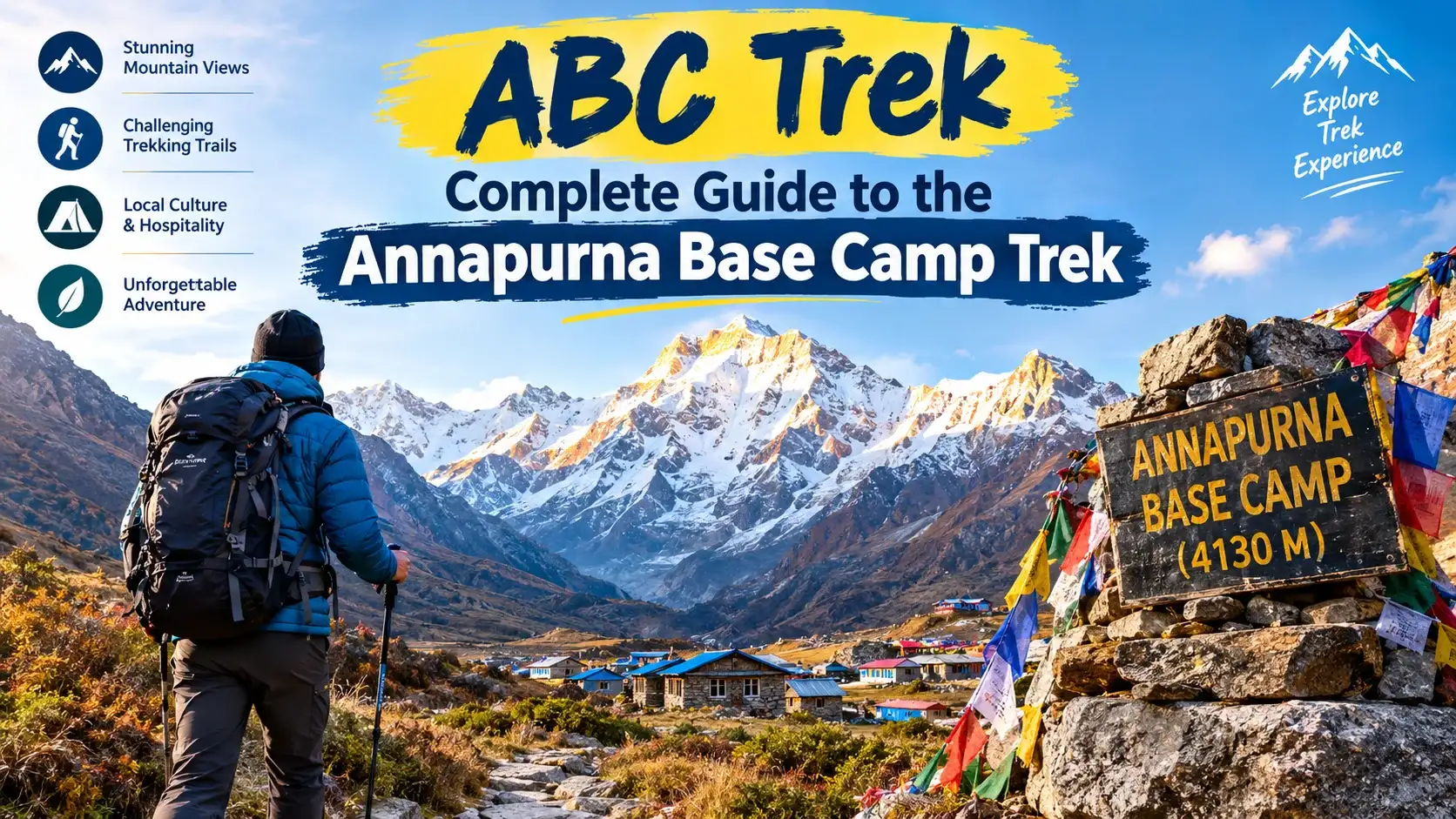
The ABC Trek, also called the Annapurna Base Camp Trek, is one of the most traveled Himalayan trekking trips in Nepal. The trek carries you into the Annapurna Sanctuary, where the trail is engulfed by towering Himalayan summits forming a natural amphitheater. The biggest attraction of the trek is when you finally reach the Annapurna Base Camp at 4130 meters. On the way there are numerous picturesque traditional villages, lush rhododendron forests, mountain streams, gushing waterfalls and stunning views of Annapurna South, Annapurna I, Hiunchuli and Machhapuchhre.
The ABC Trek does not involve a mountain flight, as some of the other treks at higher altitudes in Nepal (e. G., Everest trek). Most programs start at or near Pokhara and involve a vehicle transfer along the road to the trailhead. Typically, the trek is about 7 to 11 days. Itineraries can be shorter or longer, depending on the route taken, your pace, and whether or not you choose to visit Ghorepani and Poon Hill.
What Is the ABC Trek?
The Annapurna Base Camp Trek involves trekking through the mountains into the Annapurna region of western Nepal. The trek trail travels through forested valleys and then along mountain trails into the Annapurna Sanctuary. The trail slowly ascends from farmlands and villages situated at lower elevations into forests and then culminates in a high altitude alpine landscape.
The ultimate attraction of the ABC Trek is the scenic diversity, which varies enormously over short distances; you start off among lush green hills and terraced fields and end up surrounded by Himalayan giants over 4000 meters.
The trail also goes into the Gurung and Magar villages. There are traditional houses, Buddhist and Hindu culture, food, teahouses, and mountain communities that are friendly which make it cultural in the trek.
ABC Trek Route
The precise route of the ABC Trek varies on the itinerary you choose, however the classic trek often includes the following locations: 2. Ghandruk 3. Chhomrong 4. Bamboo 5. Dovan 6. Deurali 7. Machhapuchhre Base Camp 8. Annapurna Base Camp
Trekkers usually drive from Pokhara to the trailhead before starting the trek. The trail ascends from the lower villages through forests, on its way to several mountain settlements, such as Chhomrong. Chhomrong is a major gateway for access to the Annapurna Sanctuary.
The path from Chhomrong goes through Sinuwa, Bamboo, Dovan, and Deurali, eventually arriving at 3700m Machhapuchhre Base Camp ( 69km/45 miles from Chhomrong). The route then proceeds up to 4130m Annapurna Base Camp.
The return trek is through the valley to a lower altitude. An option, if your schedule allows, is to include Jhinu Danda, known for its natural hot springs, a welcome rest after the high altitude part of the trek.
Just how challenging is the ABC trek?
The ABC trek is widely seen as a ‘moderate’ trek. There‘s no requirement for technical or steep mountain climbing skills, ropes, or experience with mountaineering, but a reasonable level of fitness is a must due to the number of steep ascents, descents and steps found on the trail.
The challenge is primarily in going over and over and over the same terrain with elevation gain and loss, rather than any one extremely hard section. Some days you walk for hours, and the stone staircases in the Chhomrong and Ulleri areas are physically demanding.
Another important factor to bear in mind is altitude. While Annapurna Base Camp is relatively low at 4,130 meters, places like the Everest Base Camp or Thorong La pass are much higher altitudes and altitude sickness can be an issue. It is crucial to take the ascent slowly and not rush.
Physical Fitness for the ABC Trek
You do not have to be an experienced mountaineer to do the ABC Trek. Someone who is quite fit and able to walk for quite a long time during the day should be able to complete this trip if prepared well.
Pre-trek training is quite valuable. Going for regular walks, doing some trekking, rising stairs, cycling, jogging and leg building exercises, can boost your muscles and build your strength for the various ups and downs.
I think you are better off preparing for endurance rather than strength. The trek itself lasts for a number of days walking in succession and therefore your body needs to learn to cope with long periods of activity.
If you are a novice, giving yourself more days on the trek can make it much more manageable. A shorter route may be more time efficient, but the physical exertion and altitude burden will be far greater.
The Hardest Parts of the ABC Trek
One of the principal physical difficulties encountered on the route is the large number of stone steps on some sections. The ascent around Ulleri is celebrated for its extended staircase while in the Chhomrong region there is also considerable stair climbing.
This is another tiring stretch. This is where the trail officially crosses into the ‘high’ altitude region, as we head toward Deurali for the Machnapurchre Base Camp and Annapurna Base Camp. The trail is already over 3,000 meters in elevation and is gradually getting tougher.
The last climb to ABC can be a bit strenuous as you are at high altitude and have been walking a few days. However once you arrive at the sanctuary you will be rewarded as the mountains suddenly seem much nearer and larger.
It can also be unexpectedly gruelling. The long sections of downhill and stone steps can be demanding on the knees, so trekking poles may be beneficial.
Altitude on the ABC Trek
Altitude should be taken into account when doing the ABC as the trail reaches a maximum of 4130 meters. Although this is less than the highest elevation of the Everest Base Camp Trek and Annapurna Circuit treks, this does not mean one should not be concerned with altitude.
The path has a steady ascent, with various overnight halts at different heights, and is generally a slow ascent. Machhapuchhre Base Camp is at around 3700m, and Annapurna Base Camp at 4130m.
Symptoms of altitude sickness. Typical symptoms of mild altitude sickness include headache, tiredness, dizziness, nausea, poorer appetite and sleep disturbance. If these symptoms become severe or increase in severity, further descent is necessary.
Getting used to it: Walk up and down stairs slowly, drink plenty of fluids, eat well and avoid excessive physical activity.
Best Time for the ABC Trek
The optimum time to do the ABC Trek is around spring and autumn. March to May is a good time as the temperature is warmer, the rhododendrons are in bloom and the scenery of the mountains is spectacular. October and November are also busy as the weather can be dry and the views good.
In the winter the upper section may be covered with snow and it can be freezing. The views can be breathtaking but the cold may make for a much more strenuous hike!
During the monsoon months the Annapurna area receives much more rain. Tracks are wet and slippery, clouds might hide the mountains. Weather can also be different depending on which exact route one takes.
Accommodation and Food on the ABC Trek
The ABC Trek has one type of accommodation: teahouses. They are mountain hostels that offer simple rooms and toiletries. The higher you go the more basic the accommodation, and the colder the nights.
The food, if you want to buy it on the main trekking trail, is all along the trail. Dal Bhats, noodles, pasta, and all sorts of soup, baked potatoes, eggs, bread etc., can all be bought in the shops.
Dal bhat is very popular as well amongst trekkers, as it‘s a very kind of satisfying meal consisting of rice, lentils, vegetables and various side dishes. It‘s also important to eat regularly as you‘ll need a high level of energy for long days of trekking.
What are the unique attributes of the ABC Trek?
The most amazing thing about the ABC trek is, of course, the unbelievable mountain scenery. Rather than just gaping at the Annapurna range from afar, this trek actually brings you up close and personal to the Annapurna Sanctuary;
On the Annapurna side, mountains make huge, dramatic outcrops all around the sanctuary. Annapurna I, standing at 8091 meters, looms over everything; Annapurna South, Hiunchuli, Machhapuchhre and numerous other peaks provide awe-inspiring Himalayan views.
The experience of living in the mountains is also significant. Villages such as Ghandruk and Chhomrong allow us to experience traditional mountain life, while the changing terrain and forests make for an ever-changing experience.
ABC Trek for Beginners
The ABC is a worthy option for beginners who want to get a taste of real Himalayan trekking but maybe not up to the extended length and altitude of some of the other main Nepal trekking routes.
Trekking experience is advantageous but not crucial. Heartier walks require excellent fitness, preparation, gear and a willingness to walk at a regular pace.
It is better for a newbie not to have an itinerary that is a little too aggressive. If your itinerary allows for it, a few more days gives you the opportunity to rest and acclimate to altitude as well as time to enjoy all the villages, forests and mountain scenery along the way.
ABC Trek vs EBC Trek
The ABC Trek and the Everest Base Camp Trek are two of the most popular Himalayan journeys, but they are rather different. The ABC gets to a height of 4, 130 meters compared to 5,364 meters for Everest Base Camp, making the Everest trek substantially more challenging in terms of altitude.
ABC is also normally shorter and accessible by road from Pokhara compared to the long journey to the Everest region and the high-altitude trekking involved in a traditional EBC trail.
For people in a hurry wanting fantastic Himalayan scenery with a suitably moderate trekking ordeal, ABC can be top notch. If, however, you specifically want to see the EBA region and reach the base camp of the world’s highest mountain, EBC could be more your style.
Final Thoughts on the ABC Trek
The ABC Trek is a good start to Himalayan trekking because it has relatively moderate altitude, stunning mountain scenery, authentic villages, forests and an impressive objective at 4130m. The trek is punishing in places, notably for the volume of stone steps and continual up and down nature but no technical skills are necessary.
If you come prepared, plan effectively, have good trekking gear and plan for the effects of altitude it is very doable for a reasonably fit beginner or a seasoned trekker. Just take it slowly, take your time and enjoy the journey.
Disclaimer
This disclaimer applies to the discussion of the Annapurna Base Camp trek. This article provides general travel information only. Prices, opening hours, availability, routes, entry rules, and local conditions may change. Verify details with official authorities and service providers before booking. Activities depend on weather and personal circumstances, and no particular experience or sighting is guaranteed.