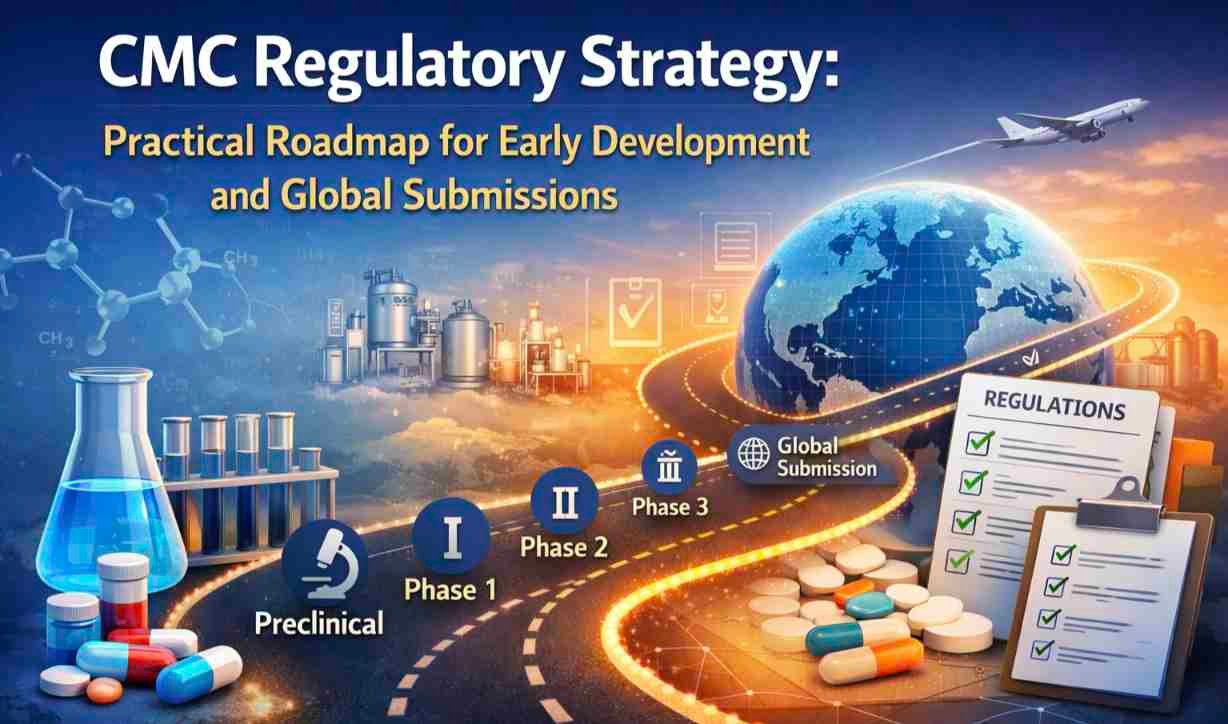
CMC Regulatory Strategy: Practical Roadmap for Early Development and Global Submissions
You need a pragmatic CMC regulatory strategy that links quality, timing, and cost to clear regulatory outcomes. A focused CMC strategy gives you a predictable path from early development through commercialization by aligning formulation, process controls, and regulatory engagement to reduce delays and approval risk.
This article shows what essential CMC elements to prioritize — formulation rationale, manufacturing controls, stability, and regulatory documentation — and how to integrate them with your overall regulatory plan. You’ll also get practical guidance on implementing controls, managing CMC risks, and keeping regulators informed to avoid setbacks during submissions and lifecycle changes.
Essential Components of CMC Regulatory Strategy
You need a clear plan that links product quality attributes, manufacturing controls, and global filing requirements to your development timelines and commercial goals. Expect to align specifications, stability, and control strategies with regional expectations while incorporating lifecycle flexibility.
Global Regulatory Requirements
You must map regulatory expectations across key markets—FDA (US), EMA (EU), PMDA (Japan), and other target agencies—early in development. Identify differences in dossier structure, required stability data duration, and regional labeling constraints.
Use a regulatory gap analysis table to capture differences in acceptance criteria, required analytical method validation standards, and impurity thresholds.
- Prepare ICH-aligned modules (CTD/CMC) and note local variations.
- Plan for country-specific requirements: e.g., additional stability chambers, comparator sourcing, or region-specific reference standards.
- Build regulatory briefing packages for meetings to secure alignment on regional expectations.
Maintain an update process to track guideline changes (ICH Q1–Q14, regional guidances). You must document decisions and justifications to support inspections and queries.
Product Lifecycle Considerations
You must design CMC deliverables for each development phase: preclinical, IND/CTA, pivotal, and post-approval changes. Define expected dossier content at each milestone: manufacturing process description, control strategy, batch analysis, and stability commitments.
Create a lifecycle map that links CMC activities to regulatory submissions and manufacturing scale-up triggers.
- Establish metrics for process performance and comparability when scaling from clinical to commercial.
- Define post-approval change procedures and risk-based comparability studies.
- Plan reserve samples, stability protocols, and ongoing stability commitments to cover regulatory submission and market exclusivity timelines.
Document your change management decision tree: what changes require prior approval, notification, or can proceed under CBE (where applicable). This prevents costly hold-ups during approval or supply changes.
Quality by Design Principles
You must apply QbD to define Critical Quality Attributes (CQAs), Critical Process Parameters (CPPs), and a robust control strategy early. Use risk assessments (e.g., FMEA) to prioritize testing and controls that directly impact patient safety and efficacy.
Develop design space justifications with experimental data and statistical analysis to support flexibility in operations.
- Implement structured DoE studies for key unit operations.
- Validate analytical methods against defined acceptance criteria for accuracy, precision, and robustness.
- Tie in-process controls to real-time monitoring where feasible to reduce batch failures.
Keep traceable documentation of risk-based decisions and design space boundaries to support regulatory discussions and inspections.
Implementation and Risk Management
You will establish practical controls, timelines, and documentation practices that link development activities to regulatory expectations and product quality. Focus on dossier completeness, disciplined change control, and documented risk assessments tied to specific failure modes.
Submission Planning and Dossier Preparation
Map required modules and country-specific dossiers early. Create a master submission timetable with milestones for analytical method validation, stability data collection points, and batch manufacturing runs tied to target filing dates. Assign owners for each Module 3 element and use a document tracker that logs version, reviewer, and approval date.
Prepare key CMC documents: the drug substance and drug product descriptions, manufacturing process flowcharts, critical quality attributes (CQAs), control strategy, and stability protocols. Include justifications for specifications and comparability data when processes or suppliers differ from clinical materials. Use standardized templates for batch records, validation reports, and certificates of analysis to reduce review cycles.
Plan regulatory pre-submission meetings by drafting specific questions on unresolved process parameters, release criteria, or foreign comparator use. Attach proposed labeling and risk-based justifications to support post-approval commitments. Ensure cross-functional review (quality, manufacturing, regulatory, and clinical) before dossier lock.
Change Control Strategies
Implement a formal change control procedure that categorizes changes by impact: minor (document), moderate (requires verification), major (requires regulatory notification/approval). Define objective criteria tied to CQAs and process parameters to determine category.
Require a documented impact assessment for every change that covers product quality, patient safety, supply continuity, and regulatory status. For major changes, prepare comparability protocols that include analytical bridging, process validation, and risk mitigation steps. Maintain a current change log accessible to regulators during inspections.
Use tiered approval authorities with defined timelines to avoid delays. For supplier or site changes, include contingency plans such as dual sourcing or tech-transfer readiness to minimize supply disruption. Archive decision rationales and supporting data to demonstrate science- and risk-based decisions during audits.
Risk Assessment and Mitigation
Perform formal risk assessments (e.g., FMEA or HACCP-style tools) focused on process steps that affect CQAs, potency, impurity profiles, and sterility. Quantify severity, occurrence, and detectability to prioritize controls and monitoring. Link each identified risk to a specific control measure and verification activity.
Develop a control strategy that integrates in-process controls, release testing, and environmental monitoring, with defined action limits and CAPA triggers. Maintain a living risk register that records mitigation status, responsible owners, timelines, and residual risk scores. Review and update the register after deviations, scale-up events, or supplier changes.
Embed routine trend analysis and stability monitoring into the risk program to detect drift early. Use targeted stability commitments and real-time monitoring where critical. Document decision logic for acceptability of residual risk to support regulatory discussions.