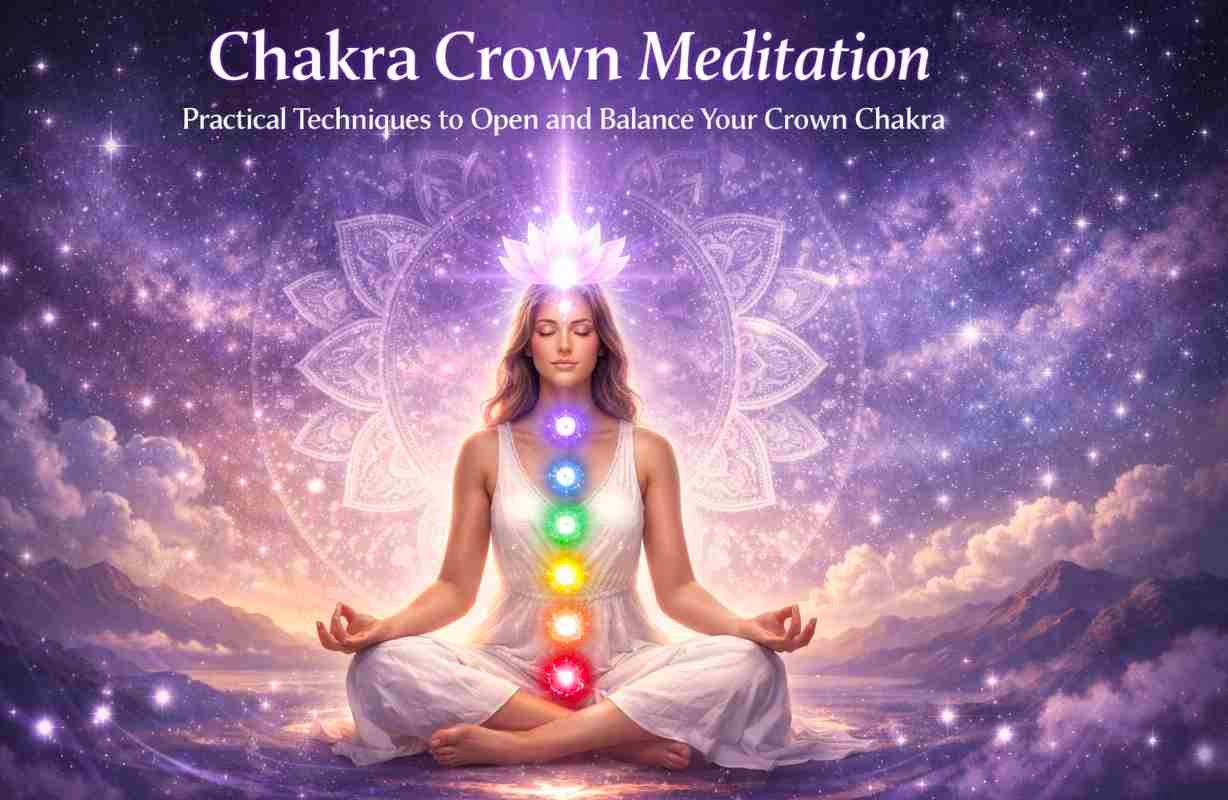
Chakra Crown Meditation: Practical Techniques to Open and Balance Your Crown Chakra
You can access a quieter, more centered sense of awareness by working with your Crown Chakra—Sahasrara—through simple, focused meditation practices. A short Crown Chakra meditation can help you open a clearer connection to inner stillness and a broader sense of meaning without requiring advanced practice or long sessions.
This article explains what the Crown Chakra represents, how it shows up in everyday life, and practical techniques you can use right away to tune into that energy. Expect guided breathing, visualization, and gentle affirmations you can apply in sessions from five to twenty minutes to deepen your sense of presence and spiritual clarity.
Understanding the Crown Chakra
You connect to higher awareness, spiritual insight, and a sense of unity when your crown chakra functions well. This section explains what that center represents, how it’s symbolized, and how imbalance shows up in daily life.
What Is the Crown Chakra?
The crown chakra, called Sahasrara in Sanskrit, sits at or just above the top of your head. It represents your capacity for spiritual connection, inner wisdom, and conscious awareness beyond individual identity.
Physically, you may notice subtle sensations—lightness, tingling, or a sense of expansion—during focused meditation or deep rest. Energetically, the crown links your personal consciousness to broader perspectives, enabling insights, clarity about life purpose, and a felt sense of meaning. In practice, people cultivate it through silence, non-attached observation, and meditation techniques that emphasize stillness and receptive awareness.
Crown Chakra Symbolism and Meaning
The primary symbol is a multi-petaled lotus, often depicted with a thousand petals, signifying unfolding consciousness. Colors associated with the crown are violet to white, representing purity, clarity, and the dissolving of ego boundaries.
You’ll also encounter light, space, and empty-centre imagery—symbols of openness rather than accumulated content. Philosophically, the crown chakra points to unity consciousness: you experience yourself as part of a larger whole rather than only as an isolated self. Practices that stimulate this center include silent meditation, breath awareness, and contemplations on interconnectedness.
Signs of an Imbalanced Crown Chakra
An underactive crown chakra often shows as spiritual disconnection, cynicism, or a sense that life lacks meaning. You might feel mentally foggy, isolated from others, or unable to access insight during quiet reflection.
An overactive crown can trigger dissociation, fixation on mystical experiences, or neglect of practical responsibilities. You may become ungrounded, overly idealistic, or chase transcendence at the expense of daily functioning. Physical signs tied to imbalance include headaches, sleep disturbances, and chronic fatigue. To evaluate your state, note patterns in your thought clarity, sense of purpose, and ability to remain present in ordinary tasks.
Crown Chakra Meditation Techniques
These techniques focus on grounding your body, opening the top of the head to receptive awareness, and refining breath, visualization, and sound to support spiritual clarity.
Preparation for Meditation
Choose a quiet, uninterrupted space where you can sit comfortably for 10–30 minutes. Sit on a cushion or chair with a straight spine so energy can move from the base through the crown; place your hands on your knees or in a mudra that feels steady.
Set a gentle timer and lower ambient light to reduce visual stimulation. Wear loose clothing and remove tight accessories around the neck and head to avoid physical distraction. If you prefer, light a mild-smelling candle or diffuse a subtle essential oil like frankincense or sandalwood to cue the mind.
Begin with 1–3 minutes of slow, diaphragmatic breathing to settle nervous system activity. Scan the body quickly for tension and release any tightness in the jaw, shoulders, and scalp. Establish the intention for your practice in a single sentence, for example: “I open to clear, calm awareness.”
Guided Visualization Practices
Start by bringing attention to the top of the head and imagine a small point of pure light there. See that point expand slowly into a soft, luminous lotus or halo; maintain steady, natural breathing while you hold this image.
Visualize the light connecting upward — like a thin cord — to a vast sky or a source of white-gold light. Allow the light to flow down through the crown and wash over your brain, clearing noisy thoughts without forcing them. If imagery drifts, return focus to the expanding light and the sensation at the scalp.
Use a progressive expansion: after 2–5 minutes at the crown, let the light spread through the forehead, then the whole head, then out beyond your body. Keep your language simple in the mind: “Open,” “Receive,” or “Allow” to support nonjudgmental witnessing of whatever arises.
Breathing Exercises for the Crown Chakra
Begin with five minutes of deep, even abdominal breathing to calm the system: inhale for four counts, exhale for four. Keep the breath smooth and avoid straining; aim for comfort and steady rhythm.
Transition to a subtle “breath into the crown” technique: on each inhale, imagine drawing light into the top of your head; on each exhale, feel that light settling gently through the skull. Use this for 5–10 minutes to cultivate a sensation of expansion without hyperventilating.
If you want a rhythmed practice, try 6:6 breathing (inhale six, exhale six) while maintaining crown awareness. Avoid breath retention or forceful pranayama unless you have prior training. End with a few normal, peaceful breaths and note any shifts in clarity or calm.
Mantras and Affirmations for Sahasrara
Use simple sounds and phrases to tune the crown. The seed sound “Om” (AUM) resonates broadly; chant one gentle, sustained “Om” for 3–5 breaths, feeling vibration at the skull. Keep volume moderate so it supports focus without distracting.
Create short, present-tense affirmations to repeat silently: for example, “I am open to higher wisdom,” or “I receive clear guidance.” Speak them once aloud at the start, then use them mentally during the practice. Pair an affirmation with a soft exhale to anchor intention.
Combine mantra and visualization by mentally intoning the sound while imagining the crown-light expanding with each repetition. Track how your attention responds and shorten or modify mantras if they stir tension.